
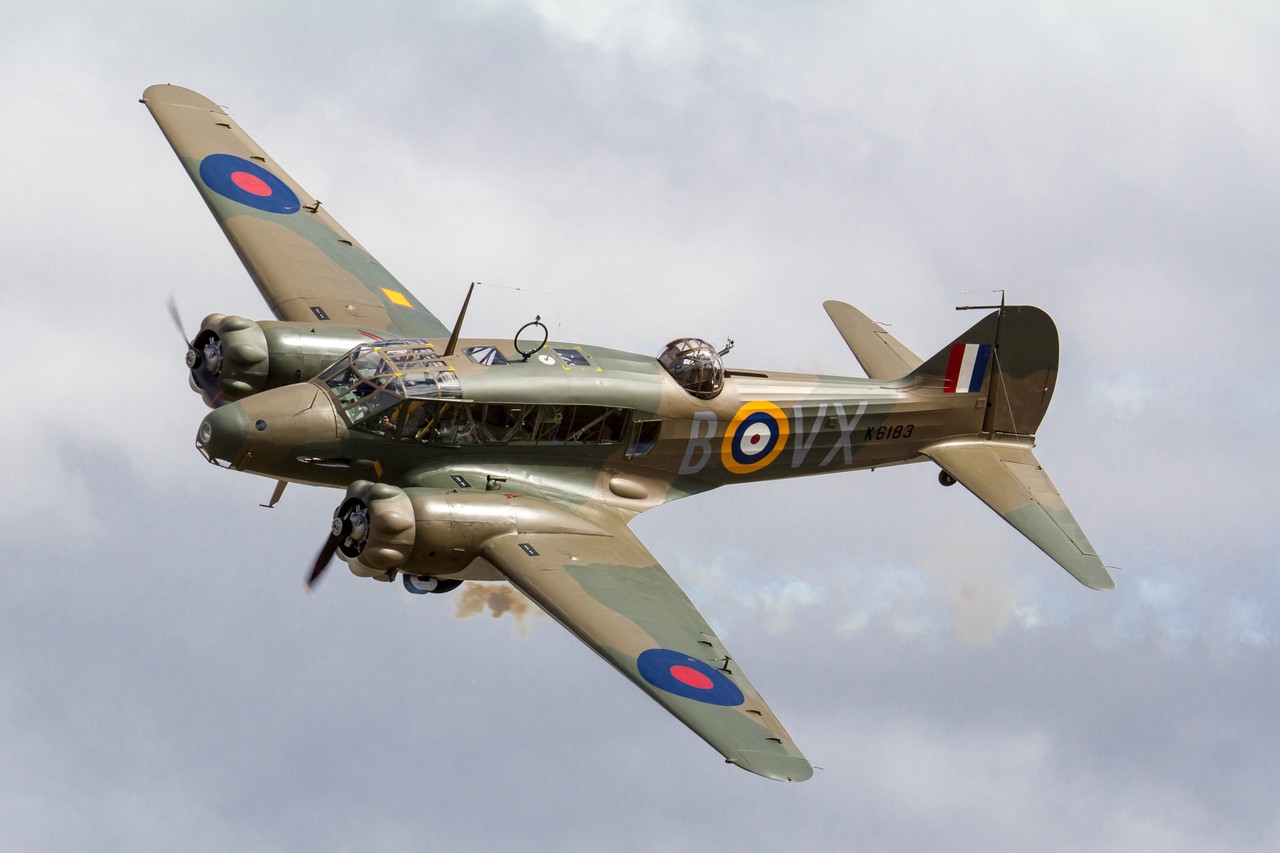
The Training Workhorse
The Anson's greatest contribution to aviation came through its role in the British Commonwealth Air Training Plan (BCATP), where it trained thousands of Allied aircrews during World War II. Between 1940 and 1954, the Royal Canadian Air Force operated over 4,400 Ansons, making it the most numerous aircraft type in RCAF service. The aircraft's forgiving flight characteristics and twin-engine configuration provided ideal conditions for teaching navigation, bombing, gunnery, and multi-engine flying techniques to student pilots who would later fly much larger bombers over Europe.
From Airliner to Military Trainer
Roy Chadwick's design team at Avro originally conceived the Type 652 as a commercial airliner for Imperial Airways, meeting specifications for a 420-mile range aircraft capable of single-engine flight at 2,000 feet while carrying four passengers. Imperial Airways received two aircraft in March 1935, operating them on the Croydon-Brindisi route with six-passenger capacity until March 1942. However, the Air Ministry's Specification 18/35 for maritime reconnaissance transformed the design into the military Anson Mk.I, which entered RAF service in 1937.
Wartime Production and Variants
Production expanded dramatically during World War II, with manufacturing occurring at A.V. Roe facilities in Chadderton and Yeadon, England, while Federal Aircraft Limited in Canada produced over 4,400 aircraft for Commonwealth forces. Key variants included the Mk.I trainer, the Canadian-built Mk.II with Jacobs L-6MB radial engines, and post-war versions like the Mk.XIX and T.22, with the final T.22 prototype flying on June 21, 1948.
The aircraft served extensively beyond training roles, particularly in early war reconnaissance missions. The Royal Australian Air Force received 40 aircraft between December 1938 and April 1939, while post-war exports included 243 aircraft to the French Air Force and 24 to the French Navy between 1945 and 1947.
A.V. Roe's Legacy
A.V. Roe and Company, founded in 1910, pioneered British aviation development and produced iconic aircraft including the Lancaster bomber. The company's shadow factory system, including the Yeadon facility, enabled rapid wartime production expansion. Avro merged into Hawker Siddeley in 1963, later becoming part of British Aerospace in 1977 and ultimately BAE Systems in 1999, where its engineering heritage continues today.
Reliable Powerplants
The Armstrong Siddeley Cheetah V and IX radial engines, producing 240-350 horsepower each, provided the Anson with exceptional reliability crucial for training operations. Armstrong Siddeley Motors manufactured these air-cooled radials from 1932 into the 1950s, incorporating supercharging for improved altitude performance. The engines' forgiving characteristics and low power output made them ideal for student pilot training, while their proven reliability enabled the aircraft to perform early wartime coastal patrols.
Pilot Experience and Performance
With its enclosed crew compartments—a first for RAF aircraft—the Anson offered modern training conditions while maintaining manageable performance characteristics. The aircraft's 9,275-pound maximum weight, combined with its twin-engine safety margin, provided confidence for inexperienced pilots learning multi-engine procedures. Its 190 mph maximum speed was sufficient for training purposes while remaining predictable and controllable.
Extended Service Life
The Anson's versatility ensured remarkable longevity, serving from 1935 until the RAF's final retirement on June 28, 1968. Production continued until approximately 1952, spanning 17 years and producing 10,996 aircraft across all variants. This extended production run reflected the aircraft's continued relevance as training requirements evolved through the war years and into the early jet age.
Museum Preservation
Today, examples of the Anson are preserved in Canadian museums, including Anson Mk.II serial 7207 at the National Air Force Museum of Canada and another at The Hangar Flight Museum in Calgary. These preserved aircraft represent the type's crucial role in training the aircrews who fought in World War II, earning the Anson recognition as one of the most important trainer aircraft in aviation history.