
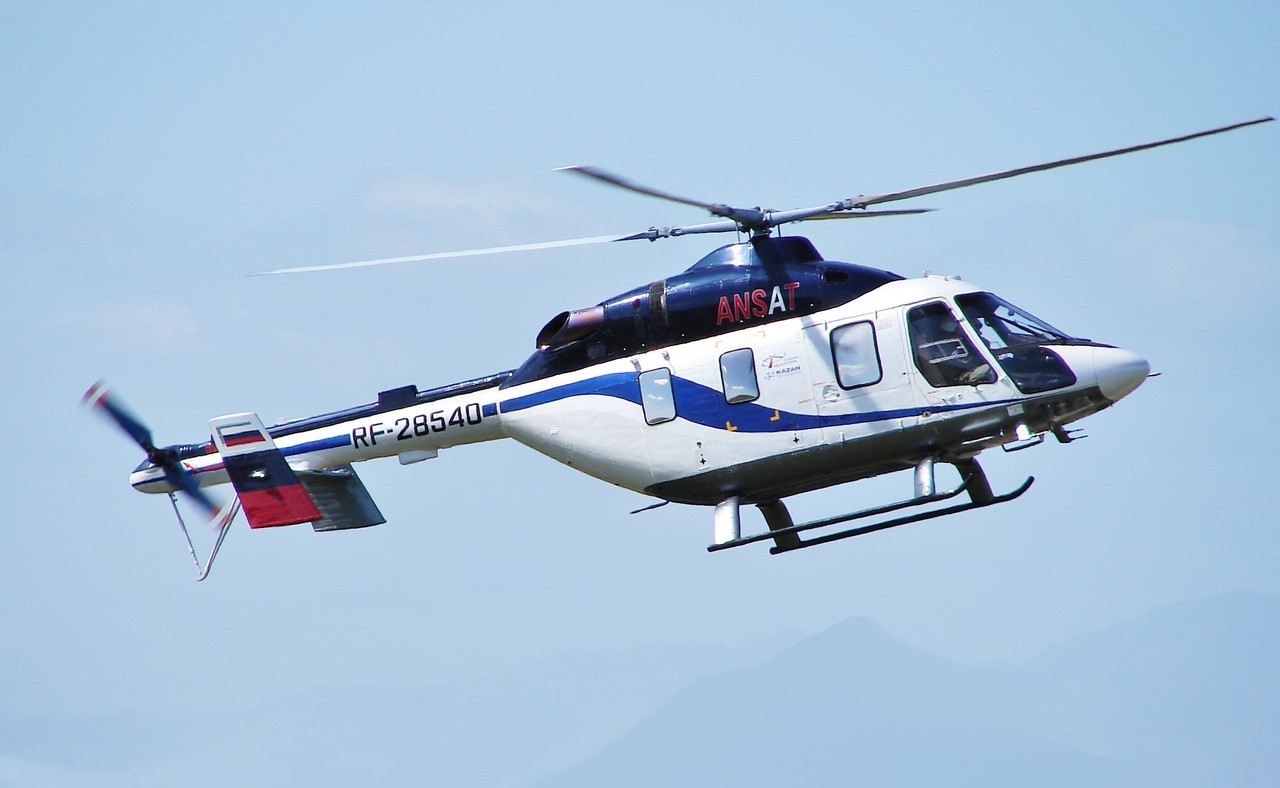
Development Origins
The Ansat emerged from Kazan Helicopters' ambitious transition from licensed production to independent design capability. After decades of manufacturing Mil Mi-8 and Mi-17 helicopters under license since 1951, the company established its own design bureau in 1993, receiving official approval from Russian authorities in January 1997. The new helicopter aimed to fill a critical gap left by the obsolescent Mil Mi-2, providing modern training and utility capabilities for both military and civilian operators.
Design work proceeded through collaboration with multiple Russian institutions, including structural calculations by Kazan State Technical University, rotor development by Aviation Scientific Co., and transmission systems by Aeromechanica Co. This distributed approach reflected the post-Soviet aviation industry's adaptation to new economic realities while maintaining technical expertise.
Flight Testing and Certification
The first prototype achieved its maiden hover on 17 August 1999, powered by Pratt & Whitney Canada PW206 engines. Full forward flight followed on 6 October 1999, marking a significant milestone for Russian helicopter development. However, early testing revealed transmission limitations after approximately four hours of operation, leading to the introduction of the more powerful PW207 engines in the second prototype, which first flew on 27 December 2001.
Civil certification proved to be a lengthy process, with the Aviation Register of the Interstate Aviation Committee finally granting approval on 28 August 2013 for the basic multipurpose version. This fourteen-year development cycle reflected both the technical challenges of creating an entirely new helicopter design and the regulatory complexities of the post-Soviet aviation environment.
Military Adoption
The Ansat-U military trainer variant achieved a crucial victory when it won a Russian Air Force competition on 14 September 2001, defeating established competitors including the Mil Mi-34 and Kamov Ka-226. This success validated Kazan's design approach and secured the helicopter's future production.
The military variant featured dual controls for instructor and student pilots, fixed tricycle landing gear for training safety, and distinctive upward/downward-opening clamshell doors that enabled rapid reconfiguration between training and utility missions. Russia's Aerospace Forces began operating the type at the Syzran Higher Military Aviation School and the Torzhok Combat Training Centre, with initial deliveries of ten aircraft between 2009 and 2011.
Military orders totaled approximately 50 Ansat-U helicopters across multiple contracts: ten units in 2008-2009, 32 in March 2011, and a final batch of ten delivered on 20 December 2017. As of recent reports, between 13 and 18 remain in active service with Russian training units, fulfilling their primary role of pilot instruction rather than combat operations.
Technical Innovation
The Ansat incorporated several advanced features for its class, including a classic four-blade main rotor paired with a two-blade tail rotor configuration. Hydromechanical flight controls provided reliable operation while the modular cabin design allowed operators to quickly reconfigure the aircraft for different missions.
Powered by twin Pratt & Whitney Canada PW207K turboshaft engines producing 470 kW (630 shp) each, the helicopter achieved a maximum speed of 275 kph (171 mph) and operational ceiling of 4,500 meters (14,764 feet). The aircraft's 540-kilometer range and impressive climb rate of 1,289 meters per minute demonstrated competitive performance in its class.
Production History
Full-scale production authorization came in December 2008, with serial manufacturing beginning around 2009-2010 at Kazan Helicopters' facilities in Kazan, Tatarstan. Production continued through at least 2017, ultimately producing approximately 80 airframes across all variants.
The limited production numbers reflected both the specialized nature of the helicopter's mission and the constrained budgets of potential operators during this period. Unlike mass-production civilian aircraft, the Ansat served specific military training requirements and niche civilian utility roles.
Legacy and Future Development
The Ansat represents a significant achievement in Russian aviation independence, demonstrating the successful transition from Soviet-era licensed production to indigenous design capability. While production numbers remained modest compared to established Western competitors, the helicopter successfully fulfilled its primary objective of modernizing Russian pilot training capabilities.
Kazan Helicopters has announced plans for future variants, including the modernized Ansat-M scheduled for series production from 2022 and the next-generation Ansat-NT featuring improved rotors and engines. These developments suggest continued evolution of Russia's first post-Soviet light helicopter design, though the aircraft's ultimate legacy will depend on its ability to compete in international markets beyond its current regional focus.