
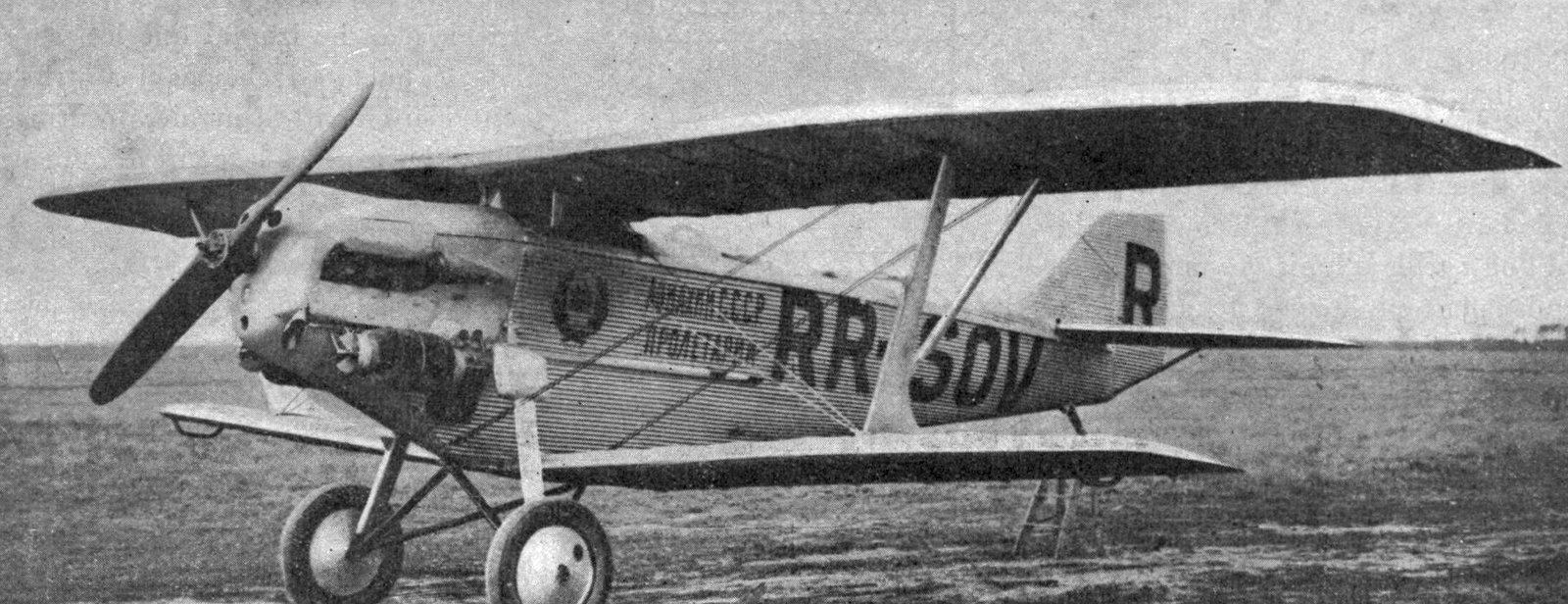
The Tupolev ANT-3 was a reconnaissance bomber developed in the mid-1920s by Andrei Nikolaevich Tupolev and his design team at the Central Aero-Hydrodynamic Institute (TsAGI). The aircraft is historically significant as part of the early Soviet effort to move away from wooden airframes toward all-metal construction, a design philosophy that would define Tupolev's subsequent work. The ANT-3 conducted its first flight on August 6, 1925, and eventually entered service in 1929.
Manufacturing of the ANT-3 took place at a Moscow-based aircraft factory that served as the primary production hub for Tupolev's early bomber designs. This facility later evolved into the Khrunichev State Research and Production Space Center (GKNPTs Khrunichev). While the ANT-3 itself did not reach the same level of documented production as later models, the plant utilized the experience gained from these early projects to produce other significant aircraft, including the ANT-4 (TB-1) starting in 1929 and the ANT-6 (TB-3) between 1931 and 1935. During World War II, the same industrial complex produced the Tu-2 bomber.
Technical documentation for the ANT-3 remains sparse in open sources, with specific engine models, power outputs, and performance metrics not reliably recorded. However, its role as a reconnaissance bomber placed it chronologically before the more famous TB-1, which was used in a high-profile Moscow-to-New York flight in August 1929. The ANT-3's service history is similarly limited in the available records, noting only its 1929 entry into service without detailing specific combat roles or unit assignments.
The legacy of the ANT-3 is tied closely to the industrial evolution of its manufacturer. The Moscow plant that once built these early all-metal bombers eventually transitioned from aviation to the space industry. Today, the Khrunichev State Research and Production Space Center is a leading producer of spacecraft and heavy-lift launch vehicles, most notably the Proton and Rokot rockets, marking a complete shift from the early reconnaissance bombers of the 1920s to modern orbital launch systems.