
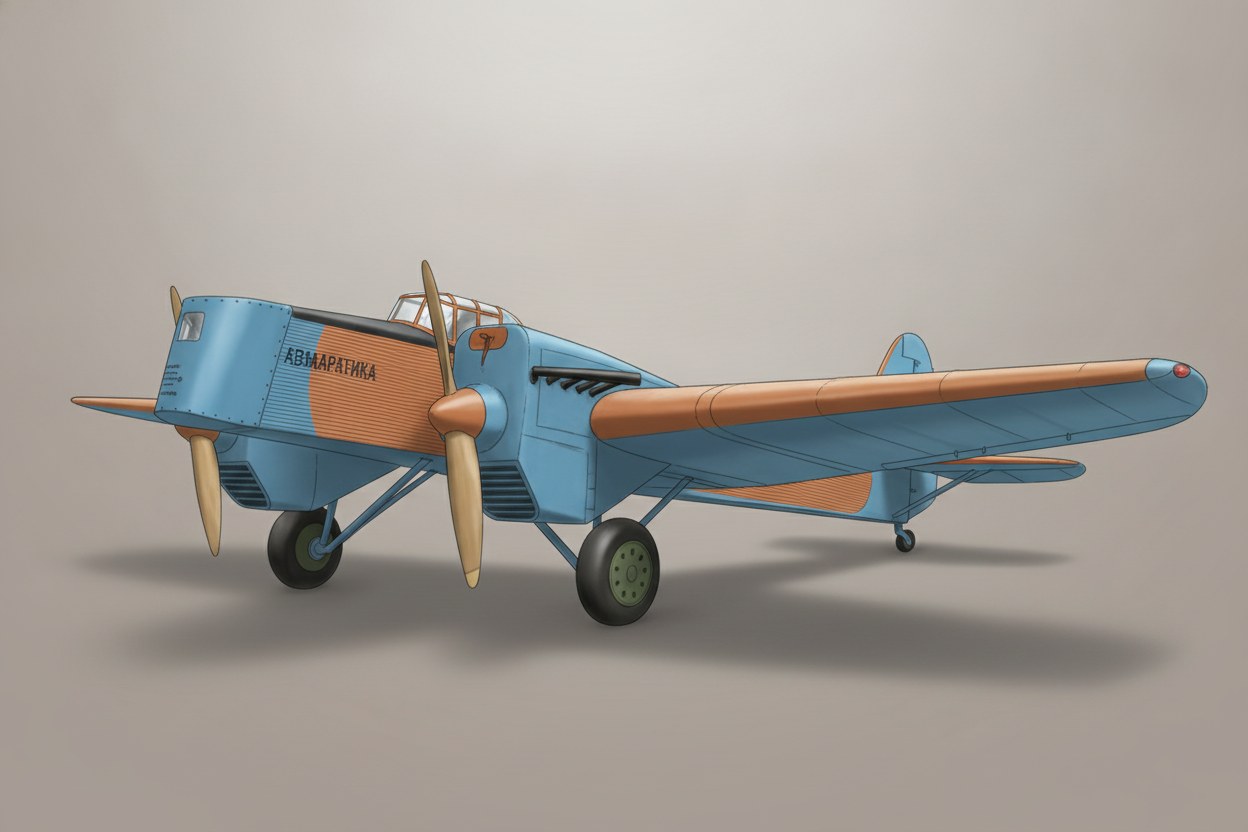
The Tupolev ANT-7, designated as the R-6 in military service, was a twin-engine landplane developed in the late 1920s. The aircraft was designed by Andrei Nikolaevich Tupolev at the Central Aero- and Hydrodynamics Institute (TsAGI), specifically within the AGOS department. The ANT-7 first flew in 1929, marking a critical milestone in Soviet aviation as one of the first successful twin-engine all-metal bombers and reconnaissance aircraft. This design followed the earlier single-engine ANT-3 and ANT-4 models and implemented Tupolev's philosophy of using duralumin and stressed-skin elements, which provided a technological advantage over the fabric-and-wood constructions common in other air forces of the era.
Series production of the R-6 began in the early 1930s, with most estimates placing the start of production between 1931 and 1932. While exact factory documentation is unavailable, several hundred aircraft were produced, with various sources estimating the total between 400 and 500 units. Manufacturing took place at multiple state aircraft factories, most notably the Taganrog aviation plant, which was a primary center for early Tupolev designs.
Technically, the ANT-7 was configured as a multi-role platform capable of serving as a day bomber, reconnaissance aircraft, or transport. It was powered by two Soviet-manufactured air-cooled radial piston engines mounted on the wings. While specific horsepower figures vary across sources, the engines were generally of a mid-power class for the period. The aircraft featured a multi-person crew and fixed landing gear.
In military service, the R-6 was operated by the Soviet Union's VVS (Red Army Air Force). It served as a standard bomber and reconnaissance type during the early 1930s before becoming obsolete by the late 1930s with the introduction of the SB and DB-3/Il-4 bombers. The design also served as the structural basis for various naval and floatplane derivatives used as torpedo bombers. Today, the legacy of the ANT-7 persists through the Tupolev design organization, which evolved from TsAGI into the modern Tupolev PJSC, a part of Russia's United Aircraft Corporation (UAC). No original ANT-7/R-6 airframes are known to survive in museums.