
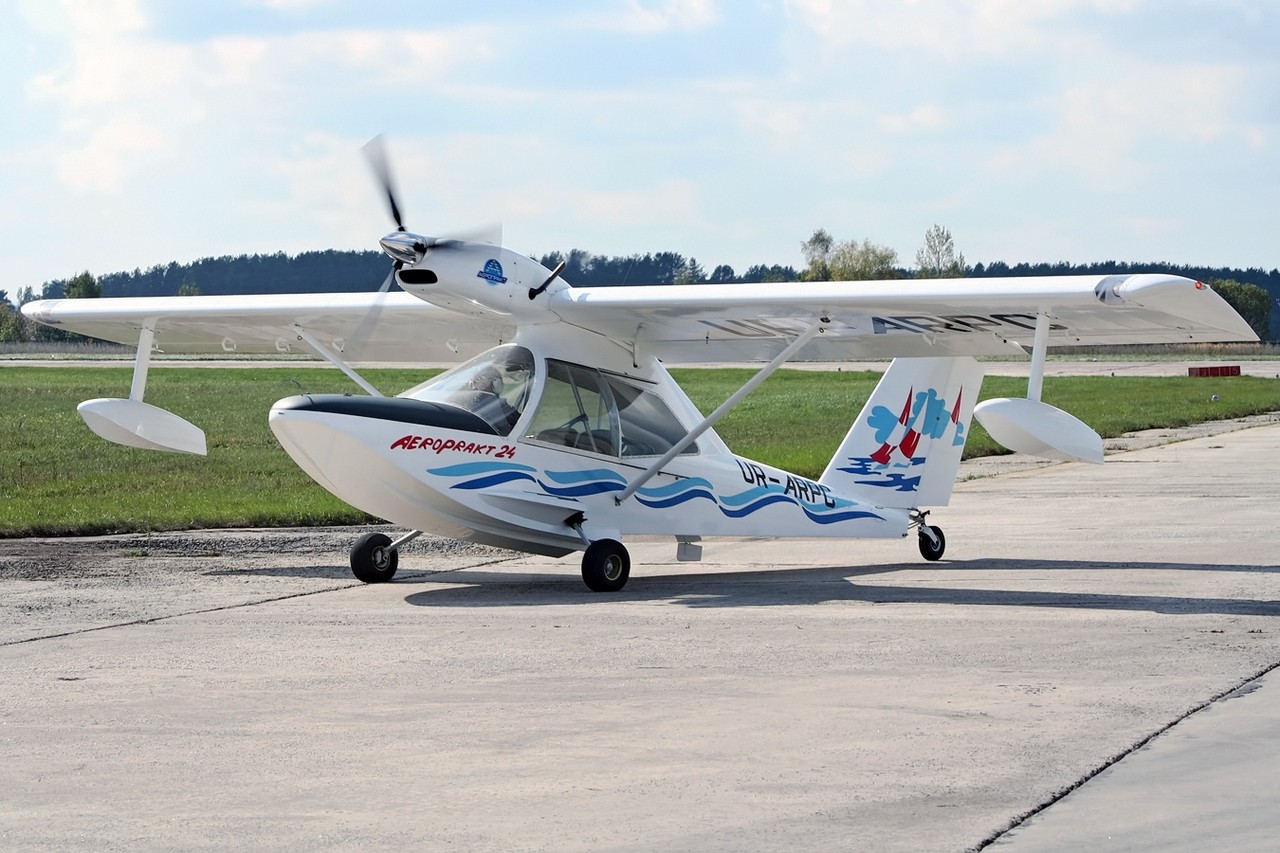
Development and Design
The A-24 Viking emerged from Aeroprakt Ltd.'s ambitious goal to create a versatile amphibian for the homebuilt market during Ukraine's aviation renaissance of the 1990s. Chief Designer Yuri Yakovlev, who founded the company in 1991 after graduating from Kuybyshev Aviation Institute and working at the renowned Antonov design bureau, led the development team that began work on the Viking by 1996.
The aircraft's design philosophy centered on practicality and amateur construction capability. Engineers selected the proven TsAGI R-11 airfoil—the same 14-percent-thick section used on the legendary Antonov An-2—for the Viking's 11-meter wingspan. The high-wing configuration provided inherent stability crucial for water operations, while the innovative retractable main landing gear tucked above the waterline to enable seamless amphibious operations.
Technical Innovation
Powering the Viking is a single Rotax 912ULS engine producing 75 kilowatts (100 horsepower), mounted in tractor configuration on the wing's leading edge. This Austrian-manufactured powerplant, part of Rotax's successful 912 series that began production in 1994, brought fuel injection and electronic ignition to the light aircraft market. With over 40,000 units produced across all variants, the 912 series became the backbone of modern ultralight and light-sport aviation.
The Viking's cabin configuration prioritizes versatility with side-by-side front seats and a removable rear seat that converts to luggage space when needed. At 7.78 meters long and 3.21 meters tall, the aircraft balances compact dimensions with practical interior volume. The 15-square-meter wing area provides a gross weight capacity of 750 kilograms, including a 440-kilogram empty weight.
Performance Characteristics
Flight testing revealed respectable performance figures for the light-sport category. The Viking achieves a maximum speed of 165 km/h (102 mph) while maintaining a docile stall speed of just 70 km/h (43 mph). Its climb rate of 4.0 meters per second (800 feet per minute) provides adequate performance for recreational flying, while the 800-kilometer range and 4.5-hour endurance enable extended cross-country flights.
These performance numbers positioned the Viking competitively within the amphibian market, offering capabilities similar to established designs while maintaining the cost advantages of kit construction. The aircraft's amphibious nature opened access to both conventional airports and water landing sites, significantly expanding operational flexibility for private owners.
The Manufacturer
Aeroprakt Ltd. traces its origins to 1986 when Yuri Yakovlev established an amateur design club following his graduation from aviation school. The informal group initially focused on reverse-engineering foreign designs, creating the Aeroprakt-8 (based on Burt Rutan's Quickie) by 1984 and the T-8 (derived from the French Baroudeur) with a 1987 prototype debut.
Formal incorporation came in 1991 amid Ukrainian independence from the Soviet Union. Operating from a 2,000-square-meter facility in Kyiv with approximately 50 employees, Aeroprakt achieved its first commercial success with the A-20 Vista, which flew in prototype form in August 1991 and entered delivery by July 1993.
The company expanded its portfolio throughout the 1990s with the A-22 Foxbat (November 1996), A-26 Vulcan (1996), and later the A-28 Victor and A-32 Vixxen (2014). This diversified approach helped Aeroprakt survive the challenging post-Soviet economic transition while building expertise across multiple aircraft categories.
Production Reality
Despite promising specifications and innovative design features, the A-24 Viking never achieved commercial success. Production remained limited to the initial development phase, with only three confirmed flying examples by the end of 2002. Official production years are listed as 1996-2002, though this likely represents development rather than serial manufacture.
By 2015, Aeroprakt offered the Viking only on special request as a kitbuilt aircraft, effectively ending any hopes of regular production. The exact total number built remains unknown, though accident records suggest a small but active fleet operated into the 2020s. Documented incidents include aircraft LA-2410 (March 23, 2008), UR-PTAF (August 29, 2020), and UR-PAPC (April 4, 2022).
Legacy and Current Status
The A-24 Viking represents both the potential and challenges facing small aircraft manufacturers in emerging markets. While technically competent and reasonably well-designed, the aircraft arrived during a period when the light-sport market faced increasing competition from established manufacturers with greater resources and distribution networks.
Today, the Viking maintains a modest presence in flight simulation communities and among aviation enthusiasts who appreciate its unique combination of amphibious capability and affordable construction. The aircraft's inclusion in FlightGear simulator and various online aviation databases ensures its technical specifications remain accessible to researchers and virtual pilots.
Aeroprakt Ltd. continues operations under its original name, focusing on more successful designs while maintaining the Viking's availability for specialized applications. The company's survival through Ukraine's economic challenges and ongoing conflicts demonstrates the resilience that characterized the A-24's development, even if commercial success proved elusive.