
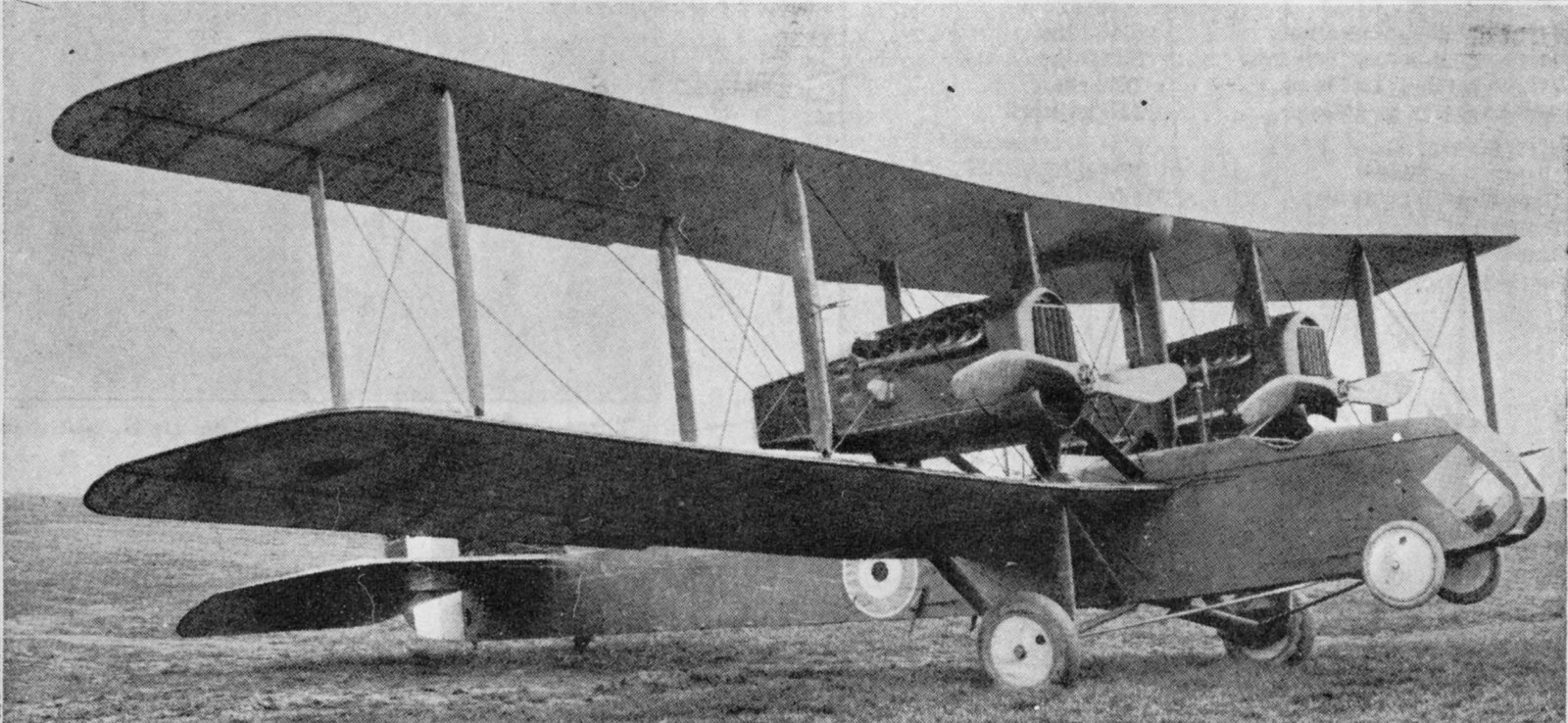
Designed by Geoffrey de Havilland at the Aircraft Manufacturing Company Ltd (Airco), the DH.10 Amiens was developed as a heavy bomber to expand the offensive capabilities of the Royal Air Force. The aircraft evolved through several iterations; the Amiens I utilized 230 hp B.H.P. engines, while the Amiens II used Siddeley Puma engines. However, the production standard became the Amiens III, which was powered by two 400 hp American-built Liberty L-12 water-cooled V-12 piston engines. The prototype first flew on March 4, 1918, and the design was noted for being faster and capable of carrying nearly double the bomb load of the Airco DH.9A.
Production began in 1918, with Airco producing the aircraft at Hendon and utilizing subcontractors including Bristol, Boulton & Paul, and Gloucestershire. Although the Air Board had envisioned a massive fleet of 1,295 aircraft to equip 58 squadrons by mid-1919, the Armistice led to massive cancellations. Ultimately, approximately 250 to 260 aircraft reached the RAF. The DH.10 entered service just as World War I ended, with only one documented combat mission: a raid on the Sarrebourg aerodrome conducted by Captain Ewart Garland of No. 104 Squadron on November 10, 1918.
In the post-war era, the DH.10 became a tool for imperial policing and early logistics. No. 97 and No. 60 Squadrons operated the type on the North-West Frontier of India and during the Third Anglo-Afghan War, conducting bombing raids against targets such as Abdur Rahman Khel and Datta Khel. Additionally, No. 216 Squadron utilized the aircraft to establish a regular airmail route between Cairo and Baghdad starting in June 1921. The aircraft also pioneered civil aviation; Aircraft Transport and Travel Ltd operated a DH.10 (registered as G-EAJO) for mail flights between London and Glasgow during the October 1919 railway strike, and at least one example served the U.S. Post Office on a route from New York City to Omaha in 1920.
Technically, the production Amiens III featured a wingspan of 65 ft 6 in and a maximum speed ranging between 112 and 129 mph. It carried a crew of three and typically armed with two to four .303 in Lewis guns on Scarff ring mounts, with an internal bomb load of approximately 920 lb. While no complete aircraft survive today, the DH.10 is remembered as a critical link in the evolution of long-range military aircraft and international airmail.