
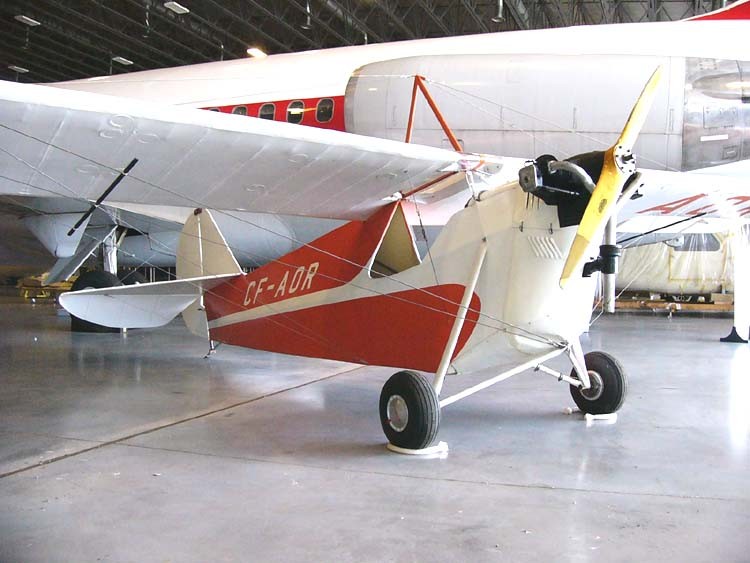
Revolutionary Impact on Light Aviation
The Aeronca C-2 transformed American aviation by making flight accessible to ordinary citizens during economic hardship. Priced at $1,245 in 1931 when the average automobile cost $670, the C-2 triggered a 'flivver-plane boom' that inspired more than 20 competitors to enter the ultralight market. Despite the Great Depression, Aeronca sold 164 units in the first two years of production, demonstrating unprecedented demand for affordable personal aircraft.
By 1937, the C-2 and its variants had established 19 official FAI and NAA lightplane records, including a remarkable altitude record of 19,425 feet, a junior altitude mark of 10,525 feet, and a 500-kilometer speed record of 70.49 mph. Stanley Huffman achieved one of the most notable feats on April 9, 1930, flying non-stop from dawn to dusk from Lunken Airport in Cincinnati to Roosevelt Field, New York.
Design Innovation and Engineering
Jean A. Roché, a senior U.S. Army aeronautical engineer at McCook Field in Dayton, Ohio, conceived the C-2's design in 1924 with assistance from Quinten Dohse. After successfully flying his homebuilt prototype on September 1, 1925, Roché joined Aeronca to refine the design for commercial production. The aircraft received type certification in February 1930 at the St. Louis Air Show, marking a milestone in aviation regulation.
The C-2's distinctive triangular cross-section welded steel-tube fuselage earned it the enduring nickname 'Flying Bathtub.' This unconventional structure, combined with high-braced wooden wings featuring spruce spars and fabric covering, created an exceptionally simple and lightweight aircraft. Wire bracing supported the 36-foot wingspan, while the open cockpit provided a plywood seat for the single pilot.
The Manufacturer's Legacy
Aeronautical Corporation of America, founded around 1928 in Cincinnati, Ohio, became the first company to achieve commercial success with truly light aircraft. Beyond the C-2, Aeronca manufactured over 1,800 engines across 11 years of production, powering not only their own aircraft but other manufacturers' designs. The company's engine division produced the reliable E-107A and E-113 series, with more powerful variants like the 36-horsepower E-112, E-113A, and E-133A engines powering the C-2 Deluxe and C-2N Scout models.
During World War II, Aeronca evolved beyond light civilian aircraft, producing more than 1,400 O-58/L-3 Grasshopper reconnaissance aircraft and 250 TG-5 gliders for military service. However, changing U.S. airworthiness standards in 1937 forced the company to halt production of early models like the C-2, ending an era of ultra-simple aircraft construction.
Engine Performance and Specifications
The standard C-2 utilized Aeronca's custom-designed 26-horsepower E-107A or E-113 horizontally opposed two-cylinder engine, specifically engineered for light aircraft applications. Despite its modest power output, the engine proved remarkably reliable for its era, enabling the 398-pound empty-weight aircraft to achieve a maximum speed of 80 mph and maintain a comfortable cruising speed of 65 mph.
With a useful load of 274 pounds, the C-2 could accommodate the pilot plus minimal equipment or baggage. The aircraft's remarkably low stall speed of 32 mph made it exceptionally forgiving for novice pilots, contributing significantly to its success as a training aircraft for flying schools across the country.
International Recognition and Variants
The C-2's reputation extended beyond American borders, with the first example arriving in Canada for the 1930 Montreal air meet. This demonstration led to the establishment of Aeronautical Corporation of Canada, which imported 17 C-2 and C-3 aircraft during the 1930s. G.A. Dickson of Pittsburgh purchased the eighth C-2 built in 1931, registering it as CF-AOR.
Aeronca developed several variants, including the two-seat Collegian model and the C-2N Scout, powered by more powerful engines. Four C-2N Scouts were produced alongside the standard models. One notable modification occurred in England, where G-ABHE was converted to a glider by H.J. Parham after engine failure, first flying in glider configuration on May 15, 1937, though it was destroyed in a storm in November 1938.
Surviving Legacy
Approximately 515 total C-2 and C-3 aircraft were built before production ceased in 1937. Today, several examples survive in museums and private collections. The Canada Aviation and Space Museum in Ottawa preserves the 1931 C-2 (CF-AOR), acquired in 1967 and modified with a C-3 tail. The first production prototype, donated by Aeronca in 1948 and restored in 1976, resides in an American museum.
At least one 1929 C-2 remains active and flying as of 2025, testament to the aircraft's enduring design and the dedication of vintage aircraft enthusiasts. The C-2's cultural significance extends far beyond its modest specifications, representing the democratization of flight and proving that innovative engineering could overcome economic constraints to make aviation dreams accessible to ordinary Americans.