
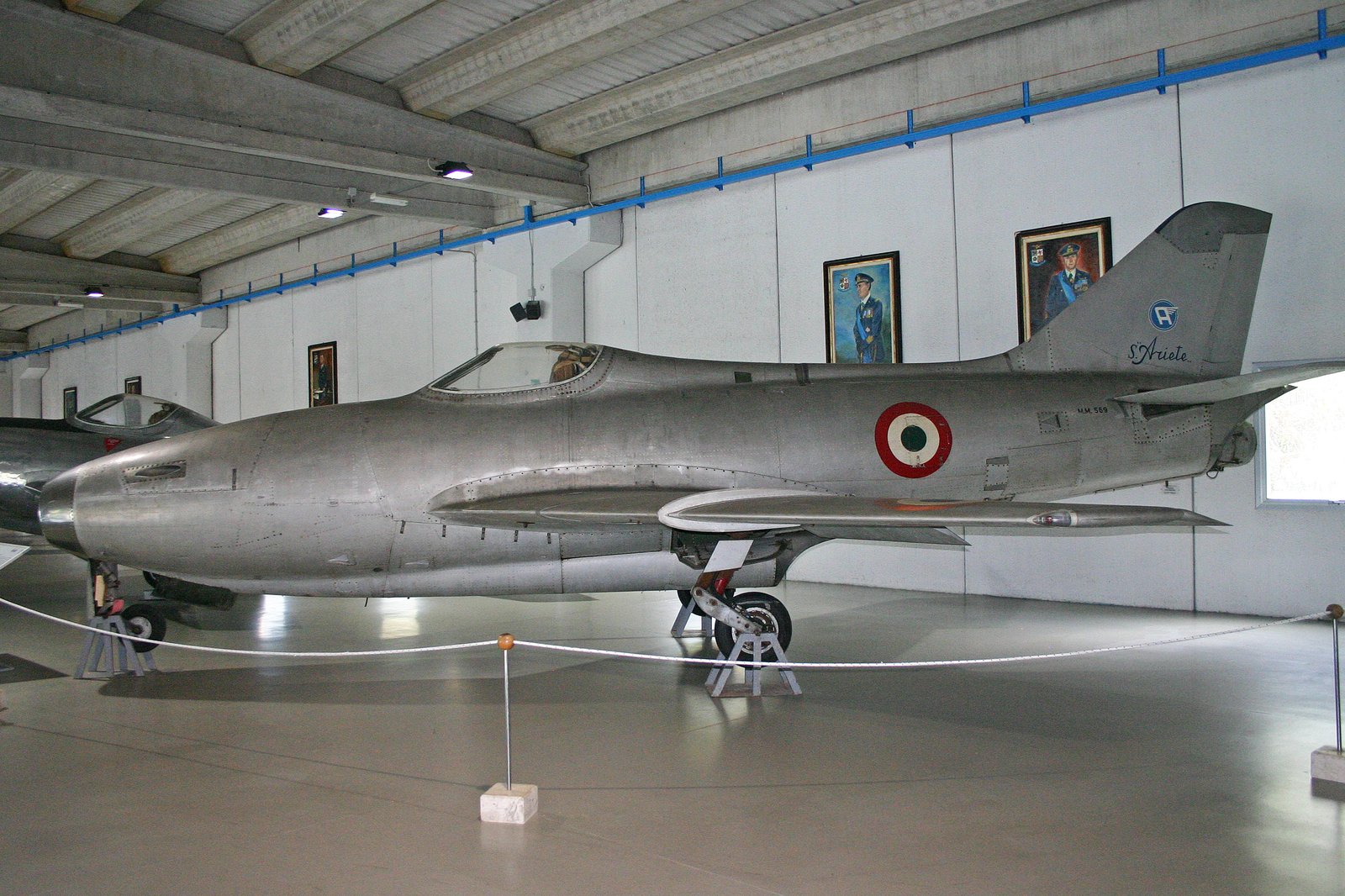
The Aerfer Ariete was an Italian prototype single-seat jet fighter developed in the late 1950s. It was designed as a refined, operational-quality version of the Aerfer Sagittario 2, a swept-wing demonstrator that had previously become the first Italian aircraft to break the sound barrier. The Ariete was intended to serve as a highly maneuverable light fighter, specifically targeted for the export market after the Sagittario 2 lost a NATO light tactical support competition to the Fiat G.91.
Manufactured by Industrie Meccaniche Aeronautiche Meridionali (AERFER) in Italy, the Ariete program resulted in only one flyable prototype. While a second airframe was started, it remained incomplete and was never finished. The sole completed prototype made its maiden flight on March 27, 1958. The aircraft's design was characterized by its compact size and a sophisticated propulsion arrangement intended to provide bursts of extra thrust during combat. It was powered by two Rolls-Royce turbojets: a primary Rolls-Royce Derwent 9 providing 3,600 lb of thrust, and a smaller Rolls-Royce Soar RSr.2 auxiliary engine producing 1,810 lb of thrust. The auxiliary engine was buried in the rear fuselage and featured a distinctive intake on the upper fuselage that opened only when the engine was in use.
Technically, the Ariete measured approximately 10.65 meters in length with a wingspan of 8.40 meters and a height of 3.40 meters. Performance data indicates a maximum speed of 675 mph (approximately 1,080 km/h), a service ceiling of 39,370 feet, and a rate of climb of 2,665 feet per minute. Although designed to carry two 30 mm HDD-825 internal automatic cannons, these weapons were never actually fitted to the prototype.
Despite its technical promise, the Ariete never entered series production and saw no operational service. The project did inspire a further conceptual derivative known as the "Leone," which proposed replacing the auxiliary turbojet with a rocket booster, though this version was never built. Today, the Ariete remains a rare example of Cold War Italian aviation experimentation, known primarily through historical records and simulation software.