
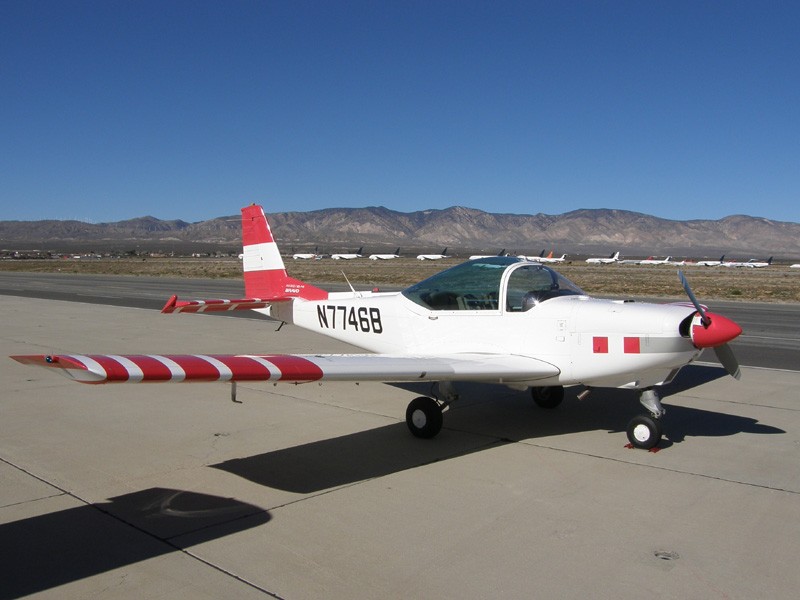
Development and Design Origins
The AS-202 Bravo emerged from a 1967 collaboration between Switzerland's Flug- und Fahrzeugwerke Altenrhein (FFA) and Italy's SIAI-Marchetti, aimed at creating a modern aerobatic trainer for an evolving aviation training market. FFA, originally established as a Swiss subsidiary of Dornier, took responsibility for the fuselage, tail section, and flight controls, while SIAI-Marchetti developed the wings, landing gear, and engine installation. The partnership reflected the late 1960s trend toward international aerospace cooperation and the need for purpose-built aerobatic trainers to replace aging fabric-covered aircraft.
Two prototypes validated the design approach: the Swiss prototype completed its maiden flight on March 7, 1969, followed by the Italian version on May 8, 1969. The aircraft incorporated NACA 63A218 modified airfoil sections at the wing root transitioning to NACA 63A415 modified sections at the tips, providing the aerodynamic characteristics necessary for both basic training and advanced aerobatic maneuvers.
Production and Manufacturing
Series production commenced in 1971, with the first production aircraft taking flight on December 22, 1971. Initial manufacturing involved both partner companies, but capacity constraints at SIAI-Marchetti led FFA to assume complete production responsibility in 1976. The Altenrhein facility continued manufacturing until 1989, ultimately delivering between 210 and 214 aircraft across all variants.
The production split favored the more powerful AS-202/18A variant, equipped with the 180-horsepower Lycoming AEIO-360-B1F engine and constant-speed propeller, which accounted for approximately 180 units. The AS-202/15, powered by the 150-horsepower Lycoming O-320-E2A with fixed-pitch propeller, represented the smaller production run with 32 to 34 aircraft completed.
Engine Technology and Performance
Lycoming's horizontally-opposed, air-cooled engines provided the Bravo's reliable powerplant foundation. The AEIO-360 series engines featured inverted oil systems essential for sustained aerobatic flight, while the O-320 offered proven reliability for basic training operations. Both engine families had accumulated millions of production units across decades of manufacturing, ensuring worldwide parts availability and maintenance expertise.
The AS-202/15 achieved cruise speeds of approximately 210 kilometers per hour with a never-exceed speed of 322 kilometers per hour. Stall speeds ranged from 89 kilometers per hour with flaps extended to 110 kilometers per hour in clean configuration. With 140 liters of wing-mounted fuel capacity, the aircraft provided a range of 890 kilometers, suitable for extended training sorties without frequent refueling stops.
Military and Training Applications
While designed as a post-World War II trainer with no combat role, the Bravo found significant acceptance among military flight training organizations. The Uganda Central Flying School operated eight aircraft, while Finland acquired ten units originally used by British Aerospace. The Finnish aircraft transitioned from military service to civilian training operations with Patria Pilot Training at Helsinki-Malmi Airport between 2000 and 2011.
British Aerospace Flight Training at Prestwick, Scotland, operated eleven AS-202 aircraft nicknamed "Wrens" for military contract training. After one aircraft was lost in an accident, the remaining fleet was sold to Finnish operators, where seven aircraft continued flying as of recent records despite losses in 2002 and 2010.
Corporate Evolution and Legacy Attempts
FFA's original corporate structure underwent significant changes following production cessation. The Type Certificate transferred to FFA Bravo AG around 2011, which commissioned GOMOLZIG Flugzeug- und Maschinenbau GmbH in Schwelm, Germany, to modernize and complete 14 remaining airframes in 2012. GOMOLZIG acquired the Type Certificate in 2015 but encountered economic difficulties that halted the revival program.
Successor entities, including ACC Columbia Jet Service, have promoted updated "New Generation" variants with modern avionics and refinements, though production has not resumed on any significant scale. The AS-202 A4 variant received certification approval in 2012 as part of these modernization efforts.
Current Status and Preservation
At least seven AS-202 aircraft remain in active service, primarily in Finland under civilian operation. The aircraft that continue flying serve as testament to the robust Swiss-Italian design philosophy and Lycoming engine reliability. While no specific museum preservation efforts have been documented, the Bravo's role in training thousands of pilots across two decades of production ensures its place in aviation training history.
The AS-202 Bravo succeeded in its primary mission of providing reliable, fully aerobatic training capabilities during a crucial period when aviation training was transitioning from basic tailwheel aircraft to more sophisticated tricycle-gear designs. Its contribution to pilot training programs worldwide, particularly in military applications, demonstrates the value of international collaboration in developing specialized training aircraft for evolving aviation requirements.