
Service History
The AS-365 Dauphin 2 achieved remarkable commercial success, with over 1,000 units delivered to 138 customers across 45 nations by 2012. Production averaged 30-40 helicopters annually by 2006, demonstrating sustained market demand throughout its operational life. Bond Helicopters became a major operator with 15 aircraft, receiving the 500th production example in February 1991. The milestone 1,000th helicopter was delivered to Pawan Hans in April 2011, marking nearly four decades of continuous production success.
Military and Coast Guard Operations
Military variants served crucial roles in search-and-rescue and anti-submarine warfare missions. The United States Coast Guard operated over 100 HH-65 Dolphin variants (construction numbers 6125-6226 and beyond) for maritime rescue operations. The French Navy and Irish Air Corps adopted the type for search-and-rescue duties beginning in 1985, while Brazil operated AS565AA variants for military transport and patrol missions. The AS565 Panther variant was specifically developed for naval operations, equipped with anti-ship missiles, torpedoes, and machine guns for combat roles.
The Manufacturer
Aérospatiale emerged from the 1970 nationalization of French aviation companies, tracing its lineage to Sud Aviation, which had formed in 1957 through the merger of Sud-Est and Sud-Ouest. The company operated independently until 2000, when it merged with DaimlerChrysler Aerospace to create Eurocopter. This entity later became Airbus Helicopters in 2014, continuing Dauphin production until the final delivery in 2021. Manufacturing took place primarily at the Marignane facility in France, with licensed production established in China as the Harbin Z-9 Haitun and in Brazil by Helibras as the MH-1 Pantera.
Engine and Technical Innovation
The Dauphin 2 represented a significant advancement over its single-engine SA360 predecessor, incorporating two Turbomeca Arriel turboshaft engines producing 630 shaft horsepower each in the initial Arriel 1 configuration. Later variants featured the uprated Arriel 1C2 engines generating 736 shaft horsepower, enabling a maximum takeoff weight increase to 4,250 kilograms. The AS365F variant, introduced in 1985, became the world's first rotorcraft equipped with electronic flight displays, pioneering glass cockpit technology in helicopter aviation.
The aircraft featured the innovative Starflex main rotor hub system and incorporated extensive use of composite materials in its construction. The SA365N variant introduced retractable landing gear, improving aerodynamic efficiency and cruise performance. These technological advances contributed to the helicopter's ability to sustain 170-knot level flight speeds and achieve an average speed of 321 kilometers per hour on the demanding Paris-London route during certification testing.
Performance Characteristics
Pilots praised the Dauphin 2 for its exceptional speed and handling characteristics, with the twin-engine configuration providing significant safety margins over single-engine helicopters. The aircraft demonstrated impressive performance capabilities, setting three speed records in February 1980 on the London-Paris route. Standard crew requirements called for one or two pilots, with passenger capacity ranging from 12 to 14 depending on configuration and mission requirements.
The helicopter's fuselage measured 11.02 meters in length with an overall height of 4.00 meters, while the main rotor diameter spanned 11.94 meters. Maximum takeoff weights progressed from 3,400 kilograms for the baseline SA365C to 4,250 kilograms for the AS365N2 variant, reflecting continuous improvements in structural design and engine power.
Production Evolution and Legacy
Total production reached 1,098 units across all variants including the AS365, AS366, and AS565 designations during the 46-year production run from 1975 to 2021. The first prototype carried construction number 003, while production examples ranged from construction numbers 50-79 for the SA365C through the 6000+ series for later variants, with the final aircraft carrying construction number 6970.
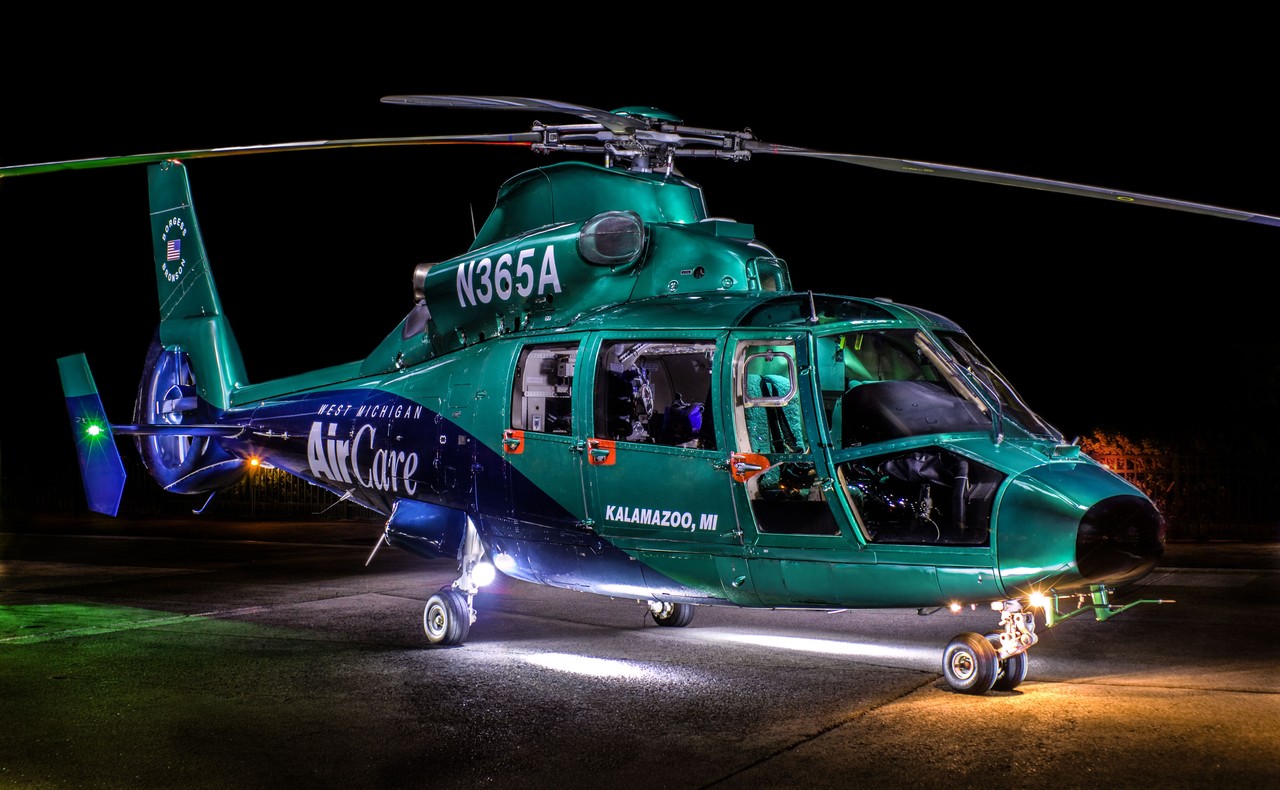
The successor H160 entered service in 2021, coinciding with the end of Dauphin 2 production. Many examples remain active in commercial and government service, including N365A, a 1990 AS365N2 that continues flying operations. The first SA365N production helicopter, F-WQAP (construction number 6001), is preserved at The Helicopter Museum, representing the type's significant contribution to rotorcraft development and establishing the foundation for modern twin-engine helicopter design principles.