
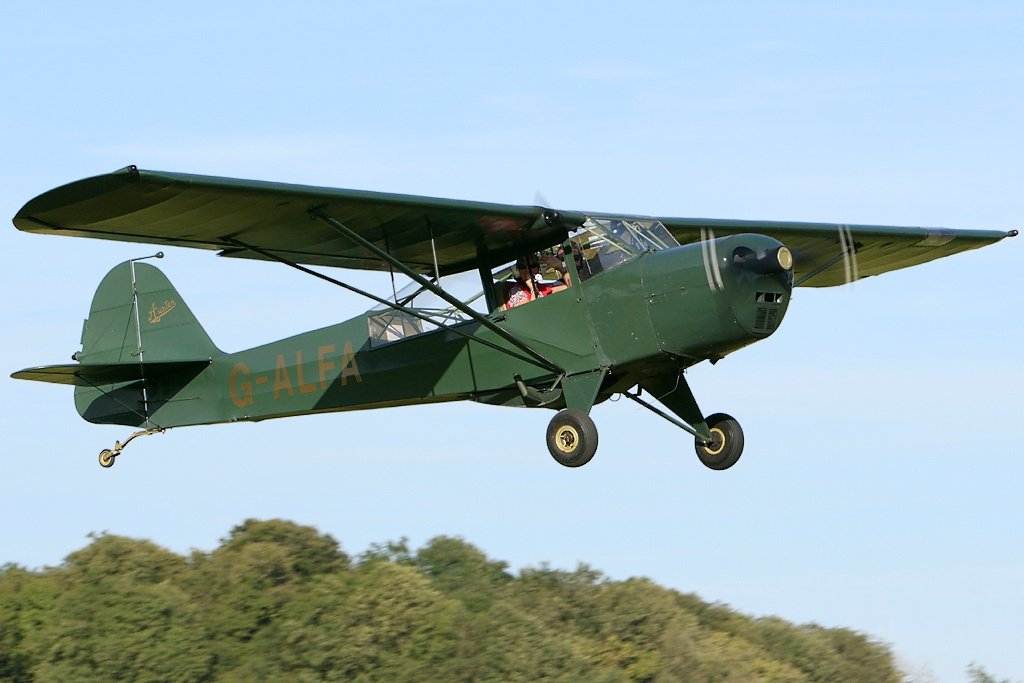
The Auster aircraft family represents a series of high-wing, strut-braced cabin monoplanes produced in Britain between 1938 and 1961. The lineage began with Taylorcraft Aeroplanes (England) Ltd, which started licensed production of American Taylorcraft Model A and B designs in 1938 at the Britannia Works in Thurmaston, near Leicester. Under the leadership of Lance Wykes, who was the driving force behind the project, these designs were adapted into the Taylorcraft Plus C and D, eventually evolving into the military Auster series and the postwar civil Auster J series. On March 7, 1946, the company officially changed its name to Auster Aircraft Limited, and production shifted to Rearsby Aerodrome. The company continued operations until June 1961, when it merged into Beagle Aircraft; the Auster name was subsequently dropped in 1962, though the designs lived on as the Beagle Terrier and Airedale.
Throughout its production history, a total of 3,868 Austers were built. The family is particularly distinguished by its extensive military service during the Second World War, where over 1,600 aircraft (estimates range from 1,604 to 1,630) were produced as Air Observation Post (AOP) aircraft for the armed forces of the United Kingdom and Canada. Operated primarily by the Royal Air Force in support of the Royal Artillery, these aircraft were utilized for artillery spotting, battlefield observation, and liaison. Key wartime variants included the Mk I, which was ordered in 1942, as well as the Mk III, IV, and V. The Mk V was powered by a 130 hp Lycoming O-290-3 engine and featured split trailing edge flaps and a placarded stall speed of 24 knots.
Following the war, the Auster J/1 Autocrat became the first British civil light aeroplane to enter production in the postwar era, with over 400 units sold for approximately £1,000 each. The family's versatility allowed for numerous adaptations, including the J/1U Workmaster for crop-spraying, as well as variants for air racing, aerial advertising, and operations using floats or skis. Technical specifications varied across the family; for example, the Auster Mk VI utilized a 145 hp de Havilland Gipsy Major engine and featured up to three seats and Junkers-style flaps. Later civilian derivatives based on the Auster 5 utilized the 150 hp Lycoming O-320-A2B engine, while other later versions employed Lycoming O-320 and O-360 engines to improve performance.