
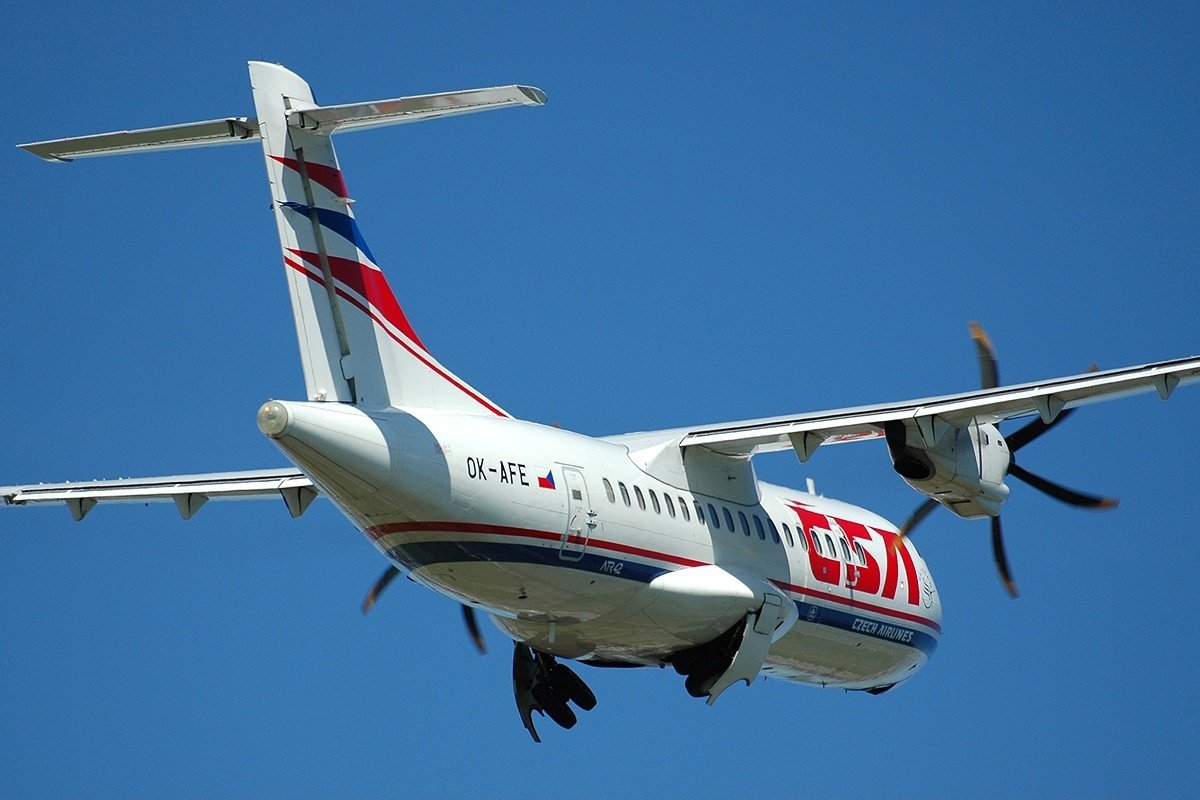
A Brief Production Window
The ATR 42-400's extraordinarily limited production run stemmed from unfortunate timing in ATR's development schedule. While the variant completed its maiden flight on July 12, 1995, with registration F-WWEF, the superior ATR 42-500 had already received certification just five days earlier in July 1995. This overlap essentially rendered the 42-400 obsolete before full-scale production could begin.
Technical Specifications
Powered by twin Pratt & Whitney Canada PW121A turboprop engines driving six-blade Hamilton Sundstrand 568F propellers, the ATR 42-400 represented an incremental upgrade over the earlier ATR 42-320. The aircraft achieved respectable performance figures for its class, with a maximum cruising speed of 266 knots and operational range of 825 nautical miles with full passenger load. These specifications positioned it competitively within the regional aviation market of the mid-1990s.
The aircraft maintained the characteristic high-wing configuration that defined the ATR 42 series, providing excellent short-field performance and operational flexibility essential for regional routes. Passenger capacity remained consistent with other ATR 42 variants at 42-50 seats, depending on airline configuration preferences.
The ATR Legacy
ATR emerged from the November 4, 1981 partnership between French aerospace giant Aérospatiale and Italian manufacturer Aeritalia, later becoming Leonardo S.p.A. This Franco-Italian collaboration established final assembly operations in Toulouse, France, where both ATR 42-400 aircraft were completed. The joint venture strategy proved successful in the regional aviation market, though the 42-400 variant would not contribute significantly to that success.
By the 1990s, ATR had established itself as a leading regional aircraft manufacturer, competing directly with Canadian Bombardier and Brazilian Embraer for market share. The company's focus on turboprop efficiency and operational economics resonated with airlines serving thin regional routes where jet aircraft proved uneconomical.
Limited Service History
The two completed ATR 42-400 aircraft found homes with distinctly different operators following their March 14, 1996 delivery date. CSA Czech Airlines acquired one aircraft for regional operations, while the Italian Government took delivery of the second example. This split between commercial and government use reflected the aircraft's versatility despite its minimal production numbers.
Receiving DGAC certification on February 27, 1996, the ATR 42-400 met all regulatory requirements for passenger service. However, its operational history remains largely undocumented due to the small fleet size and brief service period before operators likely transitioned to more modern variants.
Market Displacement
The ATR 42-500's introduction in October 1995 fundamentally altered the regional aircraft landscape, offering airlines significantly improved performance through advanced PW127 engines and enhanced passenger amenities. These improvements included increased weight capacity, superior fuel efficiency, and modernized cabin systems that airlines demanded for competitive route operations.
ATR's decision to cease ATR 42-400 production after just two examples demonstrated pragmatic business strategy rather than technical failure. The company recognized that continuing parallel production of similar variants would dilute resources and confuse potential customers evaluating their fleet requirements.
Rarity and Historical Significance
Today, the ATR 42-400 stands as perhaps the rarest production variant within the broader ATR family, with its two-aircraft production run representing less than 0.1% of total ATR 42 series output. This extreme rarity makes any surviving example historically significant for aviation museums and collectors interested in regional aviation development during the 1990s.
The variant's brief existence illustrates the rapid pace of technological advancement in 1990s regional aviation, where manufacturers continuously refined designs to meet evolving airline requirements. Airlines increasingly demanded better fuel efficiency, reduced maintenance costs, and improved passenger comfort – factors that drove constant product evolution.
ATR's Continued Success
While the ATR 42-400 failed to achieve commercial success, ATR as a manufacturer thrived throughout the following decades. The company's focus on turboprop efficiency and operational economics continued attracting airlines worldwide, particularly those serving routes where jet aircraft operations proved uneconomical.
The ATR 42-500 that superseded the 42-400 became a cornerstone of the company's product line, demonstrating that ATR's strategic decision to concentrate development resources on the more advanced variant proved correct. This success validated the Franco-Italian partnership's ability to compete effectively in the global regional aircraft market against established manufacturers.
Today, ATR remains active in regional aviation, continuing to produce updated variants of both ATR 42 and ATR 72 series aircraft for airlines worldwide seeking fuel-efficient turboprop solutions for short-haul routes.