
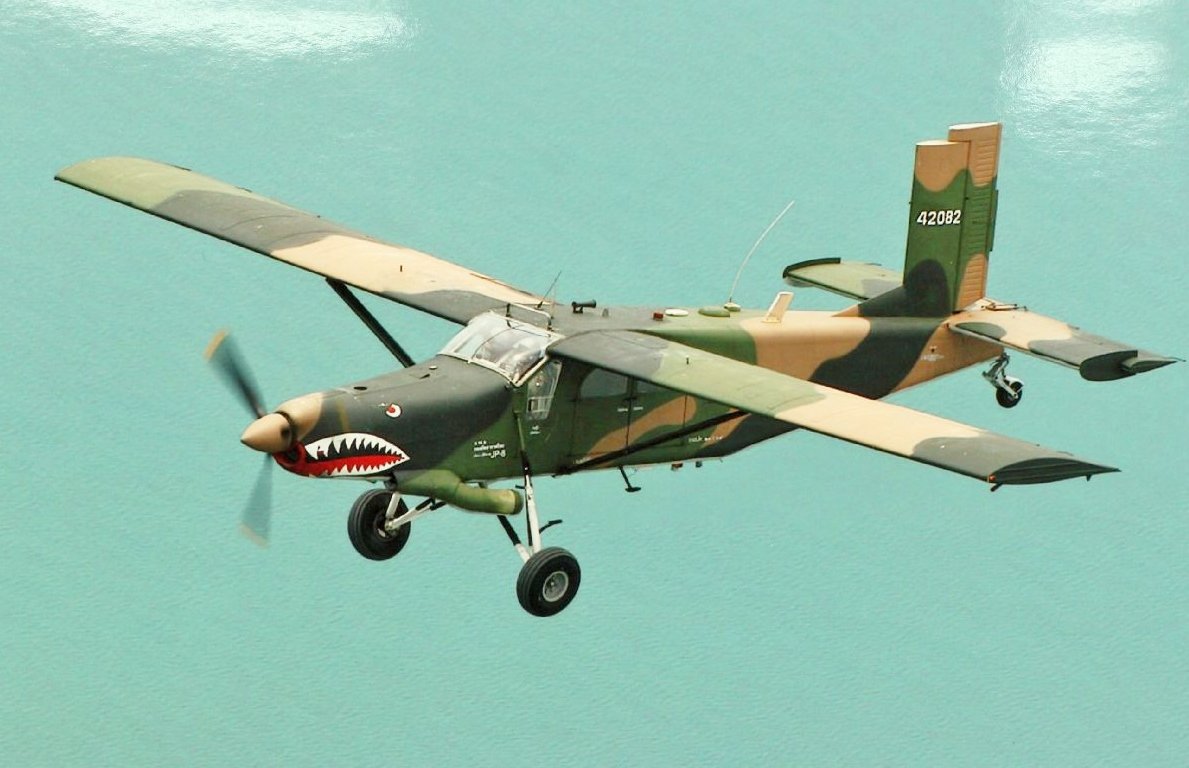
The Fairchild AU-23A Peacemaker was developed as a militarized version of the Swiss-designed Pilatus PC-6 Turbo Porter. Conceived as a low-cost, single-turboprop gunship for counter-insurgency (COIN) operations, the AU-23A was intended to function as a "flying jeep" capable of operating from short or poorly prepared airstrips. The aircraft was produced under license in the United States by Fairchild Industries (also known as Fairchild Hiller).
During the early 1970s, the United States Air Force (USAF) sought a simple COIN aircraft for use during the Vietnam War. As part of the Credible Chase program, the Fairchild Porter was selected alongside the Helio Stallion for comparative testing at Eglin Air Force Base in 1971. This led to the development of the AU-23A, which featured a specialized armament suite. The aircraft was equipped with a door-mounted XM-197 20 mm three-barrel Gatling cannon, mounted on a mobile installation in the cargo doorway to provide a wide field of fire. Additionally, the wings featured five pylons capable of carrying up to 1,925 lb of ordnance, including 250 or 500 lb bombs, napalm, rocket launchers, and cluster munitions.
In June and July 1971, the AU-23A underwent combat evaluation in South Vietnam under the PAVE COIN program. The USAF 4400th Special Operations Squadron (Provisional) flew 73 missions (94 sorties), while the Republic of Vietnam Air Force (RVNAF) flew 68 missions (85 sorties). Despite demonstrating strong STOL performance, the evaluation revealed critical vulnerabilities; the aircraft's low speed, low operating altitude, and lack of armor made it susceptible to small-arms fire and heavy machine guns, such as the Soviet DShK. Consequently, the USAF recommended against its combat use without major upgrades, and the 15 aircraft ordered for the USAF were sent to storage at Davis-Monthan AFB in 1972.
Ultimately, 35 AU-23A airframes were built. While the USAF did not maintain the type, the aircraft were transferred to the Royal Thai Air Force (RTAF) under the U.S. Military Assistance Program. The RTAF received 14 ex-USAF aircraft and an additional 20 delivered directly by Fairchild in 1976. Designated locally as the B.JT.2, the Peacemaker served primarily in counter-infiltration and border patrol roles. As of 2024, 14 aircraft reportedly remain on duty with the 501 Light Attack Squadron, Wing 5, based at Prachuap Royal Air Force Base.