
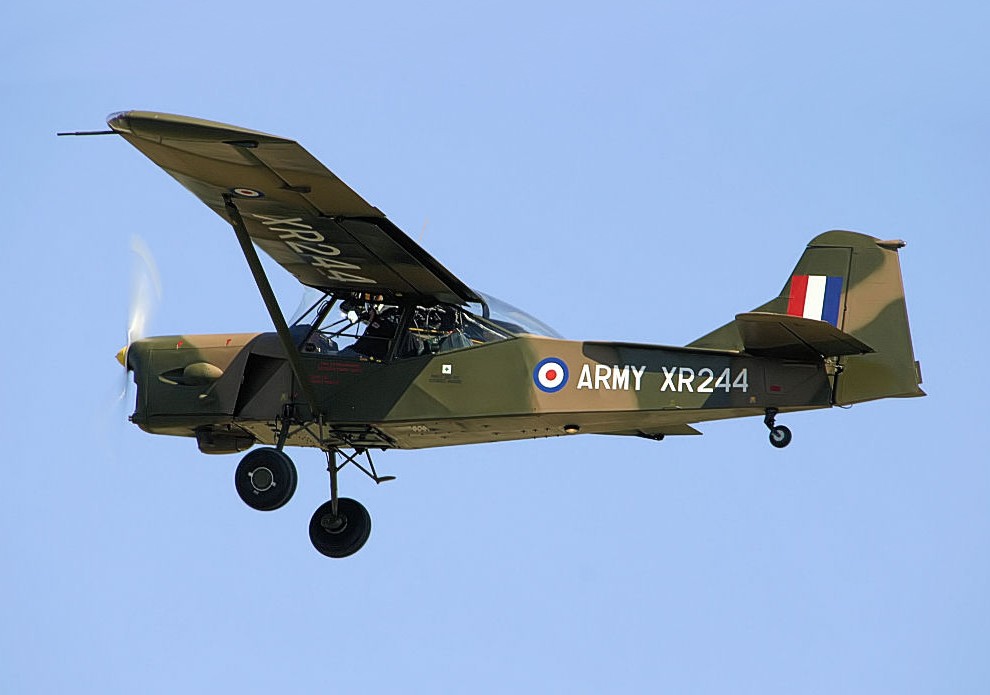
Military Dominance in Artillery Observation
The AOP.9 represented the pinnacle of British artillery observation aircraft design, serving as the backbone of reconnaissance operations across multiple theaters. No. 656 Squadron alone flew an average of 1,200 sorties per month, with their combined AOP.6 and AOP.9 fleet accumulating 143,000 sorties during Operation Firedog in Malaya by July 31, 1960. The aircraft's ability to operate from ploughed fields and muddy surfaces using low-pressure tires made it invaluable for forward area operations where traditional aircraft could not venture.
Operational Theater Excellence
British forces deployed the AOP.9 extensively during the Malayan Emergency and Aden operations in the early 1960s. The 653 Squadron Army Air Corps operated their aircraft from Falaise and Little Aden until 1966, providing critical intelligence and artillery direction in the challenging terrain of South Arabia. The aircraft's three-seat configuration allowed for a pilot, observer, and passenger, with the rear-facing observer position enabling continuous surveillance during reconnaissance missions.
Auster Aircraft Ltd. Legacy
Auster Aircraft Ltd., founded in the post-war British aviation boom, specialized in light observation and utility aircraft from their Leicestershire headquarters. The company's expertise in short takeoff and landing aircraft made them the natural choice for military observation roles. When Beagle Aircraft acquired Auster in 1960, they redesignated the AOP.9 as the Beagle E.3, though production had already concluded with 182 aircraft delivered.
Power Plant Evolution
The 180-horsepower Blackburn Cirrus Bombardier four-cylinder inverted inline engine provided the AOP.9 with significantly more power than its predecessor, the AOP.6. This powerplant, delivering 134 kilowatts, enabled improved takeoff performance from the challenging surfaces where artillery observation aircraft typically operated. A single experimental variant, the AOP.11, received a 260-horsepower Continental IO-470-D six-cylinder engine, achieving a maximum speed of 142 miles per hour when it first flew on August 18, 1961.
Design Innovation and Practicality
Engineers incorporated lessons learned during Korean War operations, where the AOP.6 had revealed limitations in versatility and field performance. The AOP.9's larger wing area, combined with its strengthened undercarriage and convertible cabin floor, addressed these operational shortcomings. The aircraft's mixed construction—metal wings and tail surfaces with fabric-covered fuselage and ailerons—balanced weight considerations with manufacturing economy while providing adequate durability for military service.
International Service Record
Beyond British operations, the South African Air Force operated AOP.9 aircraft from 1957 to 1967, utilizing them for border patrol and reconnaissance missions across the challenging geography of southern Africa. The aircraft's proven reliability in tropical and desert conditions made it suitable for diverse international operators, though most examples remained within British Commonwealth service throughout their operational careers.
Transition to History
The AOP.9 marked the end of an era, serving as the last fixed-wing artillery observation aircraft in British military service before helicopters assumed the reconnaissance role. Beaver aircraft subsequently handled the light transport duties previously assigned to AOP variants. By the 1970s, nineteen former military AOP.9 aircraft had joined the United Kingdom civil register, with fourteen remaining registered as of 2008, though only approximately three maintained current airworthiness certificates.
Preservation and Current Status
The Army Historic Aircraft Flight maintains a flying AOP.9 at Middle Wallop, preserving the operational heritage of British artillery observation aviation. The Royal Artillery Museum houses XR271, built in February 1962, as a static display representing the aircraft's military service. Captain Mike Somerton-Rayner's civilian conversion, the Auster 9M, first flew on January 4, 1968, with a 180-horsepower Lycoming O-360 engine and remained airworthy as of 2009, demonstrating the basic design's enduring qualities.