
Design Innovation
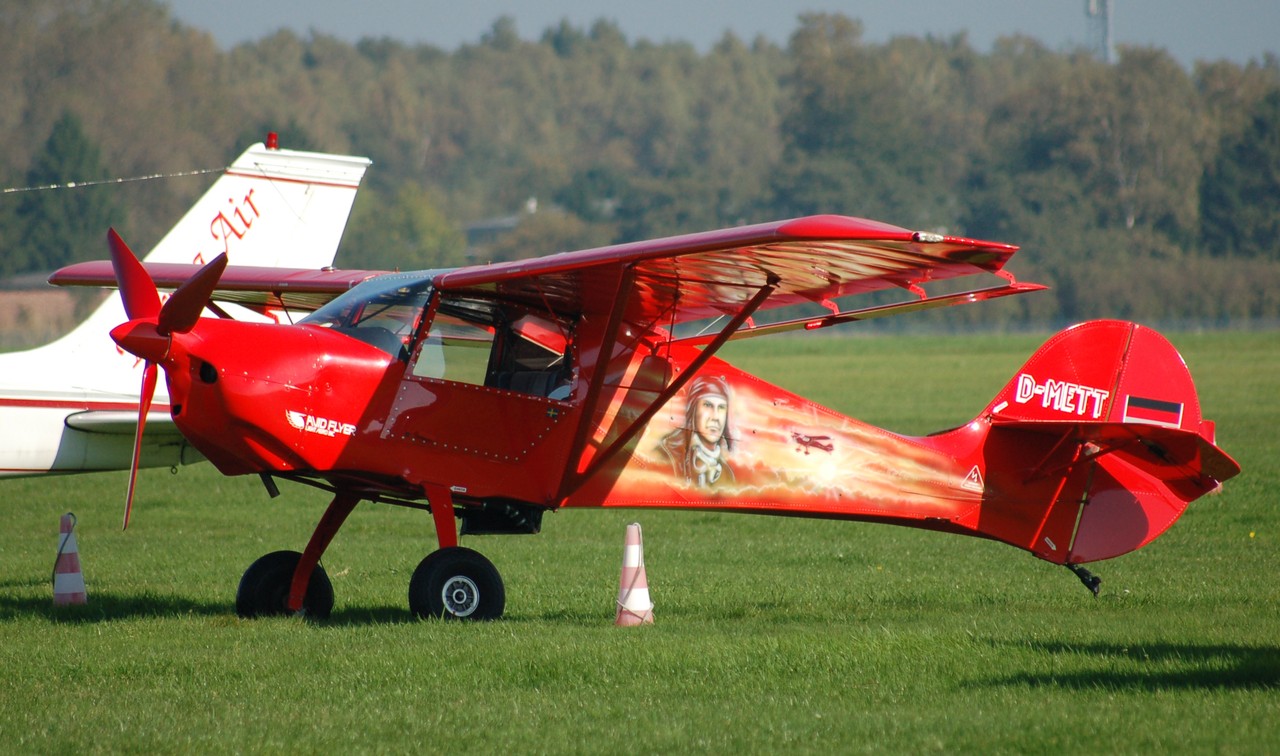
Dean Wilson's 1983 design objectives for the Avid Flyer addressed a critical gap in homebuilt aviation. While classic aircraft like the Piper Cub offered reliability but high costs, early ultralights like the Quicksilver provided affordability but questionable safety. Wilson's solution incorporated Junkers-style one-piece flaperons with offset hinges, keeping control surfaces in clean airflow for superior low-speed performance and high climb rates. The aluminum tube spars bonded with plywood ribs using filled epoxy created a lightweight yet robust structure optimized for short and rough field operations.
The prototype's debut at Oshkosh 1983 earned the "Best New Design" award, validating Wilson's approach to combining 1930s-era aircraft handling with modern ultralight construction techniques. The high-wing configuration with strut bracing provided excellent stability and ground clearance, while interchangeable wing options allowed builders to optimize for either STOL capability or higher cruise speeds.
Production History and Variants
Light Aero Inc. began kit production in Caldwell, Idaho in 1983, continuing until bankruptcy in 1998. The company's innovative marketing approach offered kits as single purchases or six separate packages, making the aircraft accessible to builders with limited budgets. Four primary variants emerged during the original production run: the base Flyer with 45-horsepower Cayuna or 65-horsepower Rotax 532 engines, the economy Bandit powered by a 50-horsepower Rotax 503, the improved Mk IV introduced in 1992 featuring a 64-horsepower Rotax 582 with curved rudder and baggage compartment, and the Magnum equipped with 125-160 horsepower Lycoming O-320 engines.
Following Light Aero's 1998 bankruptcy, production rights changed hands multiple times. Jim Tomash acquired the design and briefly operated from Ennis, Montana in 2003 before closing. Airdale Sportplane and Supply in Wisconsin produced kits from 1999 until mid-2017, manufacturing Mk IV and Magnum variants. Avid Aircraft LLC restarted operations in Unionville, Iowa in October 2017, while Light Aero Inc. maintained certification authority, issuing certificates as recently as July 2021.
Engine Configurations
The Avid Flyer's adaptability extended to its powerplant options, accommodating both two-stroke and four-stroke engines. Austrian-manufactured Rotax engines dominated lighter variants, with the liquid-cooled 582 model providing 64-65 horsepower and proving particularly reliable for ultralight applications. The air-cooled Rotax 503 and 532 series offered 45-65 horsepower options for budget-conscious builders.
Heavier Magnum variants utilized American Lycoming O-320 engines producing 125-160 horsepower, enabling higher gross weights and improved performance margins. This four-cylinder, horizontally-opposed engine, in production since the 1950s, provided the power-to-weight ratio necessary for the aircraft's exceptional STOL capabilities while maintaining the reliability demanded by backcountry operators.
Notable Achievements
The Avid Flyer achieved international recognition in 1987 when Hubert de Chevigny piloted an Avid Lite 532 equipped with 300 liters of auxiliary fuel on a historic Arctic expedition. Departing Resolute, Canada on April 2, de Chevigny reached the North Pole on May 7 in three stages, flying alongside Nicholas Hulot in an Aciasud Mistral. This expedition marked the first successful ultralight landing at the North Pole, demonstrating the aircraft's reliability and range capabilities under extreme conditions.
The flight required careful fuel management and navigation across featureless Arctic terrain, showcasing the Avid Flyer's suitability for long-distance flight despite its ultralight classification. The success of this mission elevated the aircraft's reputation among adventure pilots and backcountry enthusiasts worldwide.
Global Impact and Legacy
By 2008, approximately 2,000 Avid Flyer kits had been completed across five continents, establishing it as one of the most successful homebuilt designs of its era. European civil registers alone recorded 346 Flyers and Magnums, excluding Russian aircraft, indicating substantial international adoption. The aircraft's popularity stemmed from its forgiving flight characteristics, reasonable construction complexity, and genuine STOL performance.
The Avid Flyer's influence extended beyond its production numbers, inspiring numerous similar designs and proving that homebuilt aircraft could achieve both amateur builder accessibility and professional-level performance. Examples remain active on registries worldwide, with aircraft like FAA-registered N336N, a Magnum built in 2007-2008, continuing to operate internationally as of 2021.
The design's enduring appeal reflects its successful balance of performance, affordability, and buildability, characteristics that continue to attract homebuilders decades after the original company's founding. Current production under various entities ensures the Avid Flyer's continued availability for new generations of amateur aircraft builders.