
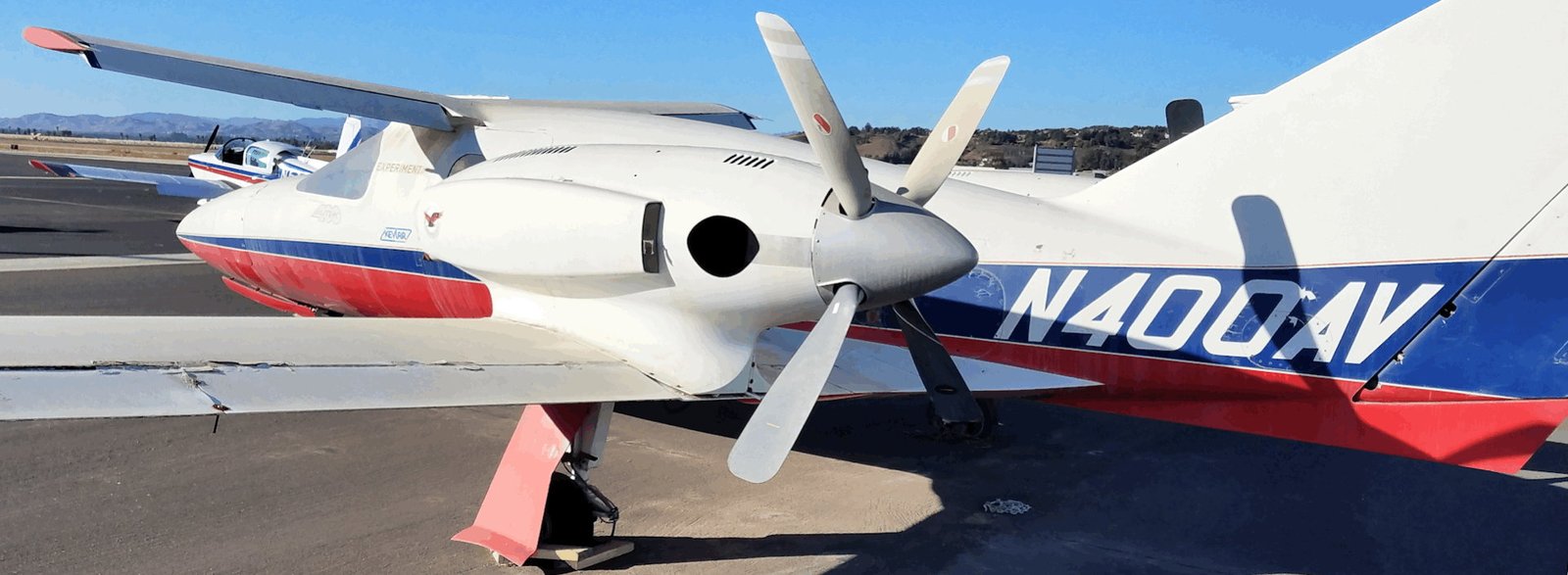
Development and Design Philosophy
The AVTEK 400 emerged from the ambitious vision of legendary aircraft designer Al Mooney, who sought to revolutionize the turboprop business aviation market in the early 1980s. Mooney's design targeted direct competition with established aircraft like the Cessna Conquest, Piper Cheyenne, and Beechcraft King Air 90, but promised superior performance through radical aerodynamic innovations. The aircraft featured a canard configuration with forward-mounted control surfaces replacing traditional tail stabilizers, combined with pusher-mounted turboprops positioned behind the engines to reduce cabin noise and increase interior space.
The prototype incorporated extensive use of advanced composite materials, including Kevlar and Nomex honeycomb structures supplied by major investor E.I. DuPont de Nemours & Company. Dr. Paul MacCready, designer of the renowned Gossamer Condor, evaluated the project and provided technical guidance that helped secure substantial funding. The design featured a swept wing with 15-degree leading-edge sweep, engines mounted low on the wing spar, and distinctive fuel strakes that provided center-of-gravity balance while contributing to the aircraft's sleek, organic appearance.
Corporate History and Financial Challenges
AVTEK Corporation operated primarily during the 1980s, securing significant investment totaling $27.5 million by 1988. The company constructed its prototype at facilities near Camarillo Airport in California, where the aircraft would eventually be stored for decades. Despite generating 102 pre-orders from potential customers attracted by promised specifications including 2,400-mile range and remarkable fuel efficiency of 10 miles per gallon, AVTEK faced mounting certification costs that ultimately proved insurmountable.
The lengthy and expensive FAA type certification process drained the company's resources throughout the late 1980s and 1990s. Without achieving the necessary approvals for commercial production, AVTEK Corporation declared bankruptcy in 1998, ending nearly two decades of development efforts. The company's assets, including the sole prototype, were subsequently sold in the early 2000s to AvtekAir, Inc., which announced ambitious plans for a revised AvtekAir 9000T version but made no substantive progress toward certification or production.
Flight Testing and Performance
The AVTEK 400 prototype received FAA Special Airworthiness Certification and completed its maiden flight in September 1984. During extensive flight testing, the aircraft accumulated more than 150 hours of flight time, validating many of its innovative design concepts. Test pilots achieved a maximum speed of 352 knots and demonstrated the aircraft's ability to reach its planned service ceiling of 41,000 feet, impressive performance figures that exceeded many contemporary turboprops.
The twin Pratt & Whitney PT6A-3 turboprop engines, each producing 680 horsepower, proved reliable throughout the test program. The PT6 series, which entered production in 1963 and has since accumulated more than 55,000 units manufactured, provided proven powerplant technology that reduced technical risk. The pusher configuration, while aerodynamically advantageous, required careful engineering to manage propeller noise and vibration characteristics.
Technical Innovations and Industry Impact
Despite never reaching production, the AVTEK 400 validated numerous advanced technologies that subsequently appeared in successful commercial aircraft. The prototype's composite construction techniques, canard aerodynamics, and pusher propeller integration provided valuable data that influenced later designs. During development, engineers lengthened the fuselage by 56 inches and refined the custom Avtek 12 airfoil to optimize performance characteristics.
The Piaggio Avanti, which achieved 236 production aircraft, and the Beechcraft Starship, with 53 units built, both incorporated similar canard configurations and composite construction methods pioneered by the AVTEK 400. These subsequent aircraft demonstrated the commercial viability of technologies that AVTEK Corporation had explored but could not bring to market due to financial constraints.
Cultural Legacy and Current Status
The AVTEK 400 prototype achieved brief fame appearing as the fictional X-400 in the television series Airwolf, specifically in the episode titled "Eagles," where it served as the villain's aircraft. This media exposure highlighted the aircraft's distinctive and futuristic appearance, which set it apart from conventional business turboprops of its era.
For decades following the company's bankruptcy, the engineless prototype deteriorated at Camarillo Airport in California, its registration cancelled and its composite structure slowly degrading in the outdoor environment. The Evergreen Aviation & Space Museum in McMinnville, Oregon, eventually acquired the historic aircraft with plans for complete restoration, recognizing its significance as a pioneering example of advanced composite and canard technology. The restoration project represents an effort to preserve this unique chapter in aviation development history, ensuring that future generations can study the innovative design concepts that influenced modern turboprop development.