
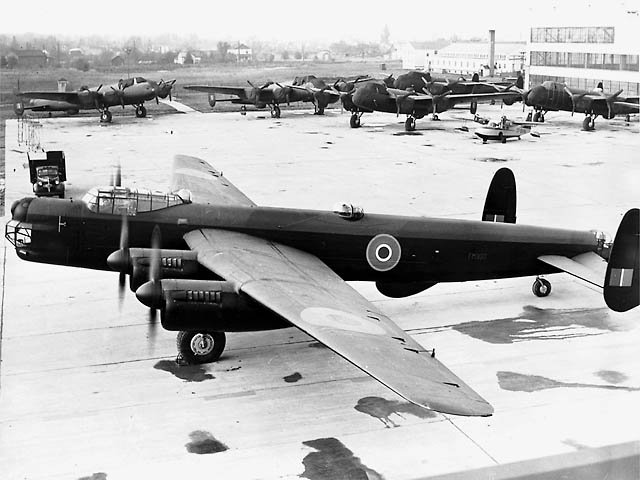
The Avro Type 694 Lincoln was developed as an enlarged derivative of the Avro Lancaster, designed to provide the increased range and fuel capacity necessary for operations against Japan in the Pacific. Led by chief designer Roy Chadwick and his team at Avro, the aircraft featured a longer fuselage and a redesigned high-aspect-ratio wing to improve high-altitude performance. The prototype first took flight on 9 June 1944 at Ringway Airport in Manchester, piloted by Captain Harry Albert Brown.
Production began in the United Kingdom, with the primary manufacturer A.V. Roe & Co. (Avro) joined by Armstrong Whitworth and Vickers-Metropolitan for the production of the Lincoln II. In Australia, the Government Aircraft Factories (GAF) at Fishermans Bend, Melbourne, produced 54 Lincoln Mk.30 aircraft between 1946 and 1950. While exact global production totals vary across sources, records indicate at least 583 UK-built aircraft and 54 Australian-built units, with total estimates generally ranging between 604 and 607 aircraft.
Technically, the Lincoln was powered by four liquid-cooled V-12 piston engines manufactured by Rolls-Royce. The Lincoln I utilized Merlin 85 engines producing 1,750 hp each, while the Lincoln II employed Merlin 66, 68A, or 300 variants. These powerplants enabled a maximum speed of approximately 300–320 mph and a service ceiling of up to 31,000 feet. The aircraft typically carried a crew of seven, including a pilot, co-pilot, navigator/bomb aimer, wireless operator, flight engineer, and gunners.
Although intended for the Commonwealth "Tiger Force" in the Pacific, the Lincoln entered service in August 1945 with No. 57 Squadron RAF, just as World War II ended, meaning it saw no combat during that conflict. However, it became a mainstay of post-war colonial operations. The RAF used the Lincoln for bombing missions during the Malayan Emergency (starting around 1950) and the Mau Mau Uprising in Kenya (from 1953). The Royal Australian Air Force (RAAF) also operated the type in Malaya and utilized Lincolns for sampling and support during British nuclear tests in Australia in 1952 and 1953. Other operators included the Argentine Air Force and the Royal Canadian Air Force, the latter of which operated three aircraft for evaluation between 1946 and 1948.
Beyond its primary bombing role, the Lincoln saw service in maritime reconnaissance via the Australian GR.Mk.31 and MR.Mk.31 "Long Nose" variants. Some airframes were converted into aerial test beds for engine research or as remotely controlled drones (Lincoln U.5). The RAF retired its final Lincolns in May 1963 from No. 151 Squadron, while the RAAF withdrew its fleet by 1961 and Argentina retired its aircraft by 1967. Today, the most notable surviving example is the Avro Lincoln B.2 RF398, preserved at the Royal Air Force Museum Cosford.