
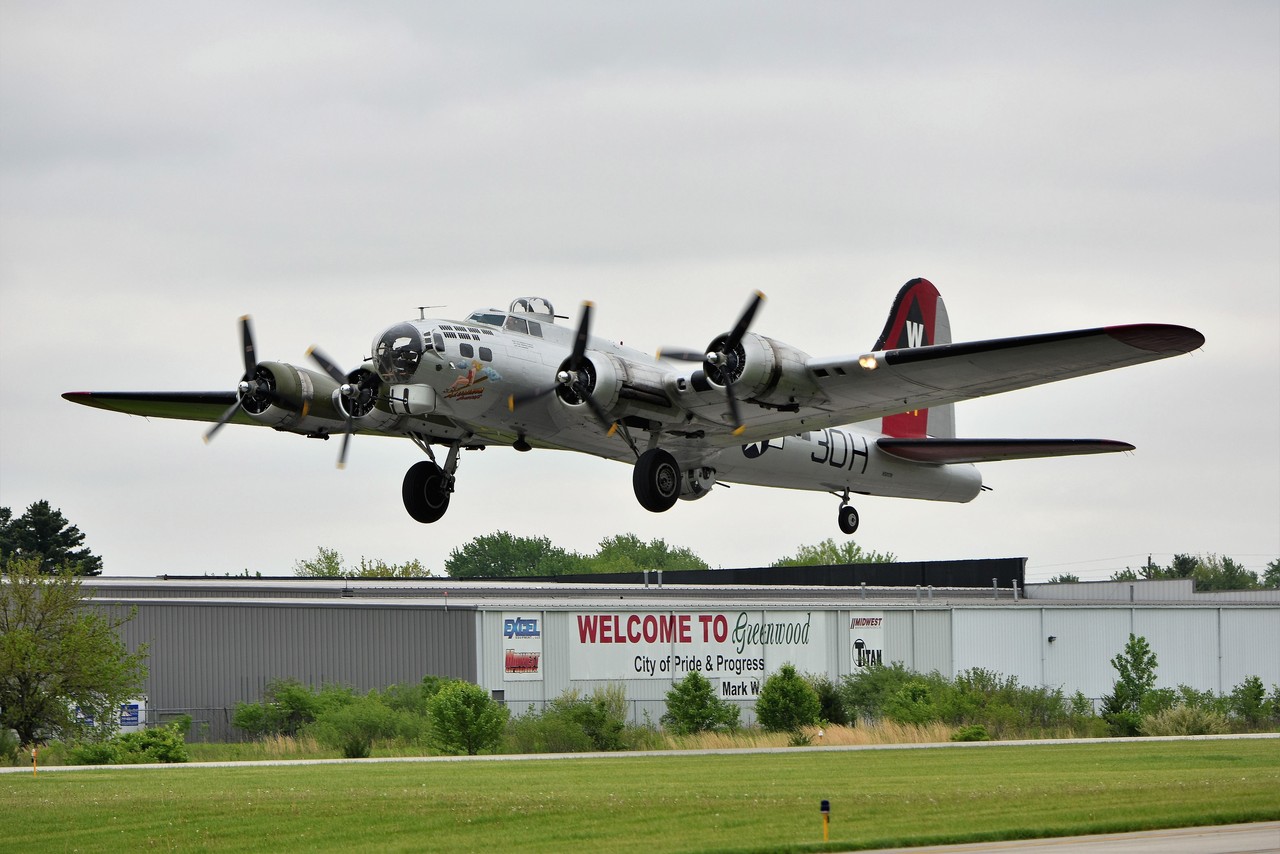
Wartime Dominance
The B-17 Flying Fortress became the backbone of the United States Army Air Forces' daylight strategic bombing campaign, participating in every theater of World War II. When Pearl Harbor was attacked on December 7, 1941, fewer than 200 B-17s were in service. By war's end, the aircraft had flown more than 291,000 combat sorties and dropped over 640,000 tons of bombs on enemy targets. The Flying Fortress earned its fearsome reputation through missions like the August 17, 1943 raid on Schweinfurt and Regensburg, where 60 B-17s were lost in a single day, yet demonstrated the aircraft's ability to absorb tremendous battle damage and return home.
The bomber's defensive armament evolved throughout the war, growing from seven .50-caliber machine guns on early models to thirteen on the final B-17G variant. This firepower, combined with formation flying tactics, allowed daylight bombing missions that complemented the Royal Air Force's nighttime raids. The aircraft served not only as a bomber but also in transport, reconnaissance, and air-sea rescue roles, proving its versatility across multiple mission profiles.
Manufacturing Achievement
Boeing's Seattle facility produced 6,981 B-17s, while Douglas Aircraft in Long Beach contributed 3,000 units and Lockheed-Vega in Burbank manufactured 2,750 examples. Production accelerated dramatically after Pearl Harbor, with monthly output reaching peak levels by 1944. The B-17F and B-17G variants represented the bulk of production, with 3,405 and 8,680 aircraft respectively. The final B-17G rolled off Lockheed's production line on July 28, 1945, exactly ten years after the prototype's maiden flight.
This manufacturing effort established records for large aircraft production that stood for decades. The three-company consortium demonstrated American industrial capacity during wartime, with quality control maintained across all production facilities through standardized tooling and inspection procedures.
The Boeing Company Legacy
The Boeing Company, founded by William Boeing in 1916, established itself as a premier aircraft manufacturer through designs like the B-17. The company's engineering team, led by project engineers including Edward Curtis Wells, created an aircraft that balanced payload, range, and defensive capabilities. Boeing's experience with the B-17 directly influenced subsequent designs including the B-29 Superfortress and established the company's reputation for large, multi-engine aircraft that continues today.
Following World War II, Boeing transitioned its bomber expertise to commercial aviation, developing aircraft like the 707 jetliner. The company remains one of the world's two major commercial aircraft manufacturers, with the B-17 representing a crucial stepping stone in its evolution from regional aircraft builder to global aerospace corporation.
Technical Innovation
The B-17 was powered by four Wright R-1820 Cyclone radial engines, each producing 1,200 horsepower in final variants. These nine-cylinder, air-cooled engines provided the reliability necessary for long-range missions over hostile territory. The aircraft's electrical system, oxygen supply for high-altitude operations, and sophisticated Norden bombsight represented cutting-edge technology for the 1930s and 1940s.
Operational crews praised the B-17's stability as a bombing platform and its ability to maintain formation flying at altitudes where German fighters struggled to operate effectively. The aircraft's service ceiling of 35,600 feet and maximum range of 2,000 miles allowed deep penetration strikes into occupied Europe. Cruising speed of 182 miles per hour enabled reasonable transit times while maintaining fuel efficiency for extended missions.
Combat Performance and Crew Experience
B-17 crews faced extraordinary dangers, with the Eighth Air Force alone losing 4,688 Flying Fortresses during European operations. Despite these losses, aircrew confidence in the B-17 remained high due to its reputation for bringing damaged aircraft home. Stories of B-17s returning with severe battle damage, including aircraft like "All American" which completed a mission despite a mid-air collision, became legendary among bomber crews.
The aircraft's ten-man crew included pilot, co-pilot, bombardier, navigator, flight engineer, radio operator, and four gunners. Training programs at bases like MacDill Field in Florida prepared crews for the complex coordination required during combat missions. Ball turret gunners, tail gunners, and waist gunners faced particularly hazardous conditions, operating in cramped, unheated positions while engaging enemy fighters.
Post-War Legacy and Preservation
The Army Air Forces rapidly retired most B-17s after 1945, with thousands sold for scrap at facilities like Kingman Army Air Field in Arizona. Today, only eight B-17s remain airworthy worldwide, while eighteen are preserved on static display in American museums. The National Museum of the United States Air Force in Dayton, Ohio, and the Museum of Flight in Seattle maintain significant B-17 exhibits.
Restoration efforts continue at facilities nationwide, with thirteen aircraft currently undergoing restoration or in storage. The Commemorative Air Force, Experimental Aircraft Association, and other organizations maintain flying examples for airshow demonstrations and historical education. These surviving aircraft serve as tangible links to the 291,508 American aircrew members who flew B-17 combat missions during World War II.