
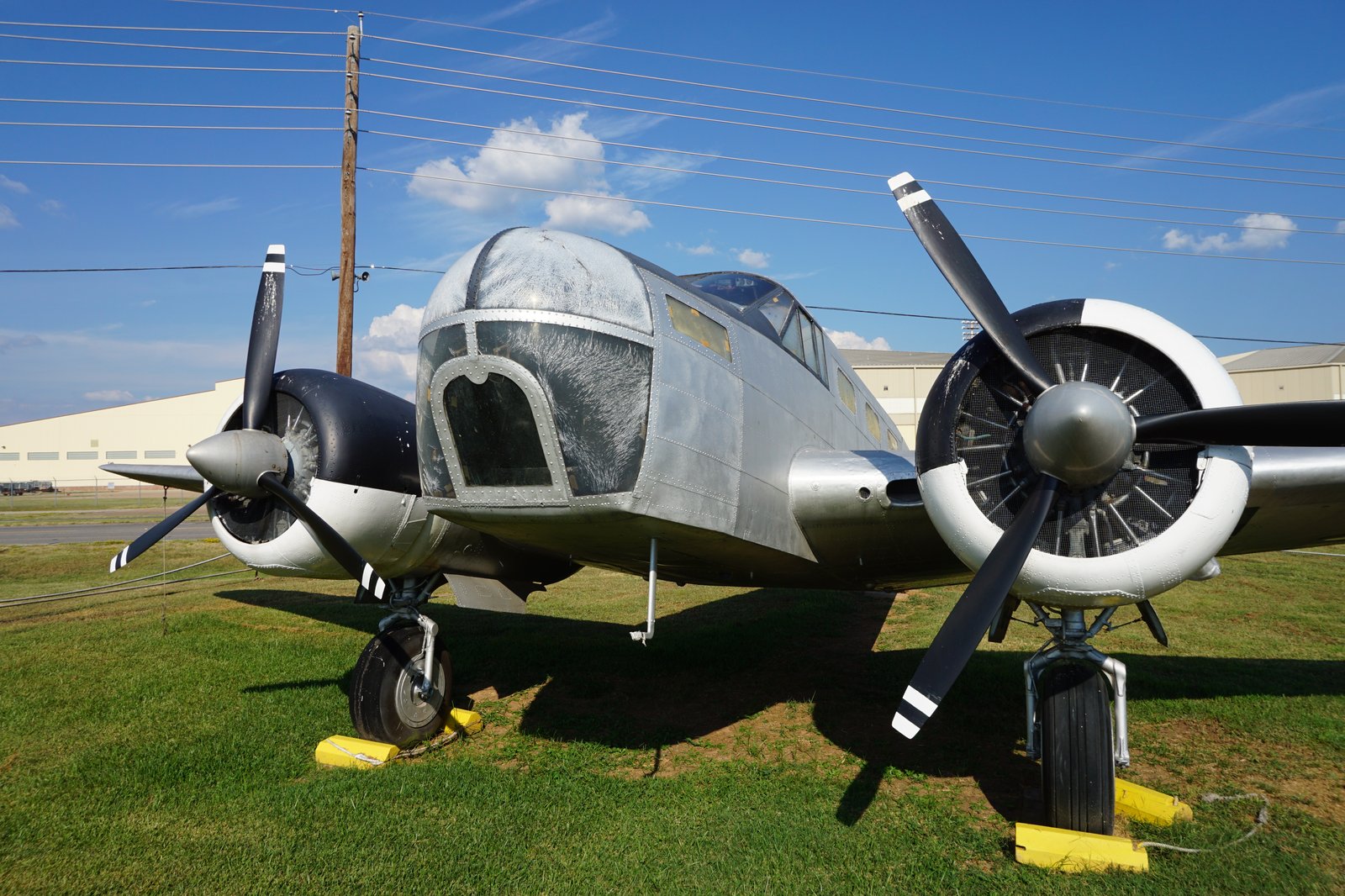
Production Legacy
The Beechcraft Model 18 established an unprecedented production record that stood for decades. Manufacturing continued uninterrupted from 1937 until November 1969, with the final H18 variant delivered in 1970 to Miyazaki Aviation College in Japan. This 32-year production span represented the longest continuous manufacturing run of any aircraft at the time. Beech Aircraft Corporation's Wichita, Kansas facilities produced over 9,000 airframes across 32 distinct variants, making it one of the most prolific aircraft designs in aviation history.
Design Innovation
Walter Beech and chief engineer Ted Wells initiated the Model 18 project in late 1935, envisioning a versatile twin-engine transport suitable for both civilian and military applications. The design team created an all-metal semimonocoque structure featuring fabric-covered control surfaces and an innovative twin-tailfin configuration reminiscent of the Lockheed Electra. Test pilots Homer "Ding" Rankin and James N. Peyton conducted the prototype's maiden flight on January 15, 1937, leading to type certification on March 4, 1937.
The aircraft's adaptability became its defining characteristic. Engineers designed provisions for skis, floats, and later tricycle landing gear configurations. The twin radial engines mounted in streamlined nacelles provided reliable power, while variable-pitch propellers enhanced performance across diverse operating conditions.
Wartime Service
World War II transformed the Model 18 into a crucial military asset. By Pearl Harbor on December 7, 1941, only 39 aircraft had been delivered, with just 29 in civilian hands. The war dramatically expanded production as the United States Army Air Forces adopted the design under multiple designations including C-45 and UC-45 for utility transport, reconnaissance, and training missions.
The Royal Canadian Air Force received 280 D18S variants, while specialized military versions included the AT-7 Navigator trainer and various transport configurations designated C-45F, C-45G, and C-45H. The aircraft served pilots, bombardiers, and navigators in training roles, proving invaluable for crew development. Notably, the Republic of China Air Force ordered six M18R light bomber variants in the late 1930s, paying $750,000 for aircraft intended for the Second Sino-Japanese War.
The Manufacturer
Walter Beech founded Beech Aircraft Corporation in 1932 after departing Travel Air, establishing operations in Wichita, Kansas. The company built its reputation on the successful Model 17 Staggerwing before launching the Model 18 project. During wartime, Beech expanded significantly, contributing to military trainer production including 1,771 of the 2,371 total AT-10 aircraft manufactured.
Beech Aircraft Corporation operated independently until Raytheon's acquisition in 1984. Following Raytheon's 2012 sale to Hawker Beechcraft, the company faced bankruptcy before Textron Aviation's purchase in 2014. Today, the Beechcraft legacy continues under Textron Aviation's ownership, maintaining the brand's reputation for quality aircraft manufacturing.
Engine Evolution
Early Model 18 variants employed various powerplants including Jacobs L-6 engines producing 330 horsepower and Wright R-760E radials generating 350 horsepower. However, the definitive configuration emerged with the prewar C18S, which standardized on Pratt & Whitney R-985 Wasp Junior engines. These nine-cylinder air-cooled radials delivered 450 horsepower each, enabling higher maximum takeoff weights reaching 9,900 pounds on later H18 variants.
The turbine conversions that earned the B18T designation represented a significant evolution. Companies like Conrad and Volpar performed 12-14 conversions between 1963 and 1964, installing turboprop engines such as the Pratt & Whitney PT6A. These modifications substantially improved performance and increased maximum takeoff weight capabilities while modernizing the classic airframe.
Performance Characteristics
The Model 18's performance envelope made it exceptionally versatile for diverse missions. Typical cruise speeds ranged from 180-200 miles per hour, while service ceilings reached 18,000-20,000 feet. Range capabilities exceeded 1,000 miles with auxiliary fuel tanks, supported by standard fuel capacity of 160 US gallons. The aircraft accommodated two crew members plus 6-11 passengers depending on configuration.
Pilots appreciated the aircraft's stable handling characteristics and reliable twin-engine safety margins. The tailwheel configuration, though later supplemented by tricycle gear options, provided excellent ground handling on unpaved airstrips. Variable-pitch propellers enhanced takeoff performance and cruise efficiency across varying operational conditions.
Enduring Legacy
The Model 18's extraordinary longevity extends far beyond its production years. Hundreds remain airworthy today, with over 240 older airframes receiving tricycle gear conversions for improved ground handling. The National Air and Space Museum preserves a Beechcraft D18S, recognizing the type's historical significance in American aviation development.
Modern B18T turbine conversions ensure continued operational relevance, combining classic aesthetics with contemporary powerplants and avionics. The aircraft's 32-variant flexibility, proven reliability, and distinctive twin-tail silhouette established design principles that influenced subsequent Beechcraft products. Its success bridged pre-war innovation with post-war utility aviation expansion, creating a lasting legacy that continues inspiring aviation enthusiasm worldwide.