
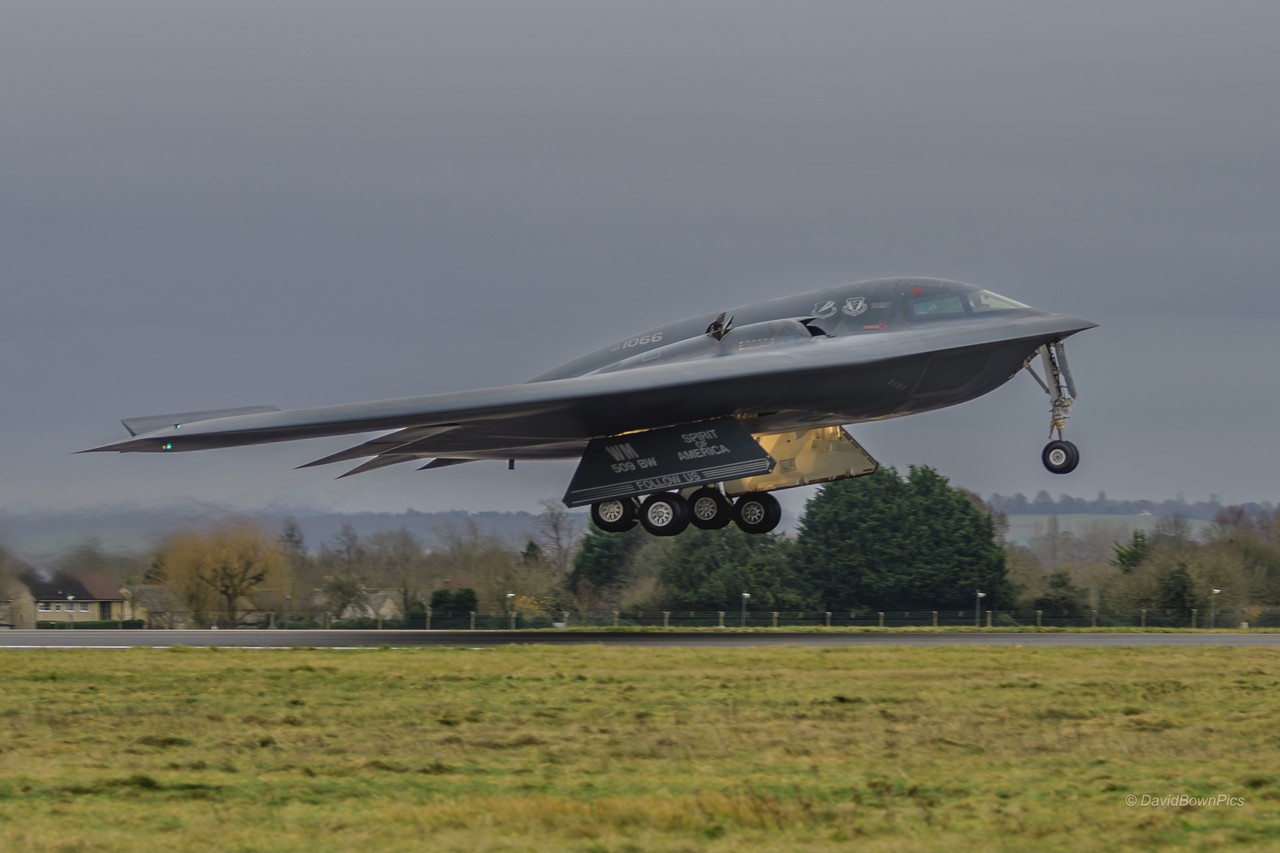
Strategic Dominance
The B-2 Spirit transformed modern warfare by providing the United States with an unparalleled strategic strike capability. During Operation Allied Force in 1999, just six B-2s destroyed 33 percent of all Serbian targets in the first eight weeks of combat, flying nonstop missions from Whiteman Air Force Base in Missouri to Kosovo and back. This combat debut validated two decades of development and demonstrated that a small number of stealth bombers could achieve what previously required massive conventional air campaigns.
Development and Innovation
Originating as the Advanced Technology Bomber program in the 1980s, the B-2 emerged from Northrop's award of the contract in 1981, with the B-2 designation assigned in 1984. The aircraft represented a revolutionary departure from previous stealth designs, abandoning the angular faceted approach used on the F-117 in favor of curved surfaces made possible by exponential increases in computing power. Engineers could now calculate radar cross-sections across entire curved surfaces rather than analyzing individual panels separately.
The flying wing configuration eliminated traditional fuselage and tail structures, creating what is essentially a short but extremely broad wing spanning 172 feet. This design philosophy traced back to Northrop's earlier flying wing experiments but incorporated decades of advancement in materials science, flight control systems, and stealth technology.
Manufacturing Legacy
Northrop Grumman Corporation served as prime contractor, manufacturing all 21 aircraft at Air Force Plant 42 in Palmdale, California between 1984 and 1997. The production team included Boeing Military Airplanes Company, Hughes Radar Systems Group, General Electric Aircraft Engine Group, and Vought Aircraft Industries. Originally planned as a 132-aircraft program, the end of the Cold War reduced requirements to the final count of 20 operational bombers plus one experimental aircraft.
Northrop Grumman continues operating today as a major defense contractor, maintaining and modernizing the remaining B-2 fleet while developing its successor, the B-21 Raider. The company's stealth expertise, pioneered with the B-2, established it as the preeminent designer of low-observable aircraft.
Propulsion and Performance
Four General Electric F118-GE-100 turbofan engines, each producing 17,300 pounds of thrust, power the B-2 through its missions. These engines are buried deep within the wing structure to minimize infrared and radar signatures, with specially designed exhaust systems that cool and disperse engine emissions. The aircraft achieves high subsonic speeds and can operate at altitudes up to 50,000 feet.
With a maximum takeoff weight of 336,500 pounds and fuel capacity of 167,000 pounds, the B-2 can deliver 40,000 pounds of ordnance across intercontinental distances. Its 6,000-nautical-mile unrefueled range enables global strike missions from a single base, though aerial refueling extends operational reach virtually anywhere on Earth.
Operational Service
Whiteman Air Force Base in Missouri remains the sole operational base for all 19 surviving B-2s, following the loss of one aircraft in a 2008 crash and retirement of another after a 2022 accident. Each bomber requires a two-person crew consisting of a pilot and mission commander, reflecting the aircraft's sophisticated systems and complex mission profiles.
The B-2 achieved full operational capability in December 2003, nearly two decades after the program began. Beyond the Kosovo conflict, B-2s flew extended missions during Operation Enduring Freedom in Afghanistan and completed their first combat deployment during Operation Iraqi Freedom, flying 49 sorties and delivering more than 1.5 million pounds of munitions.
Engineering Marvel and Cost
At approximately $2.1 billion per aircraft including development costs, the B-2 Spirit stands as the most expensive aircraft ever built. This extraordinary cost reflects the revolutionary technology integration required to achieve its stealth capabilities while maintaining the structural integrity and flight characteristics necessary for global strategic missions.
The aircraft's stealth features extend beyond its external shape to include specialized coatings, internal weapon carriage, and careful attention to every detail that might reflect radar energy. Even routine maintenance requires climate-controlled hangars to protect the radar-absorbent materials that give the B-2 its low-observable characteristics.
Future and Legacy
Scheduled for retirement by the early 2030s, the B-2 Spirit will be succeeded by the Northrop Grumman B-21 Raider, which incorporates lessons learned from three decades of B-2 operations. The B-2's legacy extends beyond its direct military impact to include advancement of stealth technology, composite materials, and fly-by-wire flight control systems that influenced subsequent aircraft design across military and civilian applications.
For thirty-five years, the B-2 has maintained America's strategic nuclear deterrent while providing unmatched conventional strike capabilities. Its ability to penetrate the most sophisticated air defense systems ensures that potential adversaries cannot create sanctuary areas beyond the reach of American military power, fundamentally altering strategic calculations worldwide.