
Design Innovation
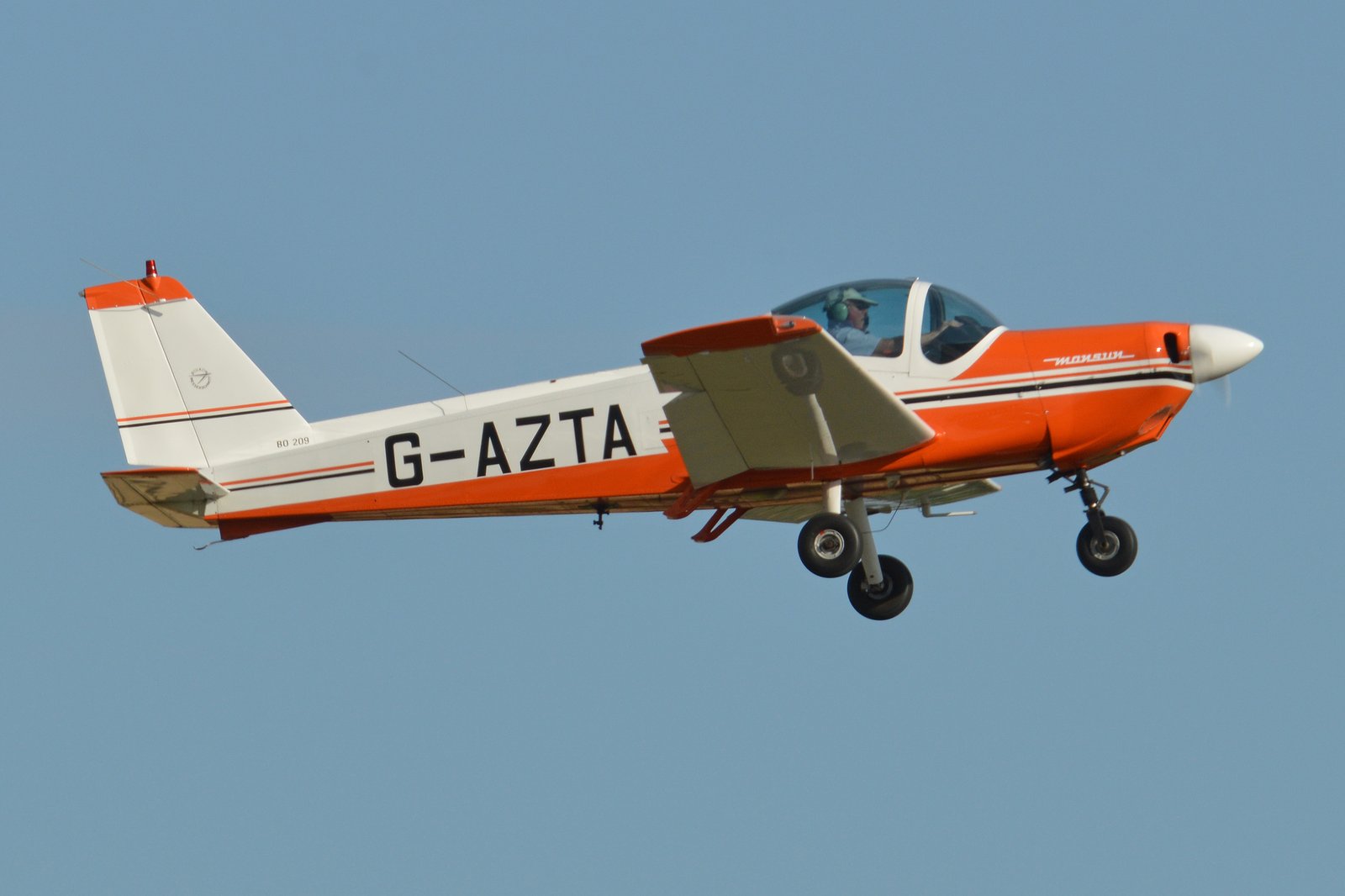
The Monsun emerged from an ambitious after-hours project undertaken by three Bölkow engineers in 1965. Led by Dr. Hermann Mylius, the company's technical director, along with Walter Heynen and Johannes Krauss, the team aimed to create a more versatile successor to the Bölkow Bo 208. Their design incorporated several groundbreaking features, most notably foldable wings that allowed the aircraft to be stored in smaller hangars and even towed behind an automobile. The aircraft was engineered to withstand up to three negative Gs and six positive Gs, making it suitable for aerobatic training and recreational flying.
Engineering Excellence
Powered by the reliable Lycoming O-320-D1A engine producing 160 horsepower, the Monsun featured side-by-side seating in a spacious cockpit that addressed pilot feedback about cramped quarters in competing aircraft. The design team incorporated hand-actuated brakes instead of conventional toe brakes, and later production variants included a retractable nose wheel. With a fuel capacity of 37 US gallons and NACA 64215 airfoil at the wing root transitioning to NACA 64212 at the tip, the aircraft achieved excellent performance characteristics for its class.
Production Reality
Following the prototype's maiden flight in December 1967, MBB formally selected the design to replace the Bo 208 in April 1969. The aircraft received its type certificate on April 9, 1970, and entered production at MBB's Laupheim factory. By the 1970 Hanover Air Show, the company had secured 57 orders, demonstrating strong initial market interest. However, production lasted only two years, from 1970 to 1972, with exactly 100 aircraft completed before MBB announced termination to focus resources on the more promising Bo 105 helicopter program.
International Markets
Of the 100 aircraft produced, Sweden became the largest operator, purchasing 60 Monsuns for use as basic trainers in their flight training programs. The aircraft's robust construction and docile handling characteristics made it well-suited for instructional use. Ten examples were imported to the United States in 1971 as part of an ambitious marketing campaign targeting the American general aviation market. Piper Aircraft showed considerable interest in the design, conducting evaluation flights and considering incorporating the Monsun into their product line, but ultimately rejected the proposal due to production cost concerns.
The Manufacturer Legacy
Bölkow, the original design company, had merged with Messerschmitt and later Blohm & Voss to form Messerschmitt-Bölkow-Blohm during the aircraft's development period. This corporate evolution reflected the consolidation occurring in the European aerospace industry during the 1960s. The company that emerged from these mergers eventually became part of what is now Airbus Defence and Space, which continues to provide support for lightweight and historic aircraft through its heritage programs.
Extended Production Attempts
After MBB terminated production in March 1972, German company Pneuma-Technik E. Ficht acquired the manufacturing rights and established Monson GmbH in November 1973. Operating from Weiden, Bavaria, this new venture aimed to continue production but managed to complete only two additional aircraft before ceasing operations in June 1974. This brief revival brought total Monsun production to 102 aircraft across all manufacturers.
Technical Performance
The Monsun's empty weight of 1,067 pounds and maximum takeoff weight of 1,808 pounds provided a useful load suitable for training and touring operations. Its wing area of 110 square feet and aspect ratio of 6.8:1 contributed to predictable flight characteristics that instructors valued. The tricycle landing gear configuration enhanced ground handling safety, particularly important for student pilots transitioning from simpler aircraft types.
Current Status
Today, surviving Monsuns represent rare examples of post-war German light aircraft engineering. At least one example, registered as ZK-MON (construction number 168), was documented as airworthy and flying in New Zealand as recently as 2009. The aircraft serves as an important historical bridge between the reconstruction of German aviation capabilities and the modern European aerospace industry. While commercial success remained limited due to production economics and intense competition in the light aircraft market, the Monsun demonstrated the technical competence and innovative thinking that would later benefit MBB's more successful helicopter programs.