
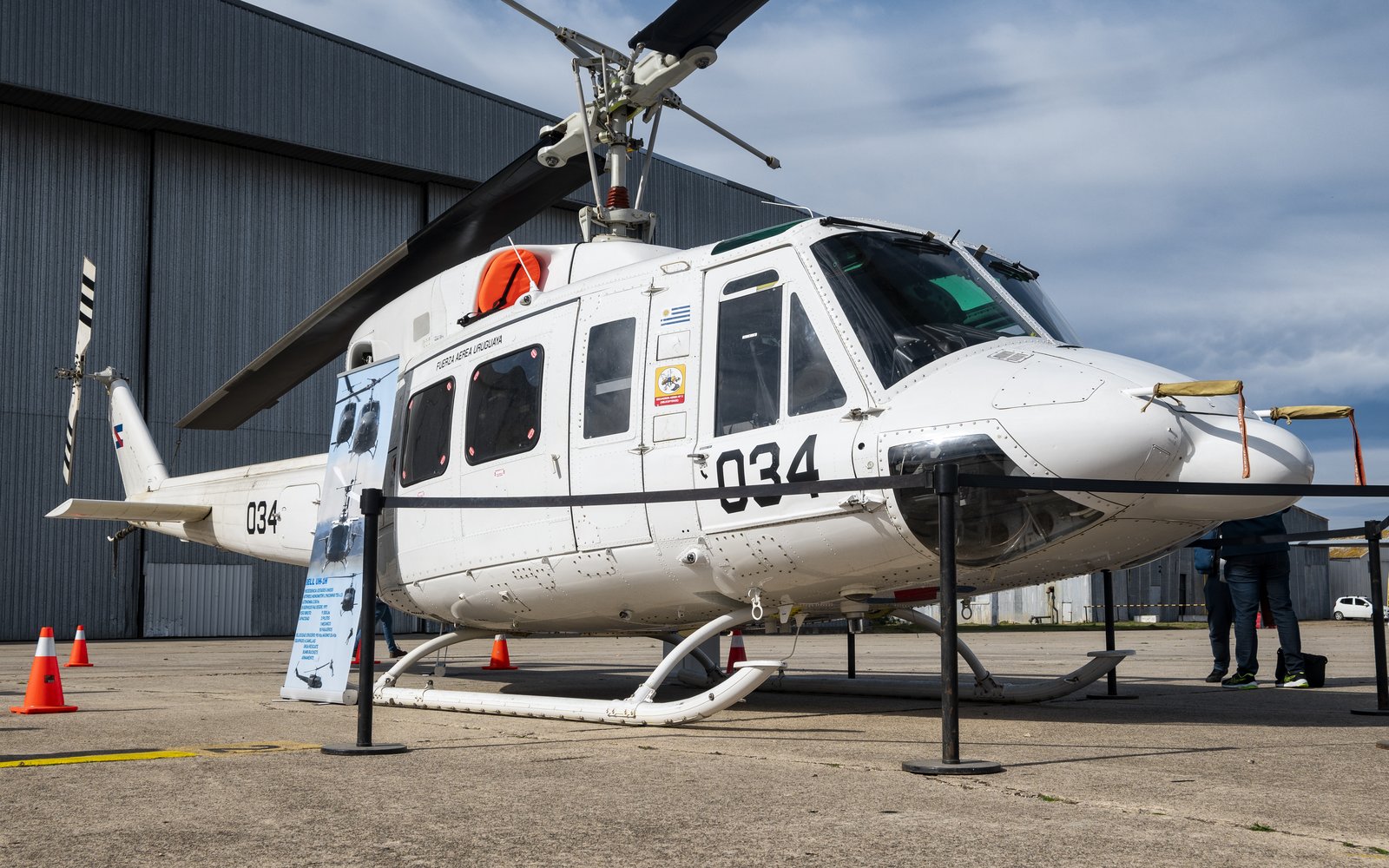
Service History
The Bell 212 achieved remarkable operational success across both military and civilian sectors, with 919 helicopters delivered during its 30-year production run. By 2021, 511 of these aircraft remained in active service, demonstrating exceptional longevity in an industry where airframes typically see shorter operational lives. The helicopter's twin-engine redundancy made it indispensable for missions where single-engine failure could prove catastrophic, establishing dominance in remote operations from Arctic resupply missions to offshore oil platform support.
Civil operators embraced the 212 for its versatility in demanding roles including aerial firefighting, law enforcement operations, and logging in remote territories. The aircraft's ability to continue flying on a single engine provided crucial safety margins that single-engine competitors could not match, making it the preferred choice for operations over inhospitable terrain or water.
Military Service
The United States military adopted the Bell 212 extensively, beginning with the UH-1N variant in 1969 for the Marine Corps and Air Force. The Navy and Marines operated 50 aircraft as HH-1N search and rescue helicopters starting in 1970, while the VH-1N served VIP transport duties from 1971. This military adoption pattern repeated internationally, with armed forces in Canada, Colombia, Croatia, Greece, Japan, Serbia, Slovenia, and Thailand incorporating the type into their fleets.
The Bell 212 achieved a historic milestone in 1979 when eight aircraft sold to China's Civil Air Authority marked the first U.S. helicopter sale to the People's Republic of China. This breakthrough opened new markets and demonstrated the aircraft's appeal across political boundaries during the Cold War era.
The Manufacturer
Bell Helicopter, founded in 1935 by Lawrence Dale Bell, had established itself as a rotorcraft pioneer through the legendary UH-1 "Huey" series before developing the 212. The company initially manufactured the 212 at its Fort Worth, Texas facility before relocating commercial helicopter production to Mirabel, Quebec, Canada in 1988. This strategic move positioned Bell closer to its Pratt & Whitney Canada engine supplier and provided access to favorable manufacturing conditions.
Licensed production expanded Bell's reach through Agusta-Bell of Italy, which manufactured the aircraft as the AB.212, including a specialized Anti-Submarine Warfare variant designated AB.212 ASW. This international partnership model became a hallmark of Bell's global strategy, combining American design expertise with local manufacturing capabilities.
Engine & Technical Innovation
The Bell 212's revolutionary Pratt & Whitney Canada PT6T-3 TwinPac engine represented a breakthrough in helicopter powerplant design. This coupled turboshaft system ingeniously paired two PT6 power turbines driving a common gearbox, creating redundancy within a single engine installation. If one turbine failed, the remaining unit could continue powering the helicopter, providing safety margins impossible with traditional single-engine configurations.
This 1,800-shaft-horsepower powerplant enabled the 212 to achieve maximum speeds of 140 mph while maintaining the reliability that made it suitable for single-pilot operations in instrument flight conditions. The PT6T's proven track record contributed significantly to the helicopter's success, as operators could depend on consistent performance across diverse environmental conditions.
Performance Characteristics
Pilots appreciated the Bell 212's predictable handling characteristics and robust performance envelope. The helicopter's maximum takeoff weight of 11,200 pounds allowed substantial payload capacity while maintaining single-engine performance margins. Its 48-foot rotor diameter provided efficient lift generation without excessive disk loading, contributing to the aircraft's ability to operate from confined areas.
The 212's speed range of 75 to 150 mph offered operational flexibility, allowing pilots to optimize flight profiles for mission requirements. Whether conducting deliberate search patterns at low speeds or transiting rapidly between locations, the aircraft delivered consistent performance that earned pilot confidence across varied operational scenarios.
Production Legacy
Bell's decision to conclude 212 production in 1998 marked the end of an era, but the aircraft's genetic legacy continued through the Bell 412. This successor incorporated a four-blade composite rotor system while retaining the twin-engine philosophy that made the 212 successful. The 412 entered production in 1979 and was also manufactured internationally, including assembly in Indonesia as the IPTN NB412.
The Bell 212's influence extended beyond direct derivatives, as its TwinPac engine concept validated coupled powerplant designs that influenced subsequent helicopter development. Today, the 511 aircraft remaining in service worldwide continue proving the design's fundamental soundness, operating in roles ranging from utility transport to specialized missions that demand twin-engine reliability. Museums and private collectors maintain additional examples, preserving this significant chapter in rotorcraft evolution for future generations to study and appreciate.