
Service History
The B-24 Liberator dominated Allied bombing operations through sheer numbers and versatility. With approximately 18,500 units manufactured between 1942 and 1945, it became the world's most produced bomber, heavy bomber, and multi-engine aircraft. The United States Army Air Forces and Royal Air Force flew B-24s on 312,734 combat sorties, dropping 634,831 tons of bombs and destroying more than 4,000 enemy aircraft. While aircrews often preferred the B-17 Flying Fortress, military leadership favored the B-24 for its superior range and payload capacity, procuring it in massive quantities.
Wartime Operations
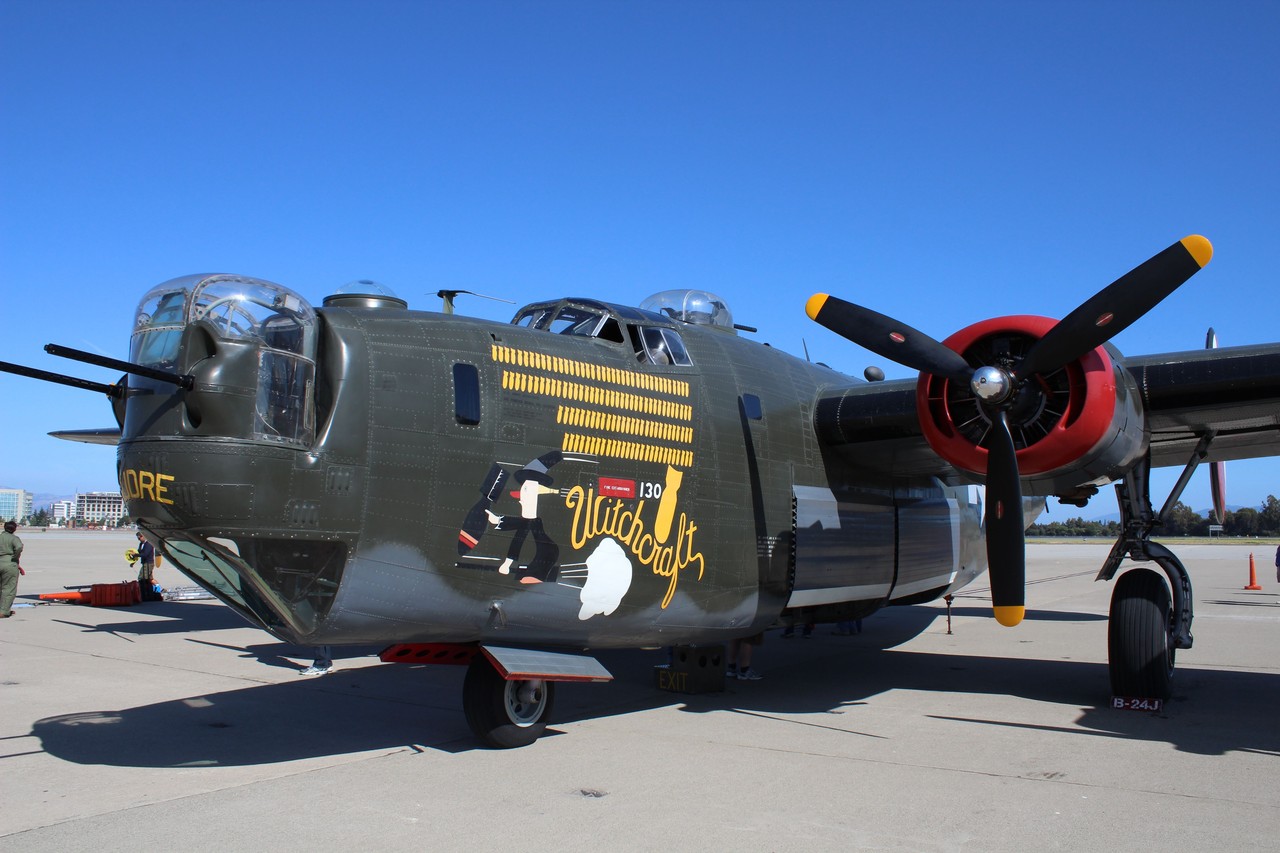
The B-24 proved invaluable in both European and Pacific theaters, with its exceptional range making it particularly effective across the vast distances of the Pacific. The aircraft served in numerous variants, beginning with the B-24A and B-24B models equipped with supercharged engines, followed by the B-24D—the first mass-produced series featuring turbocharged engines and ten defensive machine guns. Later variants included the B-24E, B-24G, B-24H, and B-24J models, each incorporating improvements in armament, engines, and operational capabilities. The bomber's twin bomb bays could accommodate up to 8,000 pounds of ordnance each, while its defensive armament of ten .50-caliber machine guns provided protection against enemy fighters.
The Manufacturer
Consolidated Aircraft Corporation of San Diego originally designed the B-24, but unprecedented wartime demand required a massive production network spanning five major facilities. Consolidated's San Diego plant produced 7,034 aircraft, while their Fort Worth facility manufactured 2,745 units. Ford Motor Company's Willow Run plant in Michigan became the star performer, producing 6,784 Liberators and demonstrating American industrial might by rolling out one aircraft every 59 minutes at peak production in 1944. North American's Dallas facility contributed 966 aircraft, while Douglas Aircraft's Tulsa plant added 964 units. By 1945, Ford's Willow Run facility alone accounted for 70 percent of monthly B-24 production despite being merely a licensed manufacturer.
Engine and Technical Innovation
Four Pratt & Whitney R-1830 Twin Wasp radial piston engines powered the B-24, with later models featuring turbocharged versions that created the aircraft's distinctive flattened oval engine nacelles. The bomber's most revolutionary feature was its Davis wing design, which provided exceptional laminar airflow and enabled the aircraft's impressive 3,700-mile range—far exceeding contemporary bombers. At 67 feet long with a 110-foot wingspan, the B-24's slab-sided fuselage maximized internal volume while maintaining structural integrity under combat conditions.
Operational Characteristics
Pilots found the B-24 demanding but capable, requiring careful attention to engine management and weight distribution. The aircraft's high wing loading and narrow landing gear made ground handling challenging, particularly when fully loaded with fuel and bombs. However, crews appreciated its spacious interior, excellent visibility from the greenhouse-style cockpit, and ability to maintain formation at high altitudes. The Liberator's service ceiling exceeded 28,000 feet, while its cruising speed of approximately 215 miles per hour made it competitive with other heavy bombers of the era.
Production Legacy
Ford's Willow Run facility epitomized American wartime production capability, featuring the world's largest assembly line at 3.5 million square feet. At peak operation, the facility employed 42,000 workers producing 650 Liberators monthly. This industrial achievement demonstrated that automobile manufacturing techniques could successfully transition to aircraft production, revolutionizing aviation manufacturing processes. The production network's efficiency enabled the United States to field bomber squadrons faster than Germany could train pilots and produce fighters to counter them.
Current Status
Today, only one airworthy B-24 Liberator remains worldwide. The Commemorative Air Force operates "Diamond Lil," preserving this historic aircraft for future generations. Several static displays exist in museums across the United States, but the extreme complexity and cost of maintaining four radial engines has prevented other restoration projects from achieving flight status. The B-24's legacy lives on through these preserved examples and the countless accounts of veterans who flew and maintained these remarkable bombers during history's greatest conflict.