
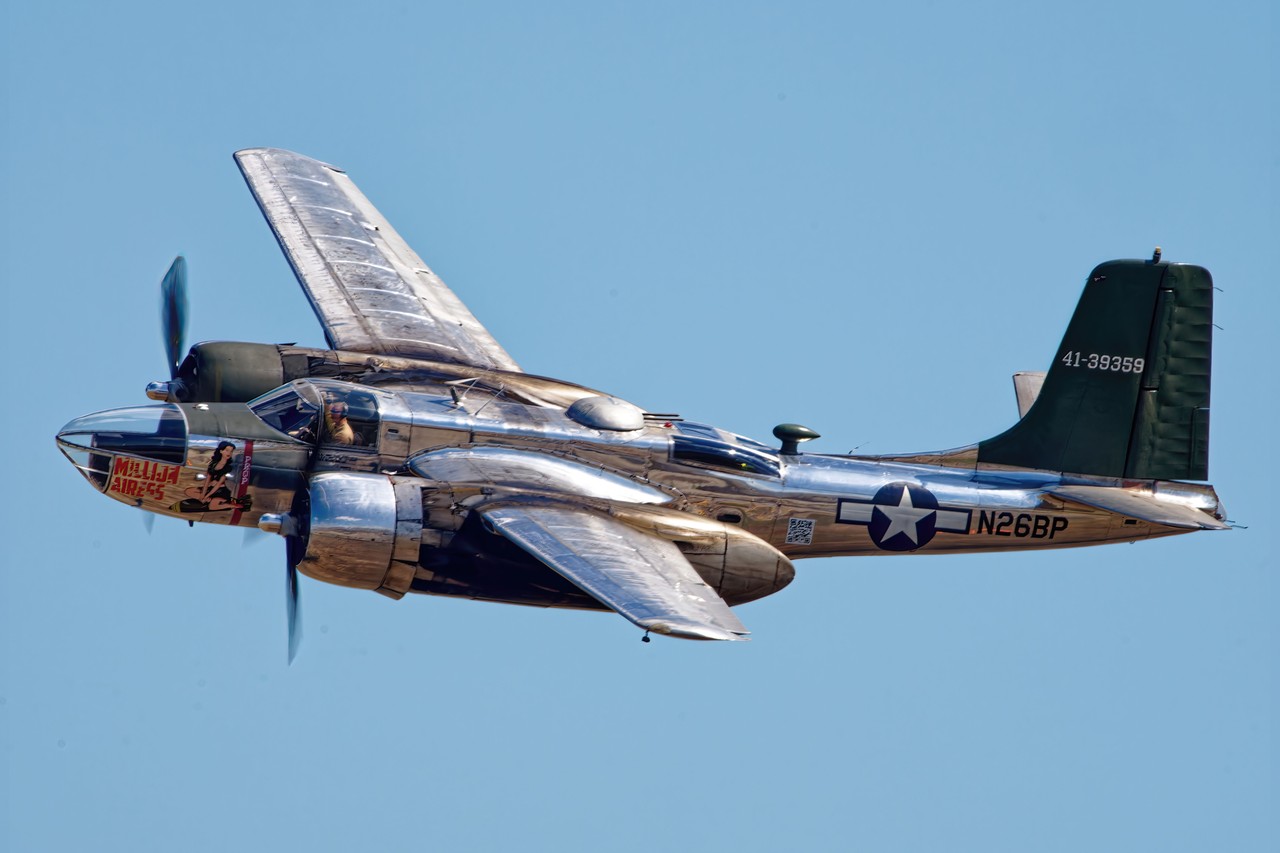
Combat Debut and Pacific Operations
The B-26 Invader entered combat on June 23, 1944, when four aircraft from the 3rd Bombardment Group's 13th Squadron attacked Japanese-held positions near Manokwari. This marked the beginning of an illustrious combat career that would span three major conflicts. The first production A-26B aircraft reached the United States Army Air Forces on September 10, 1943, with initial deliveries sent to the Southwest Pacific for field evaluation. Combat crews quickly discovered the aircraft's exceptional capabilities as both a precision bomber and devastating ground-attack platform.
In the European Theater, Douglas Invaders arrived in England during September 1944 for assignment to the 9th Air Force. These aircraft entered combat in November 1944, participating in critical missions including attacks on German supply columns during the D-Day operations and the destruction of retreating Wehrmacht tank formations. The aircraft's combination of speed, firepower, and precision made it particularly effective in the tactical bombing role.
Innovative Design and Variants
The Invader's most revolutionary feature was its interchangeable nose design. An A-26C's glazed bombardier nose could be swapped with an A-26B's solid gun nose in just a few hours, officially changing both the aircraft's designation and operational role. The A-26B variant mounted six or eight 0.50-caliber machine guns in its solid nose, while the A-26C featured a transparent nose section for precision bombing operations. Later production aircraft carried an impressive armament of 14 forward-firing machine guns, making them among the most heavily armed fighters of the era.
Production Excellence
Douglas Aircraft Company established two major production lines to meet military demands. The Long Beach, California facility produced 1,155 A-26Bs between January 1943 and September 1945, while the Tulsa, Oklahoma plant manufactured 1,291 A-26Cs and 205 additional A-26Bs. Production reached its peak in 1944, with both facilities operating at maximum capacity. The final aircraft rolled off the Tulsa production line in August 1945 following war contract cancellations.
Korean War Service
Redesignated as B-26 aircraft by the newly formed U.S. Air Force in 1948, these versatile bombers proved their worth again during the Korean conflict. The aircraft's robust construction and reliable R-2800 engines made it ideal for the demanding combat environment, where missions required both precision strikes and close air support capabilities.
Vietnam War Renaissance
The Invader experienced an unexpected renaissance during the Vietnam War through the Counter-Invader program. On Mark Engineering Company of Van Nuys, California extensively remanufactured 40 aircraft to B-26K standard, featuring upgraded 2,500-horsepower R-2800-52W engines, strengthened wings, wingtip fuel tanks, and improved braking systems. The first B-26K flew on May 30, 1964, at Van Nuys Airport.
These modernized aircraft served with the 609th Special Operations Squadron, conducting night interdiction missions along the Ho Chi Minh Trail. In May 1966, political considerations led to their redesignation as A-26A aircraft, returning to the original attack designation. The demanding operational tempo in Southeast Asia pushed these veteran airframes to their structural limits, leading to their retirement in 1969 when they reached maximum allowable flight hours.
The Douglas Aircraft Legacy
Founded in 1921 by Donald Douglas, the Douglas Aircraft Company established itself as one of America's premier aircraft manufacturers. Beyond the Invader, Douglas produced legendary aircraft including the DC-3 airliner, SBD Dauntless dive bomber, and A-4 Skyhawk jet. The company maintained its independence through both world wars before merging with McDonnell Aircraft in 1967 to form McDonnell Douglas, which Boeing acquired in 1997.
Engineering Excellence
The twin Pratt & Whitney R-2800 Double Wasp engines provided exceptional reliability and performance. These 18-cylinder radial powerplants, each producing 2,000 horsepower in standard configuration, represented the pinnacle of piston engine technology. The R-2800's reputation for durability made it the engine of choice for numerous high-performance aircraft, from the Republic P-47 Thunderbolt to the Grumman F6F Hellcat.
Operational Characteristics
Pilots praised the Invader's handling characteristics and combat effectiveness. The aircraft combined the speed of a fighter with the payload capacity of a medium bomber, creating a uniquely capable weapons platform. Its sturdy construction allowed it to absorb significant battle damage while maintaining flight capability, a crucial factor in its long service life across multiple conflicts.