
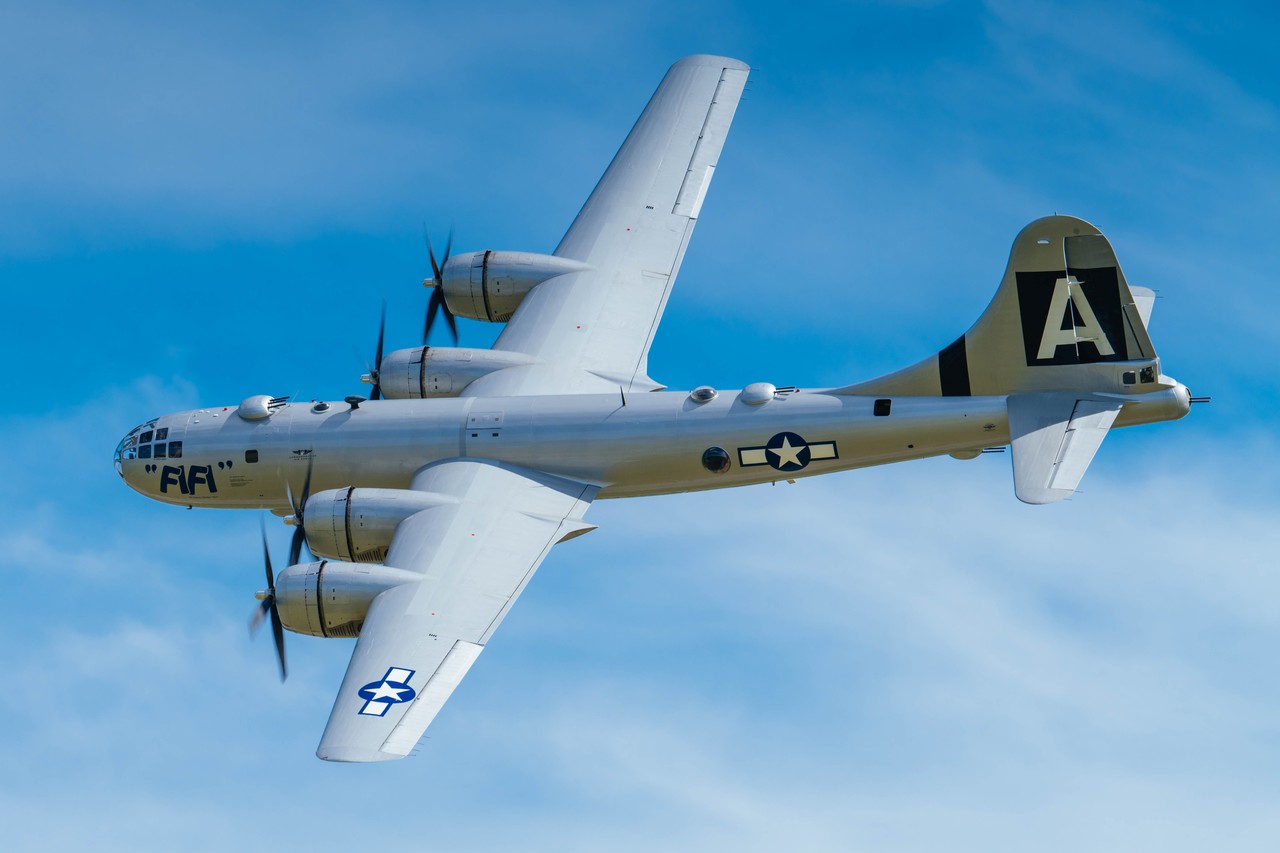
Revolutionary Design and Development
Development of the B-29 began in late 1939 as Boeing engineers created the most technologically advanced bomber ever conceived. The aircraft incorporated unprecedented features including a fully pressurized cabin allowing high-altitude operations above 30,000 feet, remote-controlled gun turrets operated by gunners inside the pressurized compartments, and sophisticated electronic fire control systems. The initial XB-29 prototype crashed on February 18, 1943, during testing due to chronic overheating problems with its Wright R-3350 engines, highlighting the technical challenges of pushing aviation technology to its limits.
Industrial Manufacturing Marvel
In February 1942, the Army Air Forces made the unprecedented decision to order B-29 production across multiple manufacturers simultaneously before testing was complete. This massive industrial undertaking involved four primary assembly plants: Boeing's Wichita facility produced 1,769 aircraft, Boeing Renton built 1,122, Bell Aircraft in Marietta manufactured 668, and Glenn L. Martin's Omaha plant constructed 536 Superfortresses. The intensive effort at Boeing-Wichita during March and April 1944 became legendary as the "Battle of Kansas," where 15,000 workers including farmhands and housewives worked 10-hour shifts around the clock to prepare the first B-29s for overseas combat.
Production accelerated rapidly from the first aircraft in September 1943. By January 1944, the 100th B-29 entered service, followed by the 500th in July 1944, the 1,000th in November 1944, and the 2,000th by March 1945. Peak monthly production reached 375 aircraft before the program concluded in May 1946 with 3,970 total Superfortresses built.
Pacific Theater Dominance
The B-29 entered combat less than two years after its maiden flight, deployed exclusively in the Pacific Theater against Japan. Operating from bases in China, India, and later the Mariana Islands, Superfortresses conducted devastating strategic bombing campaigns against Japanese industrial targets. The aircraft's pressurized cabin allowed crews to operate effectively at altitudes where Japanese fighters struggled to intercept, while its 3,250-mile range enabled strikes deep into enemy territory from distant bases.
Colonel Paul Tibbets personally selected a Martin-built B-29-45-MO on the production line in Omaha on May 9, 1945, which became the Enola Gay. This aircraft achieved eternal historical significance on August 6, 1945, when it dropped the first atomic weapon used in combat on Hiroshima. Three days later, another Martin-built Superfortress named Bockscar delivered the second atomic bomb to Nagasaki, effectively ending World War II and demonstrating American technological supremacy.
Wright R-3350 Powerplant
Four Wright R-3350 Duplex-Cyclone radial engines powered each B-29, generating 2,200 horsepower per engine. These massive 18-cylinder powerplants initially suffered chronic overheating problems that plagued early testing and caused the second prototype's fatal crash. Wright engineers eventually resolved these issues through improved cooling systems and operational procedures, though the R-3350 remained demanding throughout the B-29's service life. The engines enabled cruising speeds of 230 miles per hour at 25,000 feet with maximum speeds exceeding 350 miles per hour.
Boeing's Engineering Legacy
The Boeing Company, founded in 1916 by William Boeing, established itself as America's premier military aircraft manufacturer through the B-29 program. Boeing's Seattle headquarters coordinated the massive multi-plant production effort while its Wichita facility became the program's largest single producer. Today, Boeing continues as a global aerospace leader, though Spirit AeroSystems now operates the former Wichita B-29 plant. The engineering expertise gained from the Superfortress program directly contributed to Boeing's post-war success in both military and commercial aviation.
Post-War Service and Preservation
The B-29 continued serving the newly formed United States Air Force throughout the 1950s in various roles including strategic bombing, reconnaissance, and aerial refueling. During the Korean War, Superfortresses conducted extensive bombing campaigns against North Korean and Chinese forces. The type was gradually retired in the early 1960s as jet-powered bombers assumed strategic roles.
Today, fewer than 30 B-29s survive worldwide, with only a handful remaining airworthy. The most famous survivor, Enola Gay, underwent complete restoration and is displayed at the Smithsonian's National Air and Space Museum. Another notable example, "Doc," was discovered in 1987 and returned to flight status in 2016 through extensive volunteer restoration efforts, allowing modern audiences to witness the Superfortress in its natural element.