
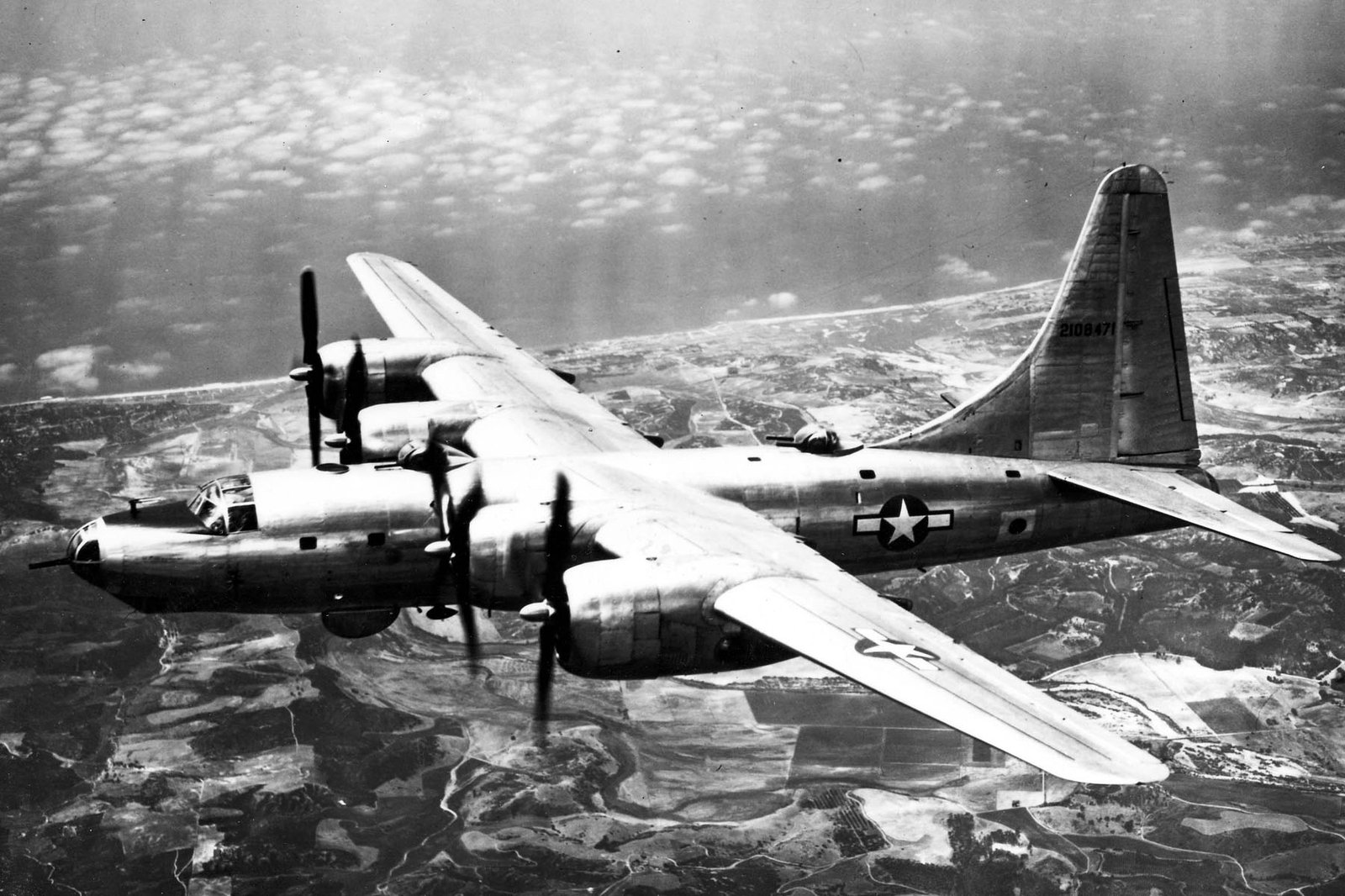
The Consolidated B-32 Dominator was conceived in 1939–1940 as a replacement for the B-17 and B-24, designed to offer higher speeds, greater range, and heavier bomb loads. The United States Army Air Forces (USAAF) commissioned the aircraft specifically as a fallback design in case the Boeing B-29 Superfortress program failed. Developed by Consolidated Aircraft's engineering team, the prototype XB-32 first flew on September 7, 1942. The aircraft was designed as a very heavy bomber with a gross weight of approximately 100,000 lb, featuring a wingspan of 135 feet and a length of 82 feet 1 inch.
Production occurred primarily between 1944 and 1945. While the USAAF initially ordered 300 aircraft and later expanded orders to 1,500, the program was terminated on October 12, 1945. A total of 118 airframes were built, including three prototypes. Manufacturing took place at the Consolidated Vultee (Convair) plant in Fort Worth, Texas, which produced 74 B-32s and 40 TB-32 trainers, and the San Diego, California plant, which produced one aircraft. Consolidated Aircraft had merged with Vultee Aircraft in 1943 to form Consolidated Vultee Aircraft Corporation, commonly known as Convair.
Technically, the B-32 was powered by four Wright R-3350-23 Duplex Cyclone 18-cylinder air-cooled radial engines, each producing 2,200 horsepower and equipped with two turbochargers and four-bladed constant-speed propellers. This configuration allowed for a maximum speed of 357 mph at 30,000 feet and a combat range of approximately 3,800 miles. For defense, it carried ten 0.50-inch Browning machine guns in powered turrets and could carry a maximum bomb load of 20,000 lb.
Operational service was limited to the Pacific Theater, with the 386th Bombardment Squadron (Heavy) serving as the primary combat unit. B-32s arrived in the Philippines in mid-May 1945, with aircraft such as serial number 42-108532, "Hobo Queen II," among the first deployed. The squadron flew six combat bombing missions against targets in Formosa before moving to Okinawa to conduct ocean search and photo-reconnaissance over the Japanese Home Islands. The B-32 is historically significant as the last Allied aircraft type to engage in air combat during World War II; a reconnaissance mission on August 28, 1945, resulted in the last American fatality in air combat of the war. Following the program's cancellation, all surviving B-32s were stored and scrapped, leaving no complete airframes in existence today.