
Service History
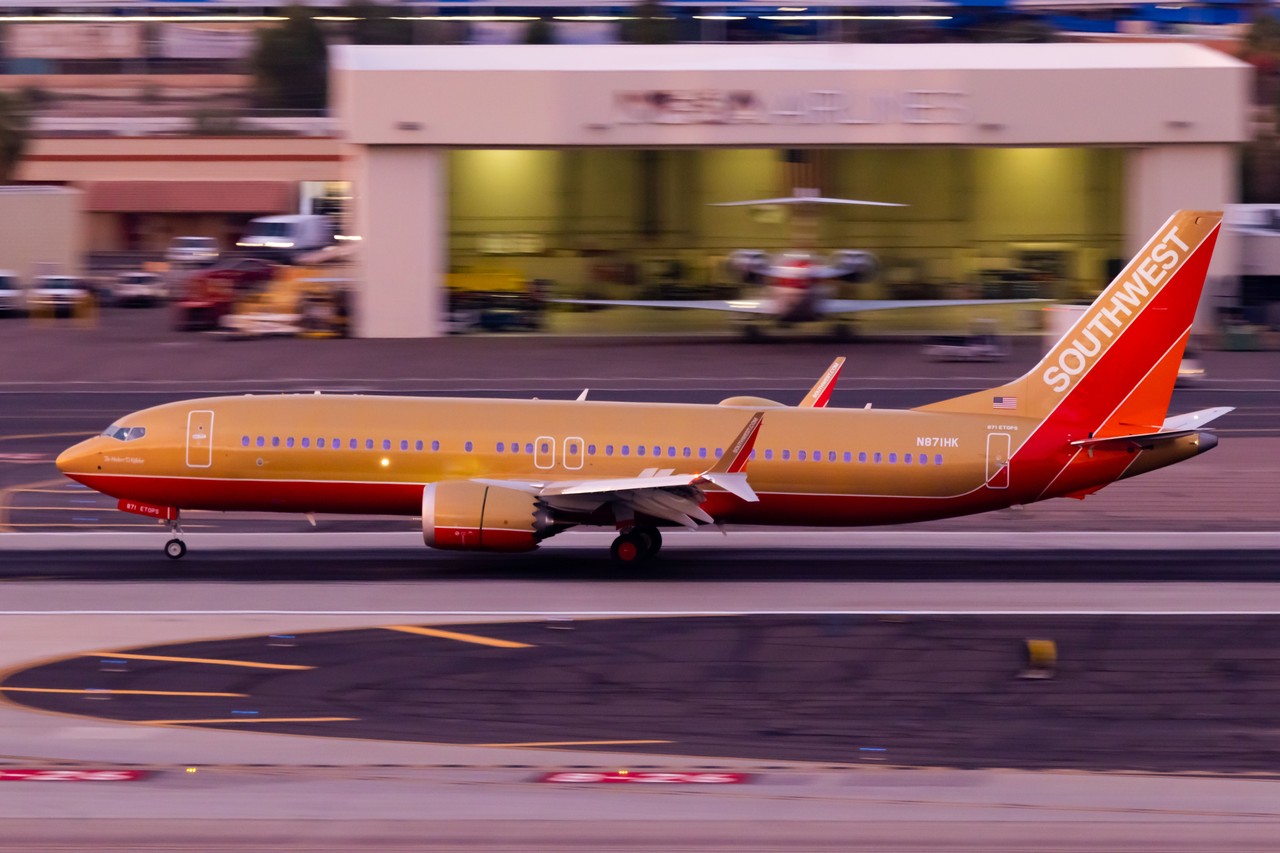
The 737 MAX 8 entered commercial service in May 2017 with Malaysian carrier Malindo Air, marking Boeing's ambitious attempt to recapture market share from Airbus in the critical narrow-body segment. Within its first year of operation, the aircraft accumulated over one million passenger miles across multiple airlines worldwide. Southwest Airlines emerged as the largest MAX operator, initially ordering 234 MAX 7 variants before shifting focus to the MAX 8 configuration. Other significant early adopters included Air China, Alaska Airlines, and India's Akasa Air, which placed a substantial 72-aircraft order in November 2021.
The aircraft's service record was dramatically interrupted by two fatal accidents within five months. Lion Air Flight 610 crashed on October 29, 2018, followed by Ethiopian Airlines Flight 302 on March 10, 2019, both attributed to failures in the Maneuvering Characteristics Augmentation System (MCAS). These tragedies resulted in a global grounding from March 2019 through November 2020, fundamentally reshaping aviation safety protocols and regulatory oversight.
The Manufacturer
Boeing Commercial Airplanes developed the MAX series as Boeing's survival response to Airbus's technological advancement. The Boeing Company traces its origins to July 15, 1916, when William E. Boeing founded Boeing Airplane Company in Seattle. Through strategic acquisitions of Rockwell International in 1996 and McDonnell Douglas in 1997, Boeing consolidated American aerospace manufacturing under one corporate umbrella. The company pioneered commercial jet aviation with the 707 in 1958 and has delivered over 11,000 aircraft in the 737 family since the original variant's debut in 1967.
The MAX program represented a $4 billion development investment, conceived as Boeing's answer to the Airbus A320neo's market success. Rather than designing an entirely new aircraft, Boeing chose to re-engine the proven 737 platform, maintaining pilot type-rating commonality with previous 737 generations—a decision that would later prove controversial during the MCAS investigation.
Engine & Technical Innovation
The MAX 8's defining feature is its twin CFM International LEAP-1B engines, each producing approximately 28,000 pounds of thrust. These advanced turbofans, manufactured by the joint venture between GE Aerospace and Safran Aircraft Engines, deliver 14 percent improved fuel efficiency compared to the previous CFM56 powerplants. The larger engine diameter necessitated repositioning the powerplants higher on the wing and incorporating advanced engine mounts to maintain ground clearance.
Boeing equipped the aircraft with distinctive split-tip winglets and refined aerodynamics throughout the airframe. The cockpit retained essential commonality with 737 Next Generation variants, requiring only differences training rather than complete pilot recertification. However, the introduction of MCAS to compensate for pitch-up tendencies caused by the repositioned engines created unforeseen handling characteristics that ultimately contributed to the type's grounding.
Performance Specifications
The MAX 8 cruises at Mach 0.79 (approximately 521 knots) with a service ceiling of 41,000 feet. In typical two-class configuration, the aircraft accommodates 178 passengers, though high-density variants can seat up to 210. The Boeing Business Jet MAX 8 variant extends range to 6,640 nautical miles for executive operations. Standard commercial variants maintain a 3,850-nautical-mile range, sufficient for transcontinental routes while optimized for short- to medium-haul operations.
Production & Legacy
Boeing initiated MAX 8 production on August 13, 2015, when Spirit AeroSystems completed the first fuselage assembly in Wichita, Kansas. The initial complete aircraft rolled out December 8, 2015, at Boeing's historic Renton Factory south of Seattle, which has served as 737 final assembly headquarters since December 1970. Boeing established additional completion facilities in Zhoushan, China, delivering their first MAX to Air China on December 15, 2018.
As of 2025, Boeing has built over 560 MAX 8 aircraft from the broader MAX family's 7,000-plus firm orders from more than 100 operators worldwide. Production rates climbed from 38 aircraft monthly in 2023 toward a planned 52 monthly by January 2025, though the January 2024 Alaska Airlines Flight 1282 door plug incident temporarily slowed expansion plans. Despite its troubled introduction, the MAX 8 remains central to Boeing's narrow-body strategy and continues operating across global route networks, symbolizing both the promise and perils of evolutionary aircraft design in competitive commercial markets.