
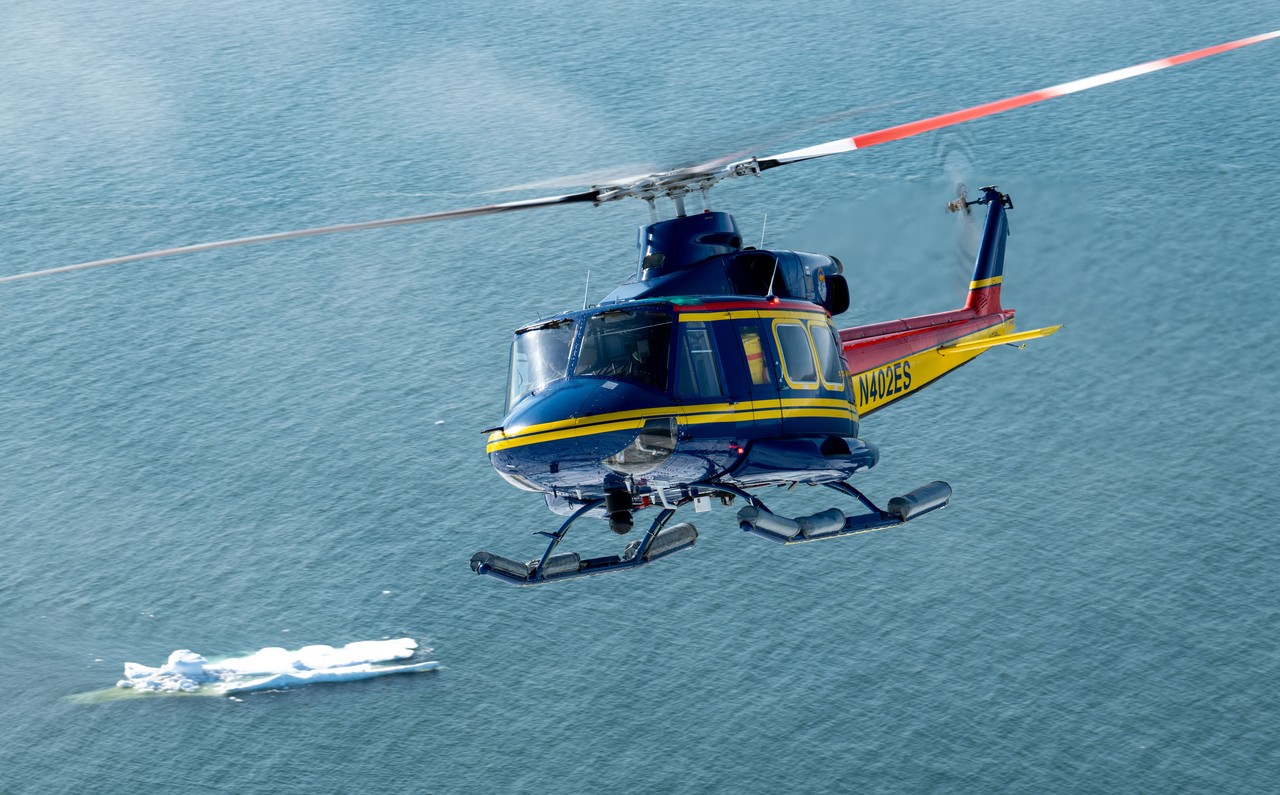
Development and Innovation
Bell Helicopter launched the 412 program in the late 1970s by converting two Bell 212 helicopters into prototypes, seeking to create a more capable utility helicopter. The company's engineers replaced the 212's traditional two-blade rotor system with an advanced four-blade composite main rotor of smaller diameter, dramatically improving performance and handling characteristics. This innovation became the defining feature that set the 412 apart from its predecessors in the legendary UH-1 Huey family lineage dating back to 1959.
The Federal Aviation Administration certified the initial model in January 1981, with Bell commencing deliveries the same month from its Texas facility. Production began with serial numbers starting at 33001 for the 221 units manufactured in Texas before Bell transferred operations to its Mirabel, Canada plant in 1989, where subsequent aircraft carried serial numbers beginning with 36001.
Military Dominance
Military markets absorbed approximately half of total Bell 412 production, with the helicopter proving exceptionally adaptable to combat and support roles. The Canadian Armed Forces became the largest single military operator, taking delivery of 100 CH-146 Griffon variants developed specifically for Canadian operations in the early 1990s. These aircraft, manufactured at Bell's Mirabel facility, served as utility transport helicopters capable of carrying troops, supplies, and conducting search and rescue missions.
The United States Marine Corps operated 170 examples of the UH-1Y Venom variant, while the Japan Ground Self Defense Force selected the type for domestic operations. Italian military forces also incorporated the 412 into their helicopter fleets, demonstrating the aircraft's international appeal for military applications.
The Manufacturer's Legacy
Bell Helicopter, originally founded as Bell Aircraft Corporation in 1935, established itself as a pioneering rotorcraft manufacturer through innovations like the 412. Now operating as Bell Textron, the company licensed production to international partners including Agusta in Italy, which built aircraft designated as the Agusta-Bell AB412, Indonesian Aerospace in Indonesia, and Fuji Heavy Industries (Subaru) in Japan. These partnerships produced 315 additional units beyond Bell's own manufacturing output.
The company's decision to maintain continuous production for over four decades reflects both the fundamental soundness of the 412's design and Bell's commitment to incremental improvement. This manufacturing philosophy enabled Bell to develop eleven distinct variants while maintaining production efficiency and operator confidence.
Powerplant Excellence
Two Pratt & Whitney Canada PT6T-3BE Twin-Pac turboshaft engines power the Bell 412, establishing an industry benchmark for reliability and safety. These twin-turbine powerplants achieved the lowest in-flight shutdown rate among aircraft turboshaft engines, a critical factor for operators conducting missions over water or hostile terrain. The engines' emergency capability allows a single powerplant to provide emergency power for 30 minutes following the failure of its partner, significantly enhancing crew and passenger survival prospects.
The latest Subaru Bell 412 EPX variant incorporates engines certified to operate without oil for up to 30 minutes, providing an additional safety margin during emergency situations. This run-dry capability represents a significant advancement in helicopter powerplant technology.
Civil Market Success
Of the 1,719 total aircraft produced, 775 units served civil markets, with 610 remaining active in commercial operations. Offshore oil and gas companies drove early demand for the type, requiring helicopters capable of transporting workers and equipment to drilling platforms in challenging weather conditions. The 412's twin-engine reliability and 4,500-pound internal cargo capacity made it ideally suited for these demanding operations.
Emergency medical services, search and rescue organizations, and corporate operators also embraced the 412 for its versatility and performance. The helicopter's ability to accommodate 13 passengers in airline-style seating or reconfigure for cargo transport provided operators with exceptional flexibility.
Performance and Capabilities
Operating with a crew of one or two pilots, the Bell 412 achieves a top speed of 161 mph and maintains a service ceiling of 20,000 feet. The aircraft's 463-mile range enables extended missions without refueling, while its 15-foot height and 56-foot overall length allow operations from confined landing sites. The 412SP variant, produced from 1984 to 1990, featured increased maximum takeoff weight of 11,900 pounds and expanded fuel capacity of 330 gallons.
Model Evolution and Legacy
Bell's systematic development approach produced a steady stream of improvements: the original 412 (1981), 412SP with enhanced performance (1984-1990), 412HP featuring improved transmission (1991), 412EP incorporating dual digital automatic flight control systems, 412EPi, and the current 412EPX with 11 percent greater horsepower capability.
Production continues today, demonstrating the enduring value of the 412's basic design. After more than 45 years of manufacturing and over 6.5 million accumulated flight hours, the Bell 412 has established itself as one of the most successful utility helicopters ever created, serving operators across six continents in roles ranging from executive transport to combat support missions.