
Service History
The Bell 47 dominated early civilian helicopter operations after receiving the world's first commercial helicopter type certificate (CAA H-1) on March 8, 1946. The first civilian delivery occurred on December 31, 1946, to Helicopter Air Transport, America's first civilian helicopter operator. During the Korean War from 1950 to 1953, production prioritized military variants designated H-13 Sioux, forcing civilian deliveries to be delayed until after the 1953 armistice. By the mid-1950s, the aircraft had established helicopter operations across multiple sectors including sightseeing, cargo transport, medical evacuation, and general aviation.
Military Service
Designated H-13 Sioux in military service, the Bell 47 served with distinction during the Korean War and throughout the Cold War era. The United States Air Force, Navy, and Army operated the aircraft beginning with Navy orders in 1947 and Army adoption in 1948. Military missions included liaison duties, observation, transport, medical evacuation, and pilot training. The H-13G variant, corresponding to the civilian 47G model, became the most produced military version with more than 3,300 units built. International military operators included the United Kingdom, which operated Westland-licensed Sioux helicopters.
The Manufacturer
Bell Aircraft Corporation was founded in 1935 by Lawrence Dale Bell, initially focusing on fixed-wing aircraft including World War II fighters such as the P-39 Airacobra and P-59 Airacomet. The company entered helicopter development under the leadership of designer Arthur M. Young, whose Model 30 prototypes from 1942-1943 evolved into the Bell 47. In 1951, Bell's helicopter division relocated to Fort Worth, Texas, where production of the 47G variant began in March 1954. Bell Helicopter merged into Textron in 1985 and continues operations today as Bell Textron Inc. In 2010, type certificates for all Bell 47 models transferred to Scott's Helicopter Service in Le Sueur, Minnesota, which maintains parts production and helicopter manufacturing.
Engine and Technical Innovation
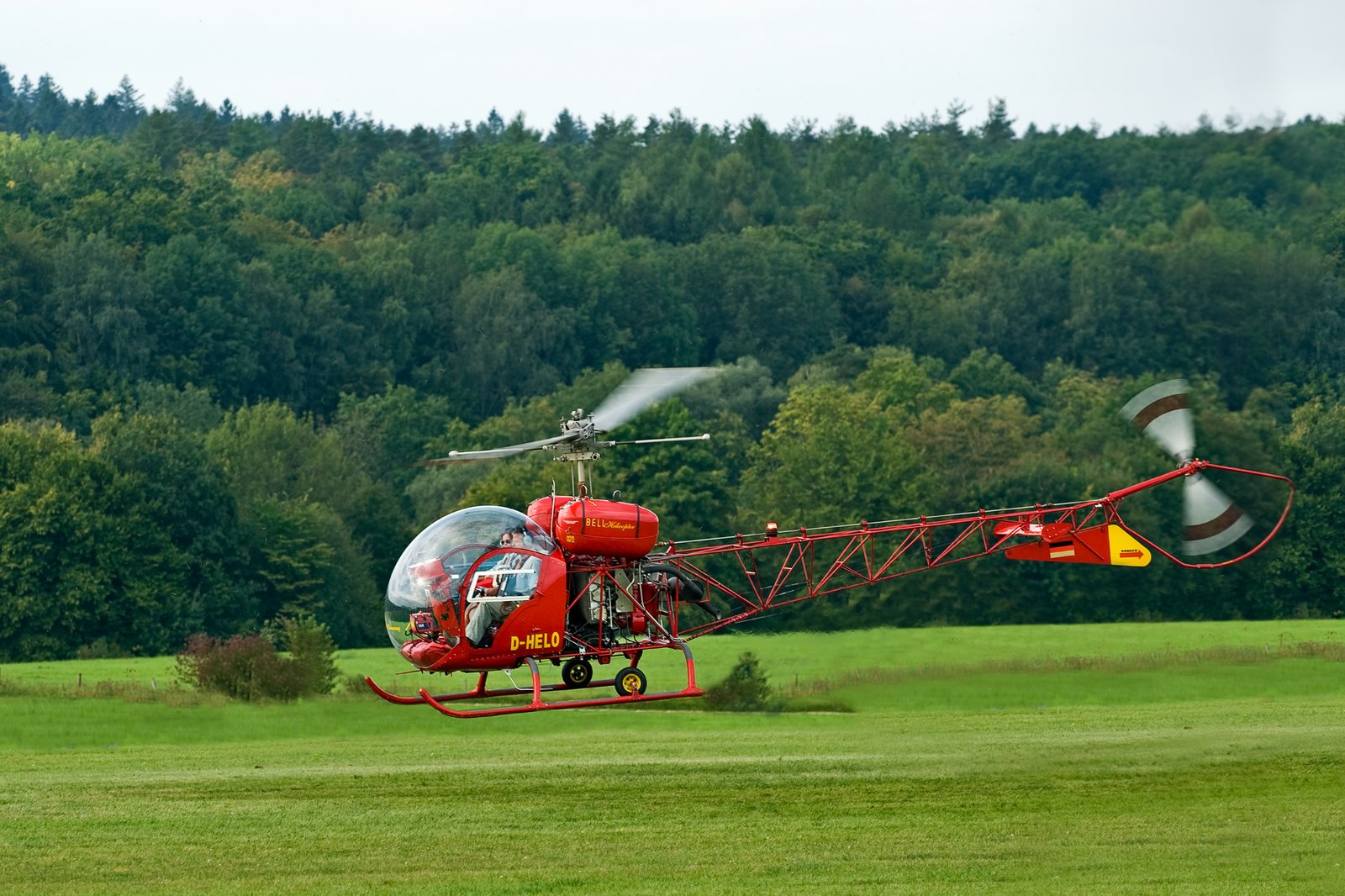
The Bell 47 utilized vertically mounted piston engines ranging from 175 to 305 horsepower, supplied by Franklin and Lycoming manufacturers. Common powerplants included the Lycoming TVO-435-F1A producing 280 horsepower in early models, the Franklin 200-horsepower engine in the 47G variant, and the Lycoming VO-435 in the 47G-2. Arthur M. Young's design innovations included the fully enclosed "goldfish bowl" Plexiglas cockpit introduced with the 47G in 1953, an open lattice tail boom for weight reduction, and a simple two-bladed rotor system. The vertical engine mounting enabled a compact design while maintaining center of gravity balance.
Performance and Pilot Experience
The Bell 47 achieved a cruise speed of 84 miles per hour with a maximum speed of 105 miles per hour and could carry payloads up to 1,057 pounds. On September 17, 1952, pilot Elton J. Smith established a helicopter range record that still stands today, flying a 47D-1 variant 1,958.8 kilometers from Hurst, Texas, to Buffalo, New York. The aircraft's handling characteristics made it suitable for both novice and experienced pilots, contributing to its widespread adoption for training purposes. Its reliability and relatively simple maintenance requirements enabled operations in diverse environments from urban centers to remote locations.
Production and Legacy
Bell manufactured more than 5,600 Bell 47 helicopters between 1946 and 1973, with licensed production adding to the total through Agusta in Italy (1954-1979), Kawasaki in Japan (until 1979, producing the KH-4 variant), and Westland in the United Kingdom. The 47G variant alone accounted for more than 3,300 units, making it the most prolific version. Approximately 1,000 Bell 47s remain airworthy worldwide as of recent counts, with over 1,068 registered with the FAA in the United States and 15 in the United Kingdom as of 2010-2011. Notable museum examples include NC-3H (the fifth aircraft built in 1946) at the Niagara Aerospace Museum in New York and a 1946 Bell 47/H-13E at the Connecticut Air & Space Center. The aircraft gained additional cultural significance through appearances in the television series MAS*H, cementing its place as an icon of early rotorcraft development.