
Service History
The Bell 47B-3 carved its niche in the emerging commercial helicopter market of the late 1940s, focusing primarily on agricultural applications and utility operations. Unlike its military counterparts, the 47B-3 was purpose-built for civilian operators seeking versatile rotorcraft solutions. The variant gained particular significance in Canada, where aircraft CF-FJA became the country's first imported helicopter in 1947, operating with Okanagan Helicopters for over 16 years until its export on December 4, 1963.
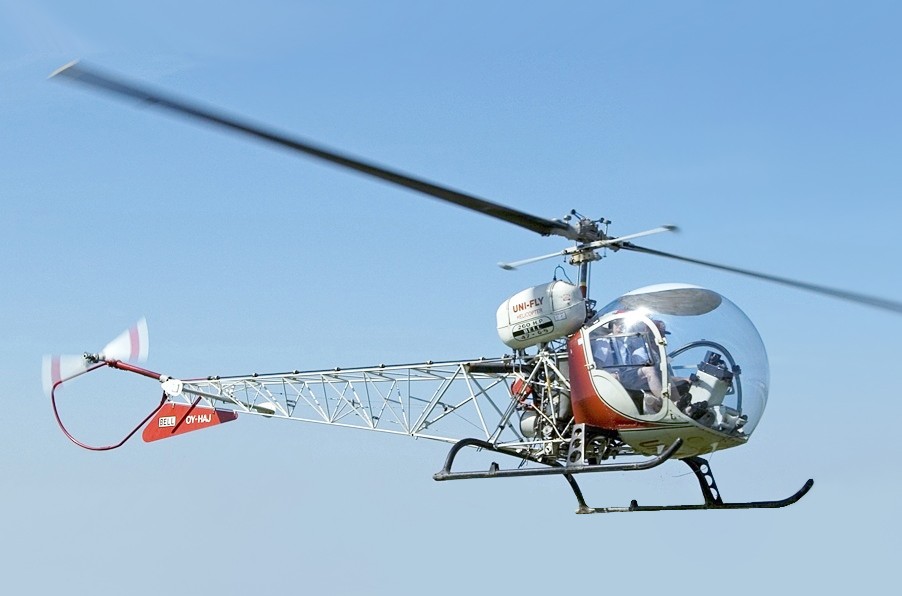
The 47B-3's agricultural capabilities revolutionized crop dusting and spraying operations, offering unprecedented access to difficult terrain that fixed-wing aircraft couldn't reach. Its open cockpit configuration with windshield provided pilots with exceptional visibility for precision work, while rear-view mirrors enhanced operational safety during low-altitude missions.
The Manufacturer
Bell Aircraft Corporation, founded by Lawrence Bell in the early 1930s, had established itself as a major defense contractor by World War II. At its peak in 1941, the company employed 32,022 workers at its Niagara Falls, New York plant, producing 9,588 P-39 Airacobras and over 3,600 P-63 Kingcobras for the war effort. Following the conflict's end, Bell strategically pivoted toward helicopter development, recognizing the commercial potential of rotorcraft technology.
The company diversified rapidly, establishing subsidiaries including Wheelabrator Corporation and Bell Automation by late 1946. Bell Helicopter eventually became a separate division, ultimately acquired by Textron in 1986. Today, the legacy continues through Bell Textron Inc., maintaining its position as a leading helicopter manufacturer within Textron Inc.'s aerospace portfolio.
Design Innovation and Technical Details
Arthur M. Young led Bell's helicopter design team, developing the Model 47 from the earlier Model 30 prototype that first flew in July 1943. Young's design objectives centered on creating a practical civilian utility helicopter for the post-war market, emphasizing simplicity, reliability, and operational economy.
The 47B-3 incorporated several groundbreaking features that became helicopter industry standards. Its transparent Plexiglas cockpit enclosure, nicknamed the "goldfish bowl," provided pilots with unmatched 360-degree visibility. The open lattice tail boom construction reduced weight while maintaining structural integrity, a design philosophy that influenced helicopter development for decades.
While specific engine details for the 47B-3 remain undocumented, early Bell 47B models utilized reciprocating piston engines typical of the series. These non-supercharged powerplants provided adequate performance for the aircraft's intended utility roles, though later variants like the 47G3B would adopt more powerful turbocharged engines such as the Lycoming TVO-435-A1A, producing 260 horsepower.
Certification Milestone
The Bell 47 series achieved a historic milestone on March 8, 1946, when it received the world's first commercial helicopter type certificate. The 47B specifically earned FAA type certificate H-1 on May 8, 1946, legitimizing helicopter operations in civilian airspace and establishing the regulatory framework for the nascent rotorcraft industry.
This certification breakthrough enabled commercial operators to legally conduct helicopter services, from agricultural spraying to passenger transport, fundamentally changing aviation's scope and accessibility.
Production and Legacy
Bell manufactured the entire 47B series, including the 47B-3 variant, as part of a total production run of 43 units. While modest by later standards, this production represented the foundation of commercial helicopter aviation. The 47B-3 served various roles including agricultural spraying, utility transport, pilot training, and news gathering operations.
One notable example, bearing NASM number 008645 and representing the 36th Bell 47B built, served continuously for 40 years in civilian operations before retirement. This longevity testified to the design's durability and practical utility in commercial service.
Today, few Bell 47B aircraft remain airworthy. The last known flying example, N116B, underwent restoration in 1989 and now resides in the Smithsonian's National Air and Space Museum. Another restored aircraft, completed in 1982 by Dr. Carrol Voss, was donated to the American Helicopter Museum in West Chester, Pennsylvania, in 1996.
The Bell 47 series ultimately produced over 5,600 aircraft plus 1,400 licensed copies, with production continuing until 1973. The 47B-3's contribution to this success established Bell's reputation in rotorcraft manufacturing and demonstrated the commercial viability of helicopter operations, laying groundwork for today's multi-billion-dollar helicopter industry.