
Service History
The Bell 47D-1 entered commercial service on December 31, 1946, when Helicopter Air Transport took delivery of the first civilian example. This milestone marked the beginning of regular commercial helicopter operations in the United States, establishing the 47D-1 as a foundational aircraft in utility aviation. The helicopter's three-seat configuration made it ideal for short-range passenger transport, training operations, and specialized missions requiring vertical lift capability.
Military Designation and Korean War Service
Military variants of the Bell 47 series, designated H-13 Sioux by the Army and Air Force, HTL by the Navy, and HUG by the Coast Guard, entered U.S. military service in late 1946. During the Korean War from 1950 to 1953, these helicopters served extensively in training, observation, and utility roles. The U.S. Army, Air Force, Navy, and British Army operated the type primarily for basic helicopter instruction and general utility missions rather than combat roles. The military designation H-13D corresponded to the civilian 47D equivalent, receiving the name "Sioux" in 1949.
The Designer and Development
Arthur M. Young designed the Bell 47 series, basing the aircraft on his third Model 30 prototype. Young's design objectives centered on creating a lightweight, reliable utility helicopter suitable for both civilian and military applications. The aircraft evolved from Model 30 test flights that began in March 1944, incorporating innovative features that would define early helicopter design. The Bell 47 became the first helicopter to receive FAA certification for civilian use on March 8, 1946, earning type certificate H-1.
Bell Aircraft Corporation
Bell Aircraft Corporation, founded in the 1930s, began helicopter development after World War II ended. The company operated facilities in New York before moving to Niagara Falls in June 1945, then relocating to Fort Worth, Texas, in 1951 as the Bell Helicopter Division. Bell pioneered civilian helicopter certification and established military helicopter designations that became standard throughout the industry. In 1985, Bell merged into Textron, becoming Bell Textron Inc., which continues helicopter production today with modern aircraft including the V-22 Osprey.
Engine and Technical Innovation
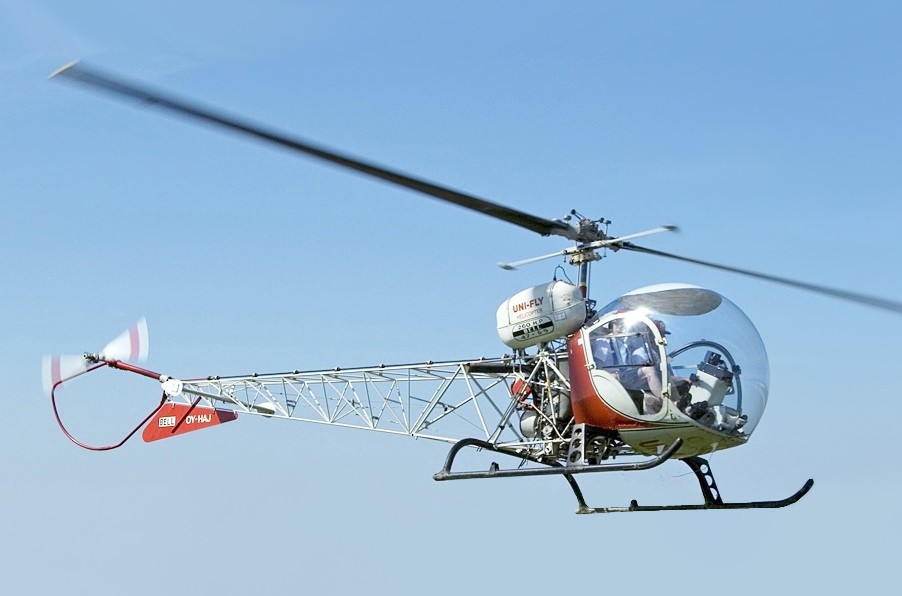
The 47D-1 utilized a 200-horsepower, six-cylinder Franklin aircooled engine, likely from the O-335 series. Franklin Engine Company manufactured this reliable powerplant specifically for early helicopter applications during the late 1940s and 1950s. The aircraft featured several groundbreaking design elements including an open airframe structure for weight reduction, a large bubble canopy that represented the largest plexiglas structure of its era, and a distinctive two-blade wooden rotor system. The open cockpit configuration with four-wheel landing gear provided excellent visibility and ground handling characteristics.
Record-Setting Performance
On July 6, 1951, Captain Wayne W. Eggert demonstrated the 47D-1's capability by flying Bell 47D-1 N167B on a 956-mile journey, including 843 miles of cross-country flight. This aircraft, serial number 21 and built in December 1947, had accumulated 387 hours and 50 minutes of flight time before its record-setting September 17, 1952 flight. For this achievement, the helicopter was modified with seven fuel tanks and operated at an overload gross weight of 2,750 pounds, significantly exceeding the standard maximum weight of 2,350 pounds.
Production and Global Manufacturing
Bell produced exactly 129 Model 47D-1 helicopters as part of the broader Bell 47 series production run from 1946 to 1974. International licensing agreements extended manufacturing beyond Bell's facilities, with Agusta in Italy building over 1,000 Model 47 variants from 1954 to 1976, Kawasaki in Japan producing 11 Model 47D helicopters plus hundreds of other variants from 1955, and Westland in the United Kingdom manufacturing the type during the 1960s. Total worldwide Bell 47 production exceeded 7,000 aircraft, making it one of the most successful helicopter designs in aviation history.
Legacy and Preservation
Approximately 10 percent of the 7,000-plus Bell 47 helicopters remain in service today, testament to the design's durability and continued utility. The aircraft holds the distinction of having the longest production run of any helicopter, spanning from 1946 to 1976 when considering licensed production. Notable preserved examples include Bell 47D-1 N167B at various museums, which was used for H-13B development before its FAA registration was cancelled on June 11, 1970. The Yanks Air Museum displays a Bell Model 47D-1 variant, preserving this pioneering aircraft for future generations to study and appreciate its role in establishing helicopter aviation.