
Revolutionary Design Achievement
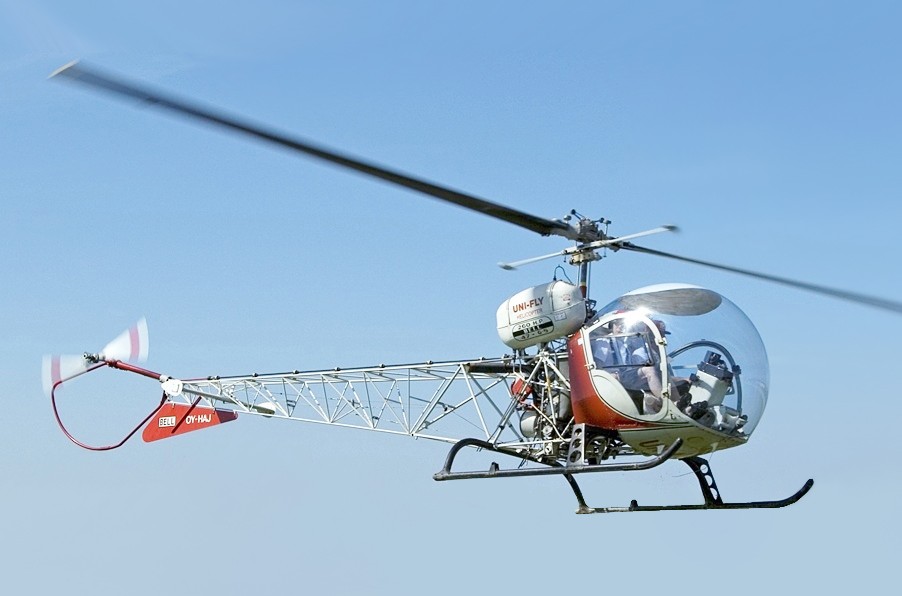
The Bell 47G emerged from the innovative mind of Arthur M. Young, who began development in March 1944 based on his earlier Model 30 prototype. Young's design broke new ground with its open lattice frame construction and revolutionary transparent Plexiglas cockpit that provided unprecedented visibility for pilots. The prototype first lifted off on December 8, 1945, at Wheatfield, New York, marking the beginning of the commercial helicopter age. On March 8, 1946, the Bell 47 became the first helicopter in the United States to receive FAA civil certification under the H-1 type certificate.
Production Excellence
Bell Aircraft Corporation launched production of the 47G variant in March 1954 at their new Fort Worth, Texas facility, following updated certification in July 1953. The company delivered over 3,300 Bell 47G models during the twenty-year production run that continued until 1974, making it the most-produced variant in the entire Bell 47 series. Total Bell 47 family production reached between 5,600 and 7,000 units worldwide when including licensed manufacturers.
International production significantly expanded the aircraft's reach. Agusta in Italy manufactured 108 AB 47G helicopters between 1954 and 1959, with test pilot Ottorino Lancia conducting the first Italian-built example's maiden flight on May 22, 1954. Kawasaki continued Japanese production until 1979, while Westland handled British manufacturing throughout the 1960s.
Military Service Excellence
The Bell 47G served extensively in military roles under various designations: H-13G Sioux for the U.S. Army and Air Force, HTL-6 for the Navy, and HUG for the Coast Guard. During the Korean War from 1950 to 1953, military variants designated OH-13 and H-13 performed critical medical evacuation, reconnaissance, and training missions. The U.S. Air Force initially received 18 Bell 47A aircraft in 1947, while the Navy operated 10 airframes.
The Royal Canadian Navy adopted the HTL-6 variant beginning in June 1955, with aircraft like serial number 1387 providing search and rescue capabilities. Military operators continued using various Bell 47G variants well into the 1990s for training and survey missions, demonstrating the design's enduring utility.
Commercial Aviation Pioneer
Helicopter Air Transport received the first civilian Bell 47 delivery on December 31, 1946, launching the commercial helicopter industry. The 47G's three-seat capacity represented a significant improvement over earlier single-passenger variants, making it economically viable for commercial operations. By 1953, Bell had sold 1,000 Bell 47 helicopters at a base price of $38,000 each.
Civilian operators employed the 47G for diverse missions including aerial surveying, crop spraying, passenger transport, police patrol, and search and rescue operations. The Adams County Sheriff's Office exemplified law enforcement applications, while Swiss operator Heliswiss ordered multiple Agusta-Bell 47G aircraft, including HB-XAV delivered in 1957.
Technical Innovation
Early Bell 47G models utilized the reliable Lycoming VO-435 six-cylinder inline piston engine producing approximately 200 to 250 horsepower. Later variants incorporated enhanced powerplants: the 47G-3B featured a turbocharged Lycoming TVO-435 generating 280 horsepower for improved high-altitude performance, while the 47G-4 employed the Avco Lycoming VO-540 engine.
The helicopter measured approximately 31 feet in length with a rotor diameter of 37 feet 2 inches and stood 9 feet 8 inches tall. Performance specifications included a maximum speed of 105 miles per hour, operational range of 300 miles, service ceiling of 11,000 feet, and climb rate of 1,100 feet per minute.
Manufacturing Legacy
Bell Aircraft Corporation, founded by Larry Bell in 1935, originally operated from Buffalo, New York, before establishing the helicopter division as Bell Helicopter in Fort Worth, Texas, in 1951. The company's aviation heritage included producing the Bell X-1, the first aircraft to achieve supersonic flight. Textron acquired Bell Helicopter in 1985, and the company continues operations today as Bell Textron Inc., remaining a leading helicopter manufacturer.
Enduring Impact
Approximately 700 Bell 47 helicopters, roughly ten percent of total production, remain airworthy today in utility roles worldwide. Notable museum examples include the 1955 Bell 47G HTL-6 (serial number 1387) displayed at Canada's Aviation and Space Museum, and various examples at the Adams County Museum and Niagara Aerospace Museum.
The Bell 47G's distinctive "goldfish bowl" appearance became an aviation icon, while pilot Elton J. Smith established an endurance record on September 17, 1952, flying 1,958.8 kilometers from Hurst, Texas, to Buffalo, New York—a record that still stands today. As the first civil-certified helicopter in the United States and the most successful light helicopter design of its era, the Bell 47G established the foundation for the modern rotorcraft industry.