
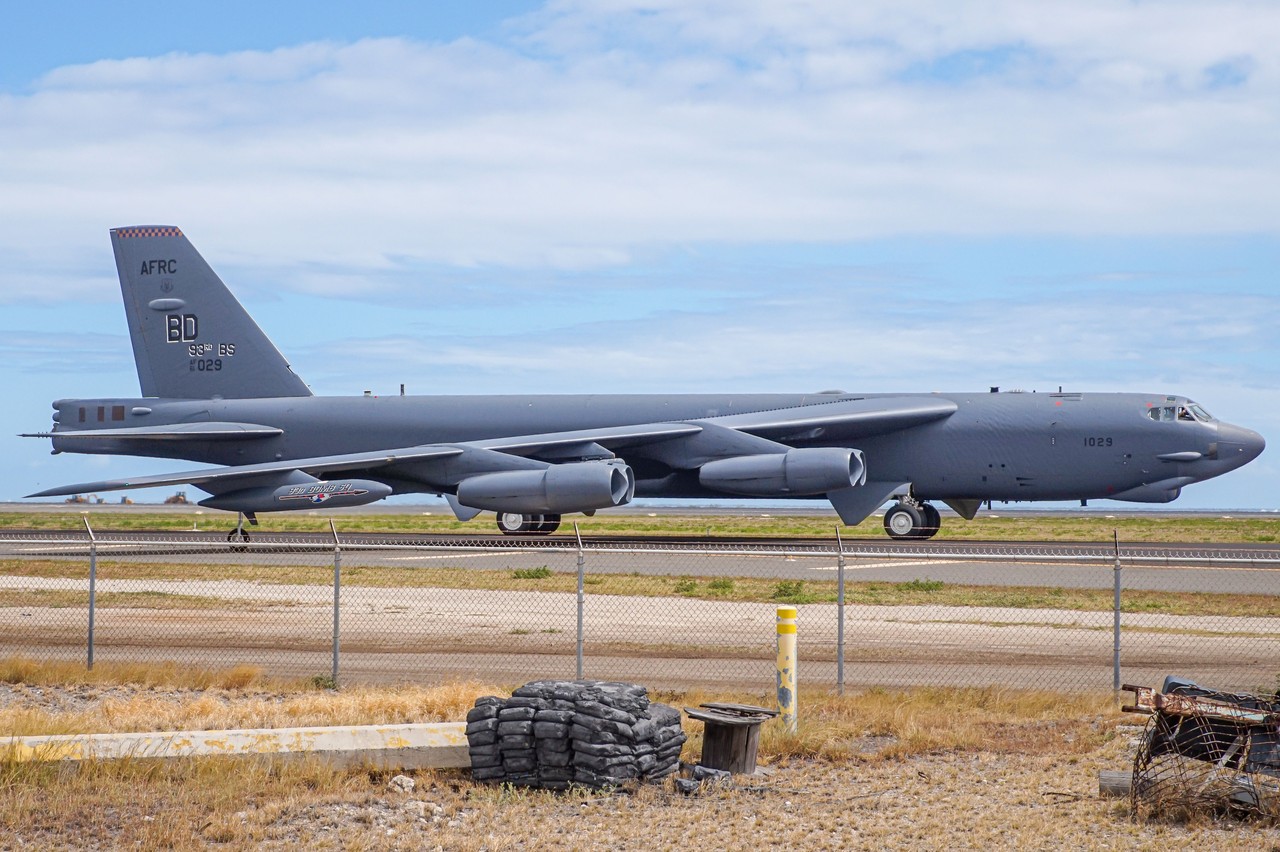
Service History
The B-52 entered operational service with the United States Air Force on June 29, 1955, when the 93rd Bombardment Wing at Castle Air Force Base received its first B-52B aircraft. For over six decades, the Stratofortress has served as the backbone of America's nuclear deterrent force, initially operating under Strategic Air Command throughout the Cold War. As of 2024, 76 B-52H aircraft remain in active service with 58 assigned to the 2nd and 5th Bomb Wings, while 18 serve with the reserve 307th Bomb Wing.
Combat Operations
The B-52 proved its conventional warfare capabilities during the Vietnam War, where it flew 126,615 combat sorties between June 1965 and August 1973. During Operation Linebacker II in December 1972, B-52s conducted intensive bombing campaigns over North Vietnam, though 17 aircraft were lost to enemy surface-to-air missiles throughout the conflict. The bomber demonstrated its global reach on January 18, 1957, when three B-52Bs completed the first non-stop jet-powered flight around the world, covering the distance in 45 hours and 19 minutes with three aerial refuelings.
The Manufacturer
Boeing Airplane Company, founded by William E. Boeing in 1916, had already established itself as a premier military aircraft manufacturer through successful designs like the B-17 Flying Fortress and B-29 Superfortress during World War II. The company operated manufacturing facilities in Seattle, Washington, where prototypes and early variants were built, and Wichita, Kansas, which produced all 193 B-52G aircraft and handled final assembly operations. Following mergers with McDonnell Douglas in 1997 and Rockwell International's aerospace division, the company continues as The Boeing Company, maintaining ongoing support and upgrade programs for the remaining B-52 fleet.
Design Evolution
Boeing's design team began work on the aircraft in 1945, initially developing a straight-wing turboprop bomber concept before Air Force General Curtis LeMay's intervention led to the revolutionary swept-wing, eight-engine configuration. The XB-52 prototype first flew in 1952, followed by the YB-52, which was piloted by Boeing test pilot Alvin "Tex" Johnston. This innovative design incorporated swept wings for high-altitude performance and a modular structure that enabled rapid upgrades throughout the aircraft's service life.
Engine Technology
Early B-52 variants from A through G utilized eight Pratt & Whitney J57 turbojet engines, each mounted in four underwing pods containing two engines apiece. The final production variant, the B-52H, introduced eight Pratt & Whitney TF33 turbofan engines, which provided significantly improved fuel efficiency for extended-range missions. These powerplants enabled the bomber to maintain subsonic speeds approaching Mach 0.86 while reaching service ceilings exceeding 50,000 feet.
Operational Capabilities
The B-52 typically operates with a crew of five to six personnel, including pilot, copilot, navigator, radar navigator, and electronic warfare officer, with early variants also carrying a tail gunner. The aircraft's cavernous bomb bay and external hardpoints accommodate up to 70,000 pounds of ordnance, ranging from conventional bombs and cruise missiles to nuclear weapons. Its unrefueled range of 8,800 miles made it ideally suited for intercontinental strategic missions without requiring forward bases.
Production Legacy
Boeing manufactured the B-52 across eight distinct variants, with production spanning from 1952 to 1962. The A-model served primarily for testing with only three aircraft built, while the most numerous variant was the B-52G with 193 aircraft produced. The final 102 B-52H bombers, delivered in 1962, remain the only variant still in active service today, testament to their robust design and continuous modernization programs.
Museum Preservation
Numerous B-52 aircraft are preserved in museums worldwide, including a B-52G at Seattle's Museum of Flight that was delivered in October 1960, and a B-52A displayed at the Pima Air & Space Museum in Tucson, Arizona. The National Museum of the United States Air Force houses a B-52D that sustained battle damage during 1972 combat operations, serving as a tangible reminder of the aircraft's wartime service. With planned upgrades to the B-52J configuration by 2030, the Stratofortress is expected to remain operational until the 2050s, potentially achieving a century of service life.