
Service History
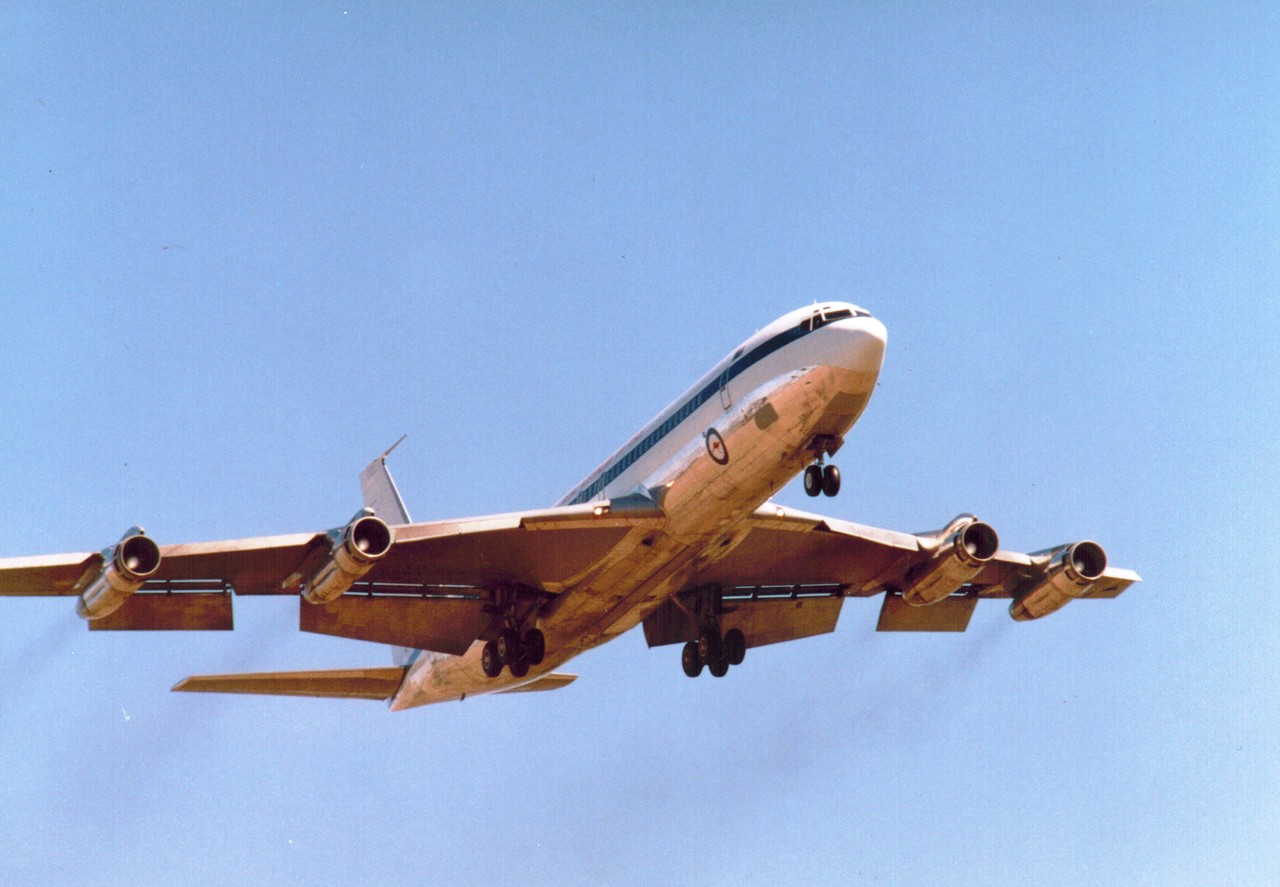
The Boeing 707-100 transformed commercial aviation when Pan American World Airways launched transatlantic service on October 26, 1958, with a New York to Paris inaugural flight. Within months, the aircraft demonstrated its capability on transcontinental routes, beginning New York to Miami service on December 10, 1958. The 707's speed advantage over propeller-driven aircraft and its reliability compared to the troubled de Havilland Comet positioned it to dominate American airline fleets throughout the 1960s.
United Airlines adopted the closely related 707-320 variant, while international carriers including Air India, Sabena, and Lufthansa incorporated the type into their long-haul operations. The aircraft's ability to carry 110 to 189 passengers depending on configuration made it economically viable for airlines seeking to capitalize on growing demand for international travel.
Military Variants
The 707's military counterpart, the KC-135 Stratotanker, originated from the same Model 367-80 prototype that spawned the commercial airliner. The United States Air Force ordered 29 initial tankers in 1954, eventually acquiring 732 KC-135A aircraft built between 1956 and the mid-1960s. The first KC-135A rolled out on July 18, 1956, and completed its maiden flight on August 31, 1956.
Strategic Air Command received the first operational KC-135As in mid-1957, employing them for midair refueling missions supporting long-range bomber operations during the Cold War. The tanker variant could also transport 160 troops or carry 83,000 pounds of cargo when not configured for fuel transfer operations. Unlike the commercial 707, the KC-135A incorporated 21 fuel tanks and specialized refueling equipment.
The Manufacturer
The Boeing Company, founded by William E. Boeing in 1916, leveraged its World War II experience building B-17 Flying Fortresses and B-29 Superfortresses to enter the jet age. The company's transition from military to commercial jet production represented a strategic shift that would establish Boeing's dominance in global airliner manufacturing.
Boeing's 1997 merger with McDonnell Douglas ironically brought together the companies that had competed directly with the 707 and Douglas DC-8 rivalry of the late 1950s. The Boeing Company continues operations today, maintaining its position as a leading aerospace manufacturer.
Engine & Technical Innovation
Four Pratt & Whitney J57 turbojets powered the 707-100, with each engine contributing to the aircraft's 600-mile-per-hour maximum speed. Pratt & Whitney, now part of RTX Corporation, produced over 20,000 J57 engines across all variants, with approximately 4,040 units specifically powering the entire 707 fleet.
The J57 turbojet technology, developed during the 1950s, provided the reliability necessary for extended overwater operations while delivering performance superior to existing propeller-driven airliners. The same engine family powered Boeing B-52 Stratofortresses and other early jet aircraft, demonstrating its versatility across military and civilian applications.
Chief engineer Joseph Sutter led the design team that refined the Model 367-80 prototype into the production 707. The aircraft featured a widened fuselage measuring 148 inches across to accommodate six-abreast passenger seating, distinguishing it from narrower military variants. Swept wings optimized for high-speed cruise flight represented advanced aerodynamic thinking for commercial aviation.
Performance Characteristics
The 707-100 achieved a service ceiling above 40,000 feet with a typical cruise speed approaching 600 miles per hour. Its 3,000-plus mile range enabled nonstop transatlantic service, eliminating fuel stops that had characterized earlier long-distance flights. Flight crews of three to four operated the aircraft, with most configurations requiring two pilots and a flight engineer.
The aircraft's speed advantage over the competing Douglas DC-8 helped secure early airline orders, though both types ultimately succeeded in establishing reliable jet service. The 707's performance envelope made previously impractical routes economically viable for scheduled airline operation.
Production & Legacy
Boeing's Renton, Washington facility produced all 1,010 Boeing 707 aircraft across variants from the first production rollout on October 28, 1957, through the program's conclusion in 1991. The 707 family's commercial success established Boeing's position in airliner manufacturing and generated revenue supporting development of subsequent aircraft including the 727, 737, and 747.
Few civilian 707s remain airworthy today, though military KC-135 variants continue serving with updated systems after decades of upgrades. The original Model 367-80 prototype resides at the Smithsonian National Air and Space Museum in Washington, D.C., following its 1972 retirement.
The 707's introduction marked the beginning of practical jet airline service in the United States, enabling the rapid expansion of international travel that characterized the 1960s. Its success validated Boeing's commercial jet strategy and established design principles that influenced subsequent airliner development throughout the industry.