
Service History
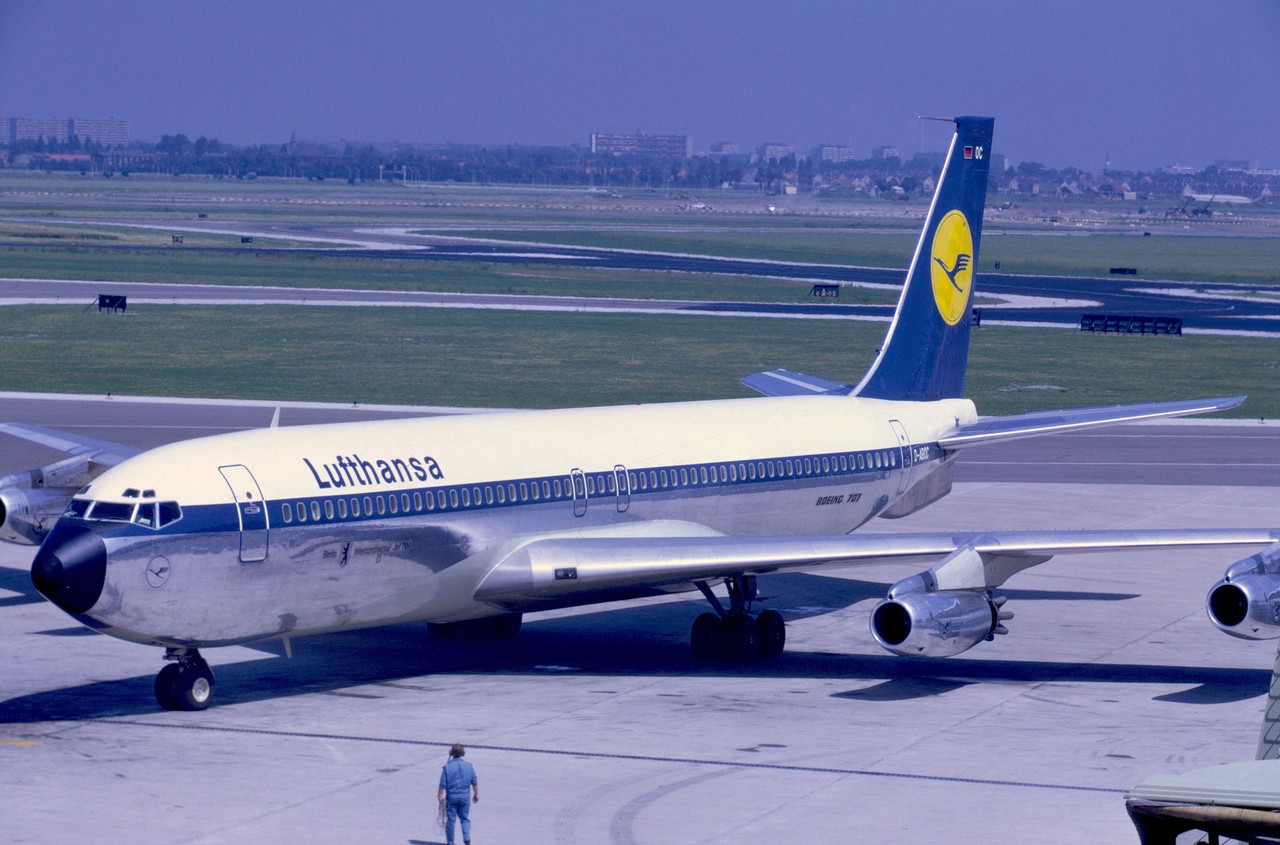
The Boeing 707 family dominated commercial aviation throughout the 1960s and 1970s, with airlines worldwide recognizing its superior performance over propeller-driven aircraft. Pan American World Airways launched regular 707 service on October 26, 1958, immediately demonstrating the aircraft's ability to cut transcontinental flight times nearly in half. American Airlines, United Airlines, and Lufthansa rapidly adopted the 707 to modernize their fleets, establishing the type as the backbone of international air travel. The 707 outsold its primary competitor, the Douglas DC-8, by more than 300 units, capturing the majority of the emerging jet airliner market.
The Manufacturer
The Boeing Company developed the 707 from their internal Model 367-80 prototype, known as the "Dash 80," which first flew on July 15, 1954. Boeing had established itself as a major aircraft manufacturer during World War II with bombers like the B-17 Flying Fortress and B-29 Superfortress. The company invested $16 million of its own funds to develop the Dash 80, gambling its future on the commercial jet market. This bold decision established Boeing as the world's leading commercial aircraft manufacturer, a position the company maintains today through its continued operations in Seattle, Washington.
Engine & Technical Innovation
Chief engineer Joseph Sutter led the 707 design team in creating an aircraft that represented a quantum leap in commercial aviation technology. The 707-300, like other variants in the family, utilized four powerful turbojet engines mounted on underwing pylons, a configuration that became standard for large commercial aircraft. Early 707-120 models employed Pratt & Whitney JT3C turbojet engines, while the later 707-320 variant featured more efficient JT4A turbofan engines that improved fuel consumption and reduced operating costs. The aircraft's swept-wing design and pressurized cabin enabled operations at altitudes exceeding 35,000 feet, well above weather disturbances that plagued lower-flying propeller aircraft.
Pilot Perspective
Pilots praised the 707 for its stability and predictable handling characteristics, though transitioning from propeller aircraft required extensive retraining in jet operations. The aircraft typically required a crew of three, including two pilots and a flight engineer who monitored the complex engine and electrical systems. Cruising speeds of approximately 600 miles per hour represented a dramatic improvement over the 300-mile-per-hour speeds of contemporary piston-engine airliners. The 707's range of nearly 6,000 miles enabled nonstop transcontinental flights and opened new transatlantic routes that previously required fuel stops in Gander, Newfoundland, or Shannon, Ireland.
Production & Legacy
Boeing manufactured 1,010 aircraft across all 707 variants between 1957 and 1991, representing one of the longest production runs in commercial aviation history. The 707 family's success stemmed from its ability to carry twice as many passengers as existing airliners while flying at nearly double the speed, fundamentally changing the economics of air travel. Pan American's initial order for 20 aircraft in 1955 validated Boeing's design approach and encouraged other airlines to abandon propeller technology in favor of jets. The aircraft's spacious cabin, capable of accommodating up to 200 passengers depending on configuration, made air travel affordable for middle-class families and business travelers.
Global Impact
The 707 inaugurated the jet age by making international travel routine rather than exceptional, shrinking the world in ways previously unimaginable. Transcontinental flights that once required eight to ten hours in propeller aircraft could be completed in four to five hours aboard a 707. The aircraft's reliability and range enabled airlines to establish regular service to previously inaccessible destinations, creating the foundation for modern global tourism and international business. Museums worldwide now preserve examples of the 707 family, recognizing its pivotal role in transforming human mobility and connecting distant cultures through rapid, reliable air transportation.