
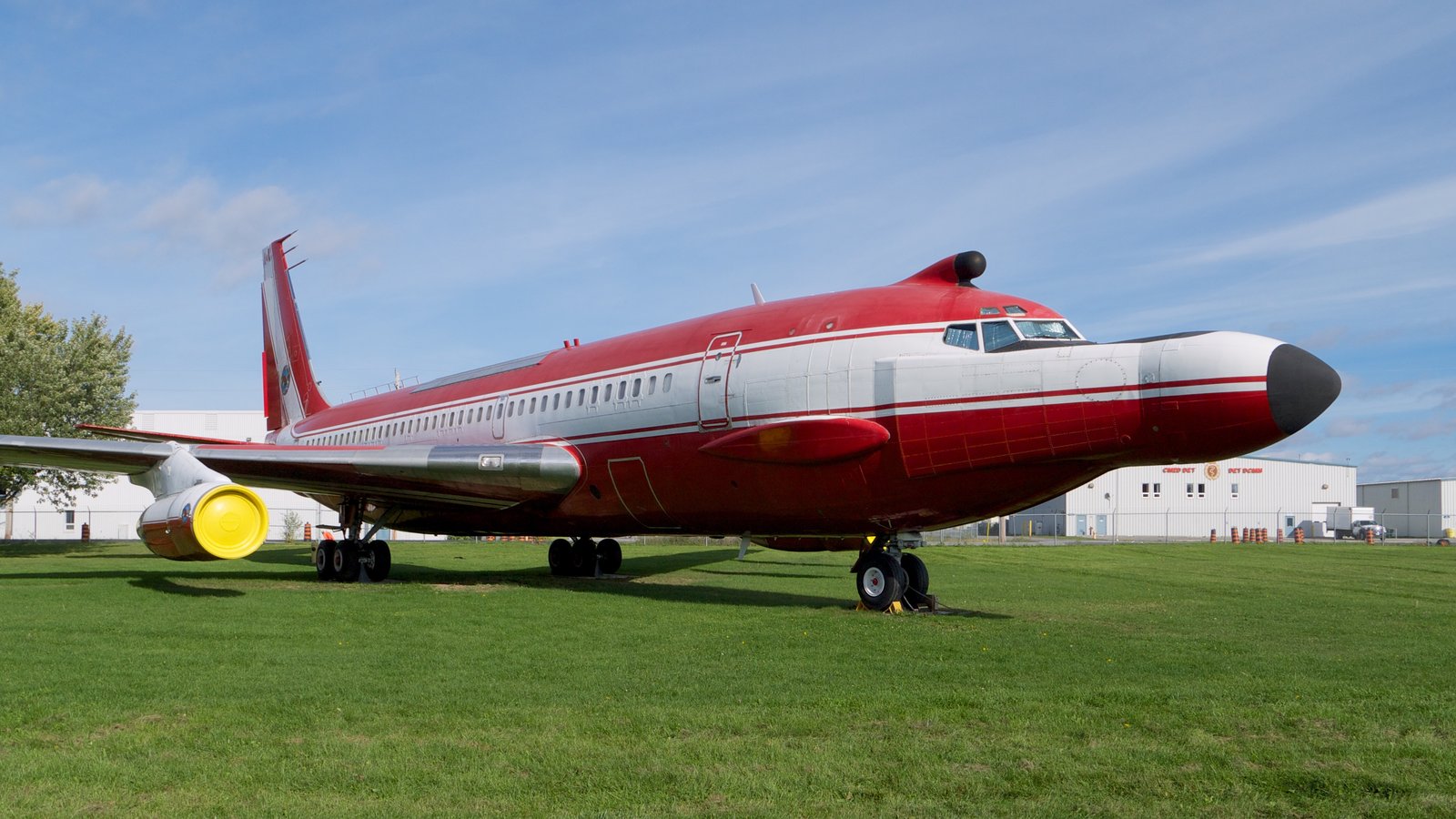
Service History
The Boeing 720 filled a crucial gap in the early jet age, enabling airlines to operate jets on shorter domestic routes previously served only by propeller aircraft. United Airlines became the launch customer, placing the first 720 into service on July 5, 1960, on the Los Angeles-Denver-Chicago route. The airline initially ordered 65 of the original 720 variant, making it the type's largest operator. American Airlines followed with 10 original 720s delivered in 1960, later converting them to the improved 720B standard and ordering an additional 15 720B aircraft starting in 1961.
Eastern Airlines operated 15 aircraft between 1961 and 1962, configuring their "720-025" variant with up to 170 passengers in high-density seating using over-wing emergency hatches. Western Airlines became a major 720B operator with 27 aircraft delivered between 1961 and 1967, while Continental Airlines operated 8 of the improved variant from 1962 to 1966.
The Manufacturer
Boeing Commercial Airplanes, a division of The Boeing Company, developed the 720 as part of their early jet airliner program. Founded in 1916, Boeing had established itself as a major aircraft manufacturer and entered commercial jet aviation with the 707 in 1958. The company's innovative approach to the 720 program involved using their Boeing 367-80 (Dash 80) prototype to test systems for both the 707 and 720, eliminating the need for a dedicated 720 prototype and significantly reducing development costs.
Boeing's engineering team announced the project in July 1957, initially designating it the 707-020 before adopting the 720 designation. This derivative approach proved highly profitable despite the aircraft's relatively low production numbers. The company underwent a major transformation in 1997 when it merged with McDonnell Douglas, and continues operations today as Boeing.
Engine & Technical Details
The original Boeing 720 utilized four Pratt & Whitney JT3C-7 turbojet engines, each producing 12,000 pounds of thrust. However, the definitive version became the 720B, powered by four Pratt & Whitney JT3D turbofan engines generating 17,000 pounds of thrust each. The JT3D engines offered 15 percent better fuel economy, significantly quieter operation, and higher thrust compared to the earlier turbojets.
This engine upgrade enabled Boeing to increase the maximum takeoff weight to 234,000 pounds on the 720B variant. The improved engines also allowed the aircraft to achieve a range of 3,200 nautical miles while maintaining its short-field performance advantages. Many original 720 operators retrofitted their aircraft to 720B standard to take advantage of these improvements.
The aircraft featured a shortened fuselage compared to the 707-120, measuring 136 feet 9 inches in length with a wingspan of 130 feet 10 inches. Boeing engineers modified the wing design specifically for better short-runway performance, innovations that were later retrofitted to some 707 variants. The fuel capacity remained at 16,060 US gallons, identical to its larger sibling.
Performance and Operations
The 720B could accommodate 156 passengers in single-class configuration, though Eastern Airlines demonstrated that up to 170 passengers could be carried in high-density layouts. The aircraft required a multi-person flight crew and was designed for a service life of 47,360 hours and 25,600 cycles. Boeing issued the type certificate on June 30, 1960, clearing the way for commercial operations.
The 720's shorter runway requirements made it ideal for serving secondary airports that could not accommodate the larger 707, effectively bridging the gap until Boeing introduced the trijet 727. This capability proved especially valuable for domestic US routes and international services to airports with runway limitations.
International Operations
While primarily serving US domestic markets, the 720 also found international operators. Pakistan International Airlines operated four 720B aircraft between 1961 and 1965, demonstrating the type's versatility in international service. Braniff International Airways used five 720s from 1961 to 1963 for both domestic and international routes.
Production and Legacy
Boeing manufactured 154 Boeing 720 aircraft between 1959 and 1967 at their Renton, Washington facility, comprising 65 original 720s and 89 improved 720B variants. Despite the relatively modest production numbers, the program proved financially successful due to minimal research and development costs as a 707 derivative.
Production ended in 1967 as airlines shifted to more modern aircraft like the Boeing 727, which offered three-engine efficiency and even better short-field performance. The 720's service record included 23 hull-loss accidents resulting in 256 fatalities across 12 fatal incidents, along with 9 hijacking incidents and one aircraft destroyed by bombing in 1976.
No Boeing 720 aircraft remain in active service today, with all examples retired from commercial operations. The type's legacy lies in proving the viability of derivative aircraft development and pioneering economical narrow-body jet operations from shorter runways during aviation's transition from the propeller age to the jet era.