
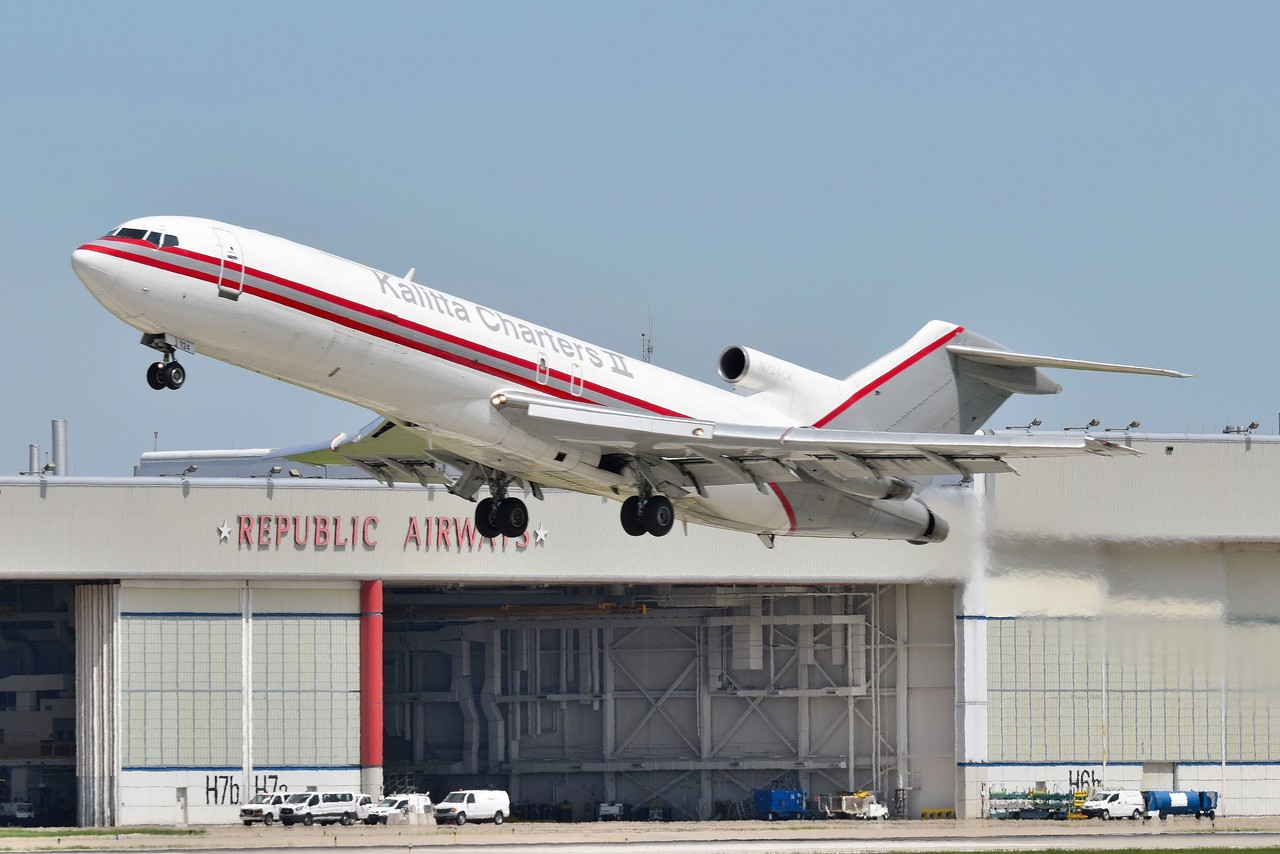
The Jet That Democratized Air Travel
The Boeing 727-200 emerged as the workhorse of American regional aviation, earning the nickname "the DC-3 of the Jet Age" for its transformative impact on commercial flight. By the program's end in 1984, the 727-200 accounted for roughly two-thirds of the entire 727 family's 1,831 delivered aircraft, with over 100 airlines operating the type worldwide.
Service History and Impact
United Airlines received the first 727-200 on October 6, 1964, with aircraft N7001U beginning a career that would span 27 years and accumulate 64,495 flight hours before retirement in 1991. Northeast Airlines inaugurated passenger service with the -200 variant on December 14, 1967, followed by Northwest Airlines, which took delivery of its first 727-200 on October 27, 1968.
The aircraft's ability to operate from shorter runways opened jet service to secondary markets across the United States. Northwest Airlines deployed 727-200s on routes like Minneapolis-Denver-Tucson and Detroit-Toronto, while Hughes Airwest operated 10 units throughout the mid-1970s on West Coast regional routes. Singapore Airlines extended the type's reach internationally, with aircraft like 9V-SGJ delivered on August 1, 1979.
The Boeing Company Legacy
The Boeing Company, founded in 1916 by William E. Boeing, had already established itself as a commercial aviation pioneer with the Model 247 in 1933 and the successful 707 jetliner in 1958. The 727 program represented Boeing's response to airline demands for a smaller, more versatile jet capable of serving routes the four-engine 707 could not economically operate.
Following its 1997 merger with McDonnell Douglas and acquisition of Rockwell's aerospace division, Boeing continued as the world's largest aerospace manufacturer. Today headquartered in Arlington, Virginia, the company's legacy includes the 727's role in proving the viability of regional jet operations that would later be dominated by Boeing's own 737 family.
Engineering Excellence
Joe Sutter, Boeing's chief engineer for both the 707 and 727 programs, led the design team that created the 727's distinctive trijet configuration. The engineers positioned two Pratt & Whitney JT8D turbofan engines on pylons flanking the rear fuselage, while routing the third engine through an S-shaped duct to an intake at the tail's base.
Pratt & Whitney's JT8D engine family, produced from 1961 to 1987, powered the majority of early jet airliners with more than 14,750 units manufactured across all variants. The 727-200's later models employed the JT8D-17A variant, each producing up to 17,400 pounds of thrust. This powerplant combination gave the aircraft exceptional short-field performance while maintaining the reliability airlines demanded for high-frequency operations.
The design incorporated several innovations including an auxiliary power unit (APU) for ground independence, advanced high-lift wing systems, and the famous aft airstair that allowed passenger boarding without ground equipment. The airstair was later sealed on most aircraft following security concerns highlighted by the 1971 D.B. Cooper hijacking incident.
Operational Characteristics
The 727-200's 153-foot fuselage stretched the original design by 20 feet, accommodating up to 189 passengers in high-density configuration with a standard three-person crew. The aircraft achieved a maximum speed of approximately Mach 0.84, service ceiling of 42,000 feet, and range of 2,500 nautical miles.
Pilots appreciated the 727-200's responsive handling and ability to operate from airports with runways as short as 4,500 feet. The trijet configuration provided redundancy that proved especially valuable during the pre-ETOPS era when twin-engine aircraft faced restrictions over extended overwater routes.
Specialized Variants
Boeing developed the 727-200F Advanced freighter variant in 1981, featuring an 11-by-7-foot cargo door and reinforced floor structure. FedEx became the primary operator of this version, taking delivery of 15 aircraft that served as crucial components of the company's growing overnight delivery network. The final 727-200F Advanced represented the last 727 delivered by Boeing in 1984.
Legacy and Preservation
Production ceased in 1984 after Boeing delivered 1,832 aircraft across all 727 variants, making it the best-selling airliner of its era until surpassed by the 737 and Airbus A320 families. Most airlines retired their 727-200s by the early 2000s due to increasingly stringent noise regulations and rising fuel costs that favored newer, more efficient designs.
The original 727, registration N7001U, found permanent preservation at Seattle's Museum of Flight at Boeing Field. Ferried from Paine Field on March 2, 2016, this aircraft serves as a testament to the 727's role in transforming American aviation from an elite mode of transport to accessible public transportation.
Today, fewer than 100 Boeing 727s of all variants remain in active service worldwide, primarily as freighters operating in remote regions where their short-field capabilities continue to provide value. The 727-200's legacy lives on in Boeing's design philosophy and the regional jet market it helped create, proving that specialized aircraft serving specific market needs can achieve remarkable commercial success.