
Service History
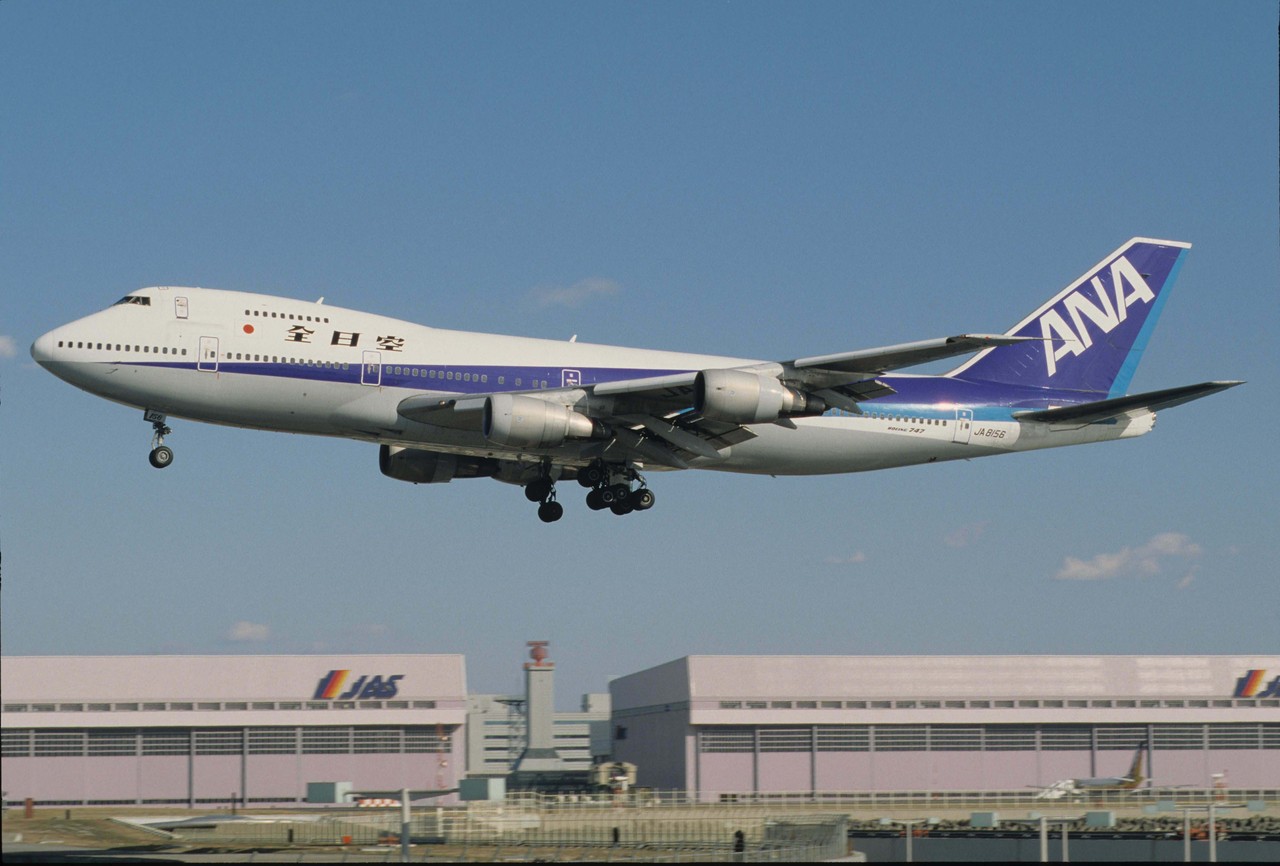
The 747SR dominated Japan's domestic aviation landscape during its operational years from 1978 to 2006. All Nippon Airways operated 20 of these aircraft, while Japan Airlines flew 9, including 2 Super Upper Deck (SUD) variants. These airlines deployed the 747SR on heavily trafficked domestic routes such as Tokyo-Nagoya, where the aircraft's ability to carry between 455 and 563 passengers made it economically viable despite its limited range of approximately 1,650 nautical miles.
The aircraft's impact was transformative for Japanese aviation, enabling airlines to move unprecedented numbers of passengers on short-haul routes. ANA configured their aircraft for 455-456 passengers, while JAL pushed capacity even higher with 563 seats in their SUD configuration. This high-density approach revolutionized regional jumbo jet operations, proving that wide-body aircraft could be profitable on routes traditionally served by narrow-body planes.
The Manufacturer
Boeing Commercial Airplanes, a division of The Boeing Company, manufactured all 29 747SR aircraft at their Everett factory in Washington state between 1978 and 1980. The Boeing Company, founded in 1916 by William E. Boeing, had evolved from a small seaplane manufacturer into one of the world's leading aerospace companies. By the time of the 747SR's production, Boeing had already established itself as a commercial aviation pioneer with the 707, which entered service in 1958.
Boeing's acquisition strategy expanded the company significantly through mergers with McDonnell Douglas in 1997, Rockwell International's aerospace division in 1996, and Hughes Space in 2000. Today, Boeing remains operational and headquartered in Arlington, Virginia, though the Everett facility where the 747SR was built concluded 747 production in 2023 after 55 years.
Design and Development
Joe Sutter, known as the "father of the 747," led the design team that created the original 747 platform beginning in 1966, with chief project engineer Jack Steiner overseeing the project's technical aspects. The 747SR represented a specialized adaptation of this design, optimized for short-range, high-frequency operations rather than the long-haul international routes the standard 747 was built to serve.
The SR variant incorporated several modifications to maximize passenger capacity while reducing structural weight for shorter flights. The aircraft featured the characteristic partial double-deck design with 660 cubic meters of volume, making it the largest passenger aircraft of its era. The upper deck hump, originally designed to accommodate a future cockpit relocation, provided additional passenger space in the SR configuration.
Engine and Technical Specifications
The 747SR was powered by four high-bypass turbofan engines, with operators choosing between Pratt & Whitney JT9D-7A or General Electric CF6-45 powerplants. The JT9D-7A, produced by Pratt & Whitney from 1968 through the 1980s, generated approximately 46,000 to 50,000 pounds of thrust and represented the first generation of high-bypass turbofan technology, delivering 20 percent better fuel efficiency than previous jet engines.
General Electric's CF6-45 alternative offered similar performance with innovations including dual annular combustors for reduced emissions. Both engine options provided the reliability necessary for high-frequency operations, as the 747SR was designed to complete multiple daily cycles rather than the long-range missions of standard 747 variants.
Performance Characteristics
The 747SR achieved a maximum speed of Mach 0.85 (572 mph) with a service ceiling of 45,000 feet and a climb rate of approximately 1,520 feet per minute. However, its defining characteristic was the deliberate limitation of range to approximately 1,650 nautical miles, achieved through reduced fuel capacity and structural modifications that allowed for increased passenger loads.
The aircraft required a two-pilot crew plus cabin staff proportional to its high passenger count. With a maximum takeoff weight of 600,000 pounds, the 747SR carried significantly less fuel than long-range variants, dedicating the weight savings to passenger capacity and the structural reinforcement necessary for frequent takeoffs and landings.
Production and Legacy
Boeing's production run of just 29 aircraft between 1978 and 1980 made the 747SR one of the rarest variants in the 747 family, which totaled 1,574 aircraft across all variants. The first delivery occurred on December 21, 1978, when ANA took possession of their initial aircraft.
By 2006, all 747SR aircraft had been retired from service, with ANA operating their final flights in March 2006 and JAL concluding operations in the third quarter of that year. The aircraft's specialized nature and the evolution of more fuel-efficient alternatives ultimately limited its operational lifespan to just 28 years.
The 747SR's legacy lies in its demonstration that wide-body aircraft could be economically viable on short-haul, high-density routes. This concept influenced later aircraft designs and operational strategies, though no direct successor matched its specific combination of capacity and range limitations. As of 2025, no 747SR aircraft remain in flying condition, marking the end of this unique chapter in commercial aviation history.