
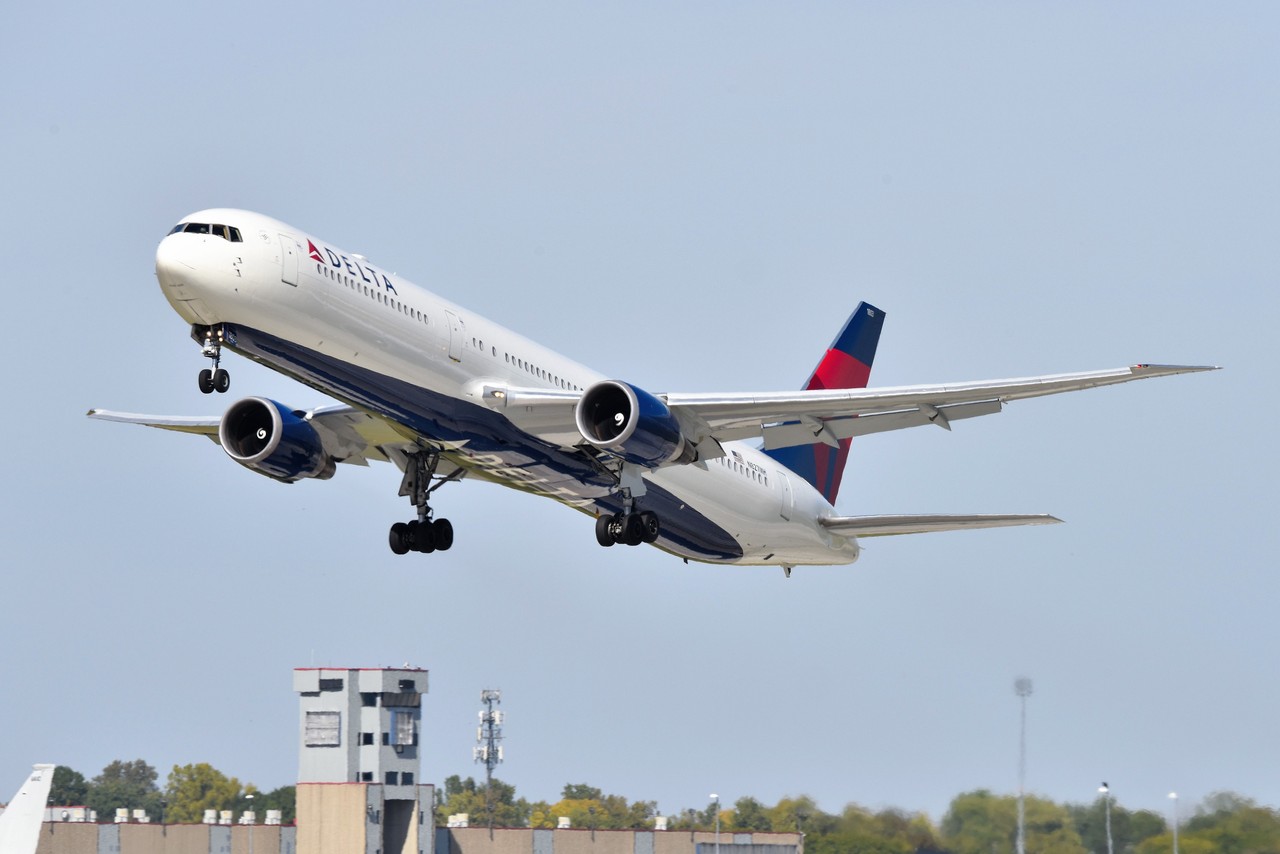
Production and Development
The 767-400ER emerged from specific airline demands in the late 1990s, when Delta Air Lines and Continental Airlines required higher-capacity aircraft for their high-volume domestic routes. Boeing launched the program in 1997, stretching the proven 767-300ER fuselage to accommodate over 300 passengers while maintaining the fuel efficiency that made the 767 family successful. Production began at Boeing's Everett factory in Washington state, where the aircraft rolled off the same assembly line that produced other 767 variants.
Manufacturing proved limited, with Boeing producing exactly 38 units between 1999 and 2002. This included 37 aircraft for commercial service and one military testbed initially intended for the canceled E-10 AWACS program, later converted to VIP transport for Bahrain. The brief production run reflected the aircraft's niche market position, competing against the larger 777 and facing the looming arrival of more fuel-efficient designs.
Commercial Service
Delta Air Lines became the launch customer, taking delivery of 21 aircraft beginning August 11, 2000. The airline inaugurated passenger service in October 2000, deploying the 767-400ER to replace aging Lockheed L-1011 TriStars on high-density domestic routes. Delta configured their aircraft for 245 passengers in three-class service, utilizing the type's capacity advantage over smaller 767 variants.
Continental Airlines operated the remaining 16 commercial aircraft, which transferred to United Airlines following the carriers' 2010 merger. United continues operating these aircraft today, with an average fleet age of 23.2 years as of recent data. The airline maintains 15 active aircraft with one typically in maintenance rotation.
Technical Innovation
The 767-400ER incorporated advanced systems that distinguished it from earlier 767 variants. Boeing equipped the aircraft with a digital glass cockpit featuring 40 computers, technology shared with the 757 to enable common type ratings between the aircraft families. Delta successfully demonstrated this capability in 1984, allowing pilots to fly both types with a single certification.
Powerplant options included either Pratt & Whitney PW4000 or General Electric CF6-80C2 high-bypass turbofan engines. The PW4000 series, in production since the 1980s, delivered thrust up to 99,000 pounds while providing enhanced fuel efficiency and reduced noise signatures. General Electric's CF6 engines offered similar reliability, proven across thousands of installations on wide-body aircraft including the 747 and various 767 variants.
The aircraft achieved a maximum cruise speed of Mach 0.86 (590 mph) with a service ceiling of 43,100 feet. Its climb performance of approximately 3,000 feet per minute enabled efficient departures from congested airports, while the 212-foot 7-inch wingspan provided the lift characteristics necessary for quick ascents.
The Boeing Company Legacy
Boeing developed the 767 family under its 7×7 program, announced in January 1978 as part of the company's expansion into twin-engine wide-body aircraft. Founded in 1916, Boeing had previously revolutionized commercial aviation with the 707 in 1958 and the 747 in 1969. The company expanded its Everett facility specifically for wide-body production, creating the manufacturing infrastructure that would support decades of 767 production.
Significant corporate changes occurred during the 767-400ER's development period. Boeing acquired McDonnell Douglas in 1997, forming Boeing Commercial Airplanes, and had previously purchased Rockwell International's aerospace division in 1996. These acquisitions strengthened Boeing's position across military and commercial markets.
Operational Performance
The 767-400ER demonstrated 30 percent better fuel efficiency compared to earlier generation aircraft, making it attractive for airlines focused on operating economics. Its Extended-range Twin-engine Operational Performance Standards (ETOPS) certification enabled efficient twin-engine operations over long distances previously requiring three or four-engine aircraft.
Pilots appreciated the aircraft's handling characteristics and the commonality with other 767 variants. The type's advanced wing design provided efficient lift generation while maintaining the stability characteristics that made the 767 family popular among flight crews. Digital systems reduced pilot workload while enhancing operational safety margins.
Current Status and Legacy
Today, 37 of the original 38 aircraft remain in active service, representing an exceptional operational record for a commercial aircraft type. Delta operates 19 active aircraft with 2 typically in maintenance rotation, while United maintains 15 in service with 1 in maintenance. The aircraft average 23.9 years of age in Delta's fleet and 23.2 years with United.
Boeing expects to end 767 production by 2027 due to evolving emissions regulations, though discussions continue regarding potential extensions for freighter variants. The 767-400ER's legacy extends through the KC-46 military tanker program, which utilizes the same basic airframe for United States Air Force operations.
The aircraft represents the final evolution of Boeing's successful 767 concept, bridging the gap between the DC-10/Airbus A300 era and modern fuel-efficient designs like the 787 Dreamliner. While production numbers remained limited, the 767-400ER successfully served its intended role as a high-capacity, efficient wide-body for specific airline requirements.