
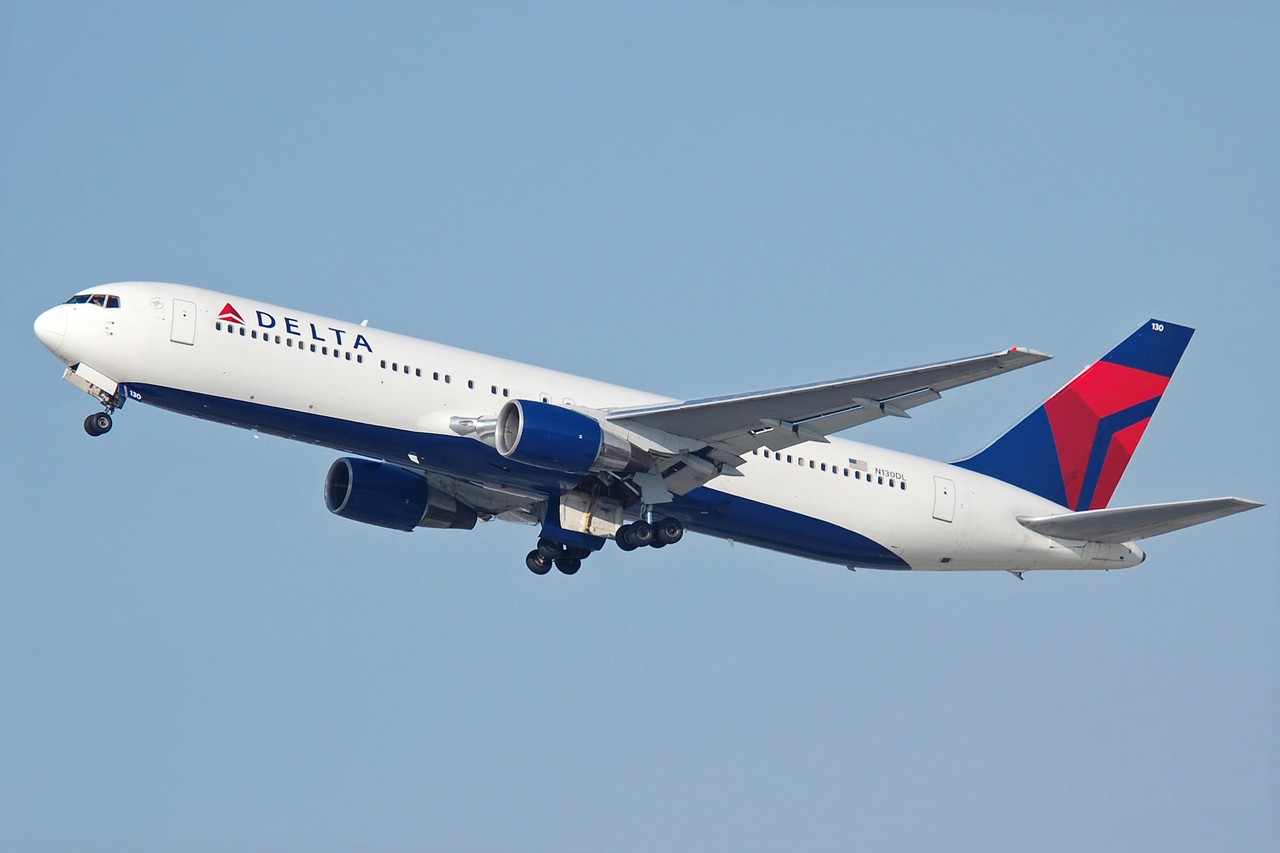
Service Dominance
The 767-200ER established Boeing's dominance in the medium-capacity long-haul market through its Extended-range Twin-engine Operational Performance Standards (ETOPS) certification, becoming the first twin-engine aircraft approved for regular transatlantic passenger service. United Airlines launched commercial operations on September 8, 1982, followed by Delta Air Lines on October 25, 1982, with CF6-powered variants. By the early 1990s, the aircraft had captured significant market share on transcontinental and international routes, with major operators including American Airlines, All Nippon Airways, Air Canada, and Trans World Airlines.
The aircraft's efficiency fundamentals transformed airline economics. Where airlines previously required three or four engines for oceanic crossings, the 767-200ER accomplished the same missions with just two high-bypass turbofans, reducing fuel consumption by up to 25 percent compared to earlier generation aircraft. This operational advantage made previously marginal routes profitable and opened new city pairs that lacked sufficient traffic for larger quad-jets.
The Boeing Legacy
The Boeing Company, established in 1916 by William E. Boeing, launched the 767 program on July 14, 1978, as part of their 7X7 development initiative alongside the narrow-body 757. Boeing's engineering teams designed both aircraft with common pilot type ratings, allowing airlines to cross-train crews efficiently. The company expanded their Everett, Washington manufacturing facility in January 1978 specifically for wide-body production, where all 767 variants have been assembled since July 1979.
Boeing's strategic vision proved prescient. The company absorbed McDonnell Douglas in 1997 and acquired Rockwell International's aerospace division in 1996, but the 767 program remained a cornerstone of their commercial aviation portfolio. Production has continued for over four decades, with more than 1,300 aircraft delivered by 2024.
Powerplant Evolution
Early 767-200 variants utilized Pratt & Whitney JT9D turbofans generating 43,000 to 48,000 pounds of thrust, the same engines that powered Boeing's 747 jumbo jet. However, the 767-200ER introduced engine options that defined modern airline operations. General Electric's CF6 series offered 10 percent better fuel efficiency than the JT9D, while Pratt & Whitney's PW4000 series, entering service in 1984, featured Full Authority Digital Engine Control (FADEC) systems that enhanced reliability and reduced pilot workload.
These high-bypass turbofan engines enabled the aircraft's impressive performance envelope. The CF6 and PW4000 variants could sustain cruise speeds of Mach 0.86 (590 miles per hour) at altitudes up to 43,100 feet, with initial climb rates exceeding 2,500 feet per minute. The extended-range variant's 6,590-nautical-mile range capability opened routes previously impossible for twin-engine aircraft.
Military Applications
While designed as a commercial transport, the 767 platform found new life in military service through the KC-46A Pegasus aerial refueling tanker program. Based on the 767-2C airframe, the KC-46A features a 15-person crew and sophisticated refueling systems including both boom and probe-and-drogue capabilities. The United States Air Force ordered 179 KC-46A aircraft, with initial deliveries beginning in 2019. Italy's Air Force also operates 767-based tankers, ordered in 2002.
Four KC-46A prototypes completed flight testing between 2014 and 2016, validating the platform's military utility. Unlike its commercial siblings, the KC-46A carries no passenger armament but provides critical aerial refueling capabilities for modern air forces.
Production Achievement
Boeing manufactured 128 original 767-200 aircraft between 1981 and 1987 before transitioning to the extended-range variant. Total 767 family production reached 1,252 aircraft by August 2022, with assembly concentrated exclusively at the Everett facility. Current production focuses primarily on freighter and tanker variants, with 94 orders pending as of 2022.
Production is scheduled to conclude by 2027 unless extended, marking the end of a 46-year manufacturing run. The program's longevity reflects the fundamental soundness of Boeing's original design philosophy and the aircraft's adaptability to evolving market requirements.
Contemporary Operations
More than 1,000 Boeing 767s remained active in 2022, predominantly serving cargo and military roles as passenger operations migrate to newer generation aircraft like the 787 Dreamliner. Major freight operators, including FedEx, have sustained demand with substantial orders: 27 aircraft in 2011, 19 in 2012, and 50 in 2015. The 767-300F freighter variant can transport 116 tons of cargo, making it invaluable for express delivery networks.
The aircraft's legacy extends beyond mere statistics. The 767 proved that properly designed twin-engine aircraft could match the safety and reliability of three and four-engine designs while delivering superior economics, fundamentally reshaping airline fleet planning and route development strategies worldwide.