
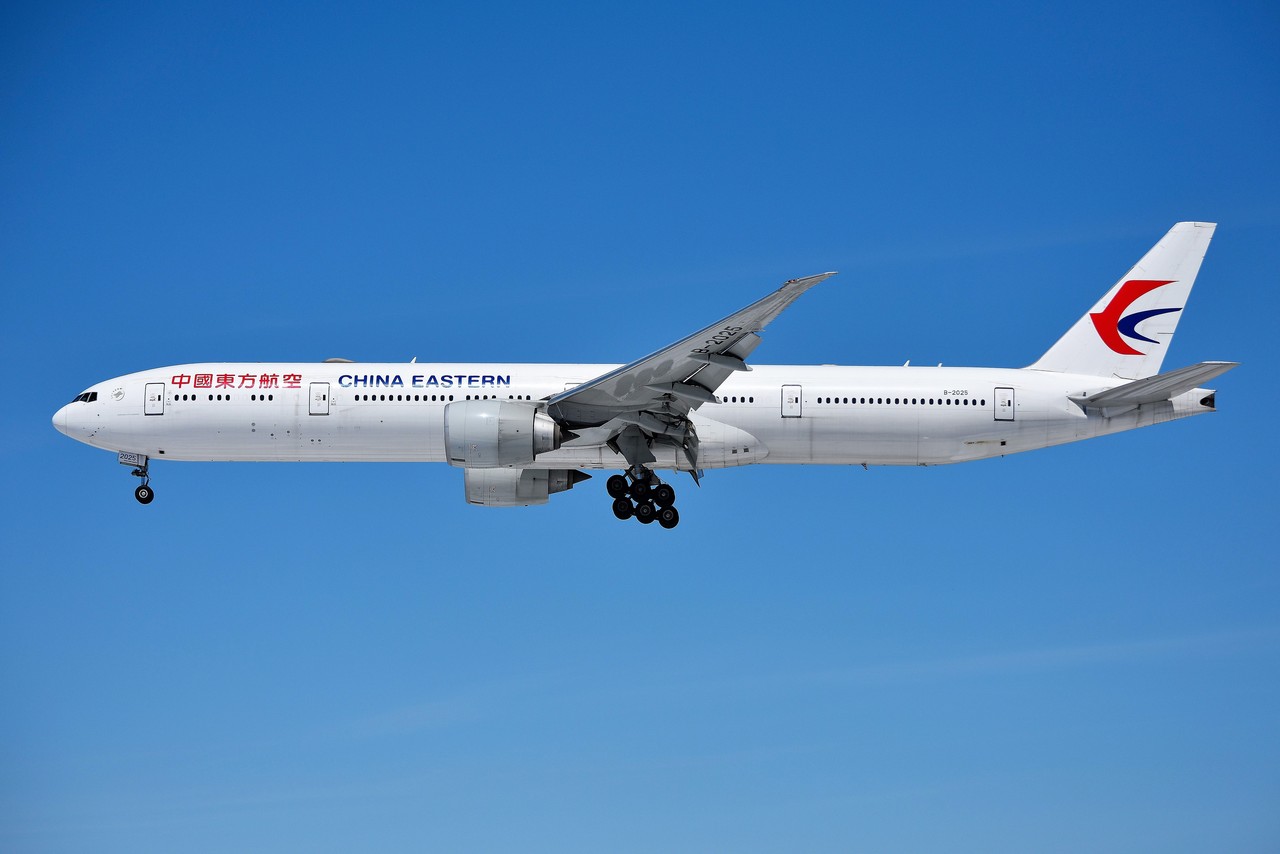
Service History
The 777-300 entered commercial service with Cathay Pacific on May 27, 1998, marking the beginning of a new era in long-haul aviation. The aircraft fundamentally transformed international air travel by demonstrating that twin-engine wide-bodies could reliably operate routes previously dominated by four-engine aircraft like the 747 and DC-10. By the mid-2010s, variants of the 777 operated over half of all scheduled transpacific flights, becoming the most widely used airliner for these demanding routes.
The 777-300ER variant, introduced in 2003, became the top-selling 777 model in the late 2000s as airlines sought to replace comparable four-engine aircraft with this more economical twinjet. With 830 aircraft delivered over 21 years of production through 2021, the -300ER variant alone demonstrated the market's appetite for efficient long-haul twins. The entire 777 family achieved remarkable commercial success, with over 2,300 aircraft ordered by more than 70 operators worldwide.
The Manufacturer
The Boeing Company, founded in 1916, developed the 777-300 as part of their strategy to compete in the long-haul wide-body market. Boeing revolutionized aircraft development by making the 777 the first commercial airliner designed entirely using computer technology. The company employed CATIA three-dimensional design software, which allowed the aircraft to be assembled virtually before physical construction began, eliminating the need for costly physical mock-ups and reducing development time.
Boeing developed the 777 program in consultation with eight major airlines, ensuring the design met real-world operational requirements. This collaborative approach proved successful, as Boeing maintained its position as one of the world's leading commercial aircraft manufacturers. In March 2018, the 777 achieved a significant milestone by overtaking the iconic 747 as the world's most produced wide-body aircraft.
Engine & Technical Details
The original 777-300 offered airlines flexibility with three engine options ranging from 77,200 to 98,000 pounds of thrust. Airlines could choose between the General Electric GE90, Pratt & Whitney PW4000, or Rolls-Royce Trent 800 powerplants, allowing operators to select engines based on their specific route requirements and maintenance preferences.
The 777-300ER variant featured the General Electric GE90-115BL, which became the world's most powerful commercial jet engine. This massive powerplant enabled the aircraft to achieve a remarkable range of 7,370 nautical miles while carrying a full passenger load. The extended-range variant incorporated increased fuel capacity, a strengthened fuselage, extended wings, and modified landing gear to handle the additional weight and operational demands of ultra-long-haul flights.
The aircraft's design represented a 20 percent stretch compared to the shorter 777-200, accommodating an additional 60 seats. This configuration allowed airlines to seat 368 passengers in a three-class layout, 451 in two classes, or up to 550 passengers in an all-economy configuration, providing remarkable flexibility for different market segments.
Development & First Flight
Boeing launched the 777-300 program on June 26, 1995, at the Paris Air Show, capitalizing on industry interest in larger twin-engine aircraft. Major assembly began in March 1997 at Boeing's Everett, Washington facility. The fuselage sections were joined on July 21, 1997, followed by rollout on September 8, 1997.
Chief test pilot John E. Cashman commanded the first flight on October 16, 1997, marking another milestone in Boeing's twin-engine wide-body program. The flight test program proceeded efficiently, benefiting from experience gained during the original 777-200 development. The aircraft received simultaneous type certification from both the Federal Aviation Administration and Joint Aviation Authorities on May 4, 1998, demonstrating international confidence in the design.
Production & Legacy
Production of the 777-300 family continued through 2021, when Boeing officially ended 777-300ER manufacturing to focus on the next-generation 777X series. The aircraft's success stemmed from its ability to operate efficiently on routes where passenger demand didn't justify larger four-engine aircraft, while offering lower operating costs than older wide-body designs.
The 777-300's legacy extends beyond mere production numbers. It proved that advanced twin-engine aircraft could safely and economically operate the world's longest commercial routes, fundamentally changing airline network planning. Major international carriers adopted the type for flagship routes, with the aircraft becoming synonymous with premium long-haul service.
Today, 777-300 and 777-300ER aircraft continue serving with airlines worldwide, operating routes from Asia to North America, Europe to Australia, and countless other international city pairs. The type remains active in commercial service, testament to its robust design and continued relevance in modern airline operations. Many aviation museums have expressed interest in preserving examples of this significant aircraft type for future generations.