
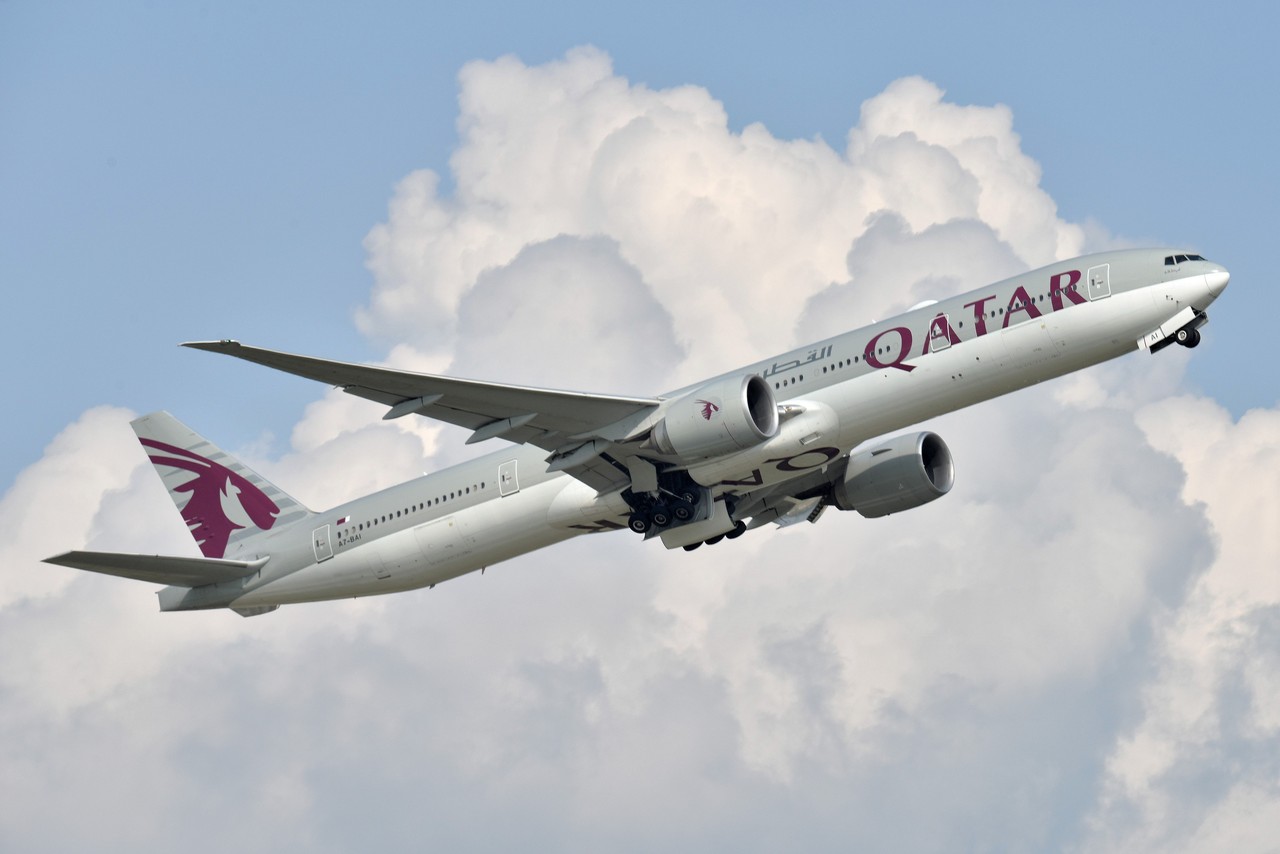
Service History
The 777-300ER fundamentally transformed international aviation by proving that twin-engine aircraft could handle the world's longest commercial routes with superior efficiency. Air France launched operations with the first delivery on April 29, 2004, establishing a new era of long-haul travel. Emirates emerged as one of the largest operators, utilizing the aircraft on routes exceeding 7,400 miles with flight times longer than 12 hours, demonstrating the variant's exceptional endurance capabilities.
The aircraft's success stemmed from its ability to replace less efficient four-engine widebodies while maintaining the same route coverage. Airlines worldwide embraced the 777-300ER for its optimal balance of passenger capacity and operational economics, with the variant accommodating between 370 passengers in three-class configuration and up to 451 in dense two-class layouts.
The Manufacturer
The Boeing Company launched the 777 program in October 1990 following United Airlines' initial order, with the original 777 prototype rolling out on April 9, 1994. Boeing's innovative approach involved collaboration with eight major airlines during the design phase, ensuring the aircraft met real-world operational requirements. The company manufactured all 777 variants at their Everett factory in Washington, which also serves as the production site for the 747 and 787 programs.
Boeing remains a dominant force in commercial aviation today, though the company officially concluded 777-300ER production in 2024 after two decades of continuous manufacturing. The final aircraft delivered that year marked the end of one of aviation's most successful widebody programs.
Engine & Technical Details
The 777-300ER utilized the General Electric GE90-115B turbofan engine, recognized as the world's most powerful commercial jet engine at the time of its introduction. This twin-engine configuration provided the thrust necessary for the aircraft's extended-range capabilities while delivering superior fuel efficiency compared to four-engine competitors.
The variant combined the stretched fuselage design of the 777-300, launched at the Paris Air Show on June 26, 1995, with the extended-range technology of the 777-200ER. Engineers achieved the 7,370 nautical mile range through increased fuel capacity, structural reinforcement of the fuselage, extended wings, and modified landing gear systems. These modifications represented a 20 percent stretch compared to earlier 777 variants while maintaining operational efficiency.
Development Timeline
The 777-300ER development began with the original 777's maiden flight on June 12, 1994, followed by the specific variant's first flight on February 24, 2003. Both the Federal Aviation Administration and European Aviation Safety Agency certified the aircraft on March 16, 2004, enabling Air France to receive the inaugural delivery just six weeks later.
This compressed certification timeline reflected Boeing's extensive experience with the 777 platform and the variant's proven design philosophy. The collaboration with eight major airlines during initial development provided valuable operational insights that streamlined the certification process.
Production & Legacy
Boeing produced the 777-300ER continuously from 2004 to 2024, establishing it as the most successful variant within the broader 777 family, which accumulated over 2,300 orders across all configurations. The variant's commercial success validated the twin-engine widebody concept for ultra-long-haul routes, setting new industry standards for reliability and fuel efficiency.
The 777-300ER's influence extends beyond its production years through the development of the next-generation Boeing 777X, which completed its maiden flight on January 25, 2020. Launch customer Lufthansa expects to begin 777X operations in 2026, with Boeing promising 10 percent improvements in fuel consumption, emissions, and operating costs compared to competing aircraft.
Many 777-300ER aircraft continue active service with airlines worldwide, representing a lasting testament to the design's durability and operational effectiveness. The variant's success fundamentally altered airline route planning by enabling direct service on previously impossible city pairs, reshaping global air travel patterns and passenger expectations for long-haul comfort and efficiency.