
Service History
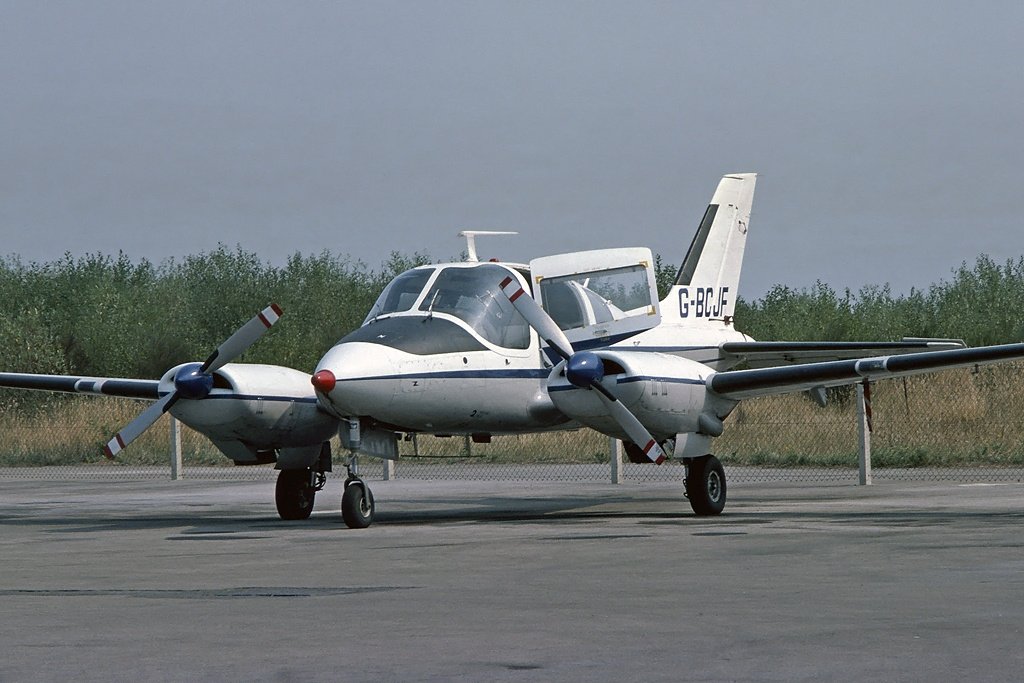
The Beagle B-206 filled a specialized niche as both a military communications aircraft and civilian light transport, though its impact was limited by modest production numbers. The Royal Air Force operated 20 aircraft as the Basset CC.1 from 1965 to 1974, serving with the Southern Communications Squadron at RAF Bovingdon (later RAF Northolt) and the Northern Communications Squadron at RAF Topcliffe (later RAF Wyton). These squadrons were redesignated as 207 Squadron and 26 Squadron respectively on February 4, 1969. The RAF's primary mission for the B-206 involved transporting five-man V-bomber crews plus their equipment from Britain to Malta, a role that won Beagle the 1963 RAF Northolt competition against the de Havilland Devon.
The Manufacturer
Beagle Aircraft Limited operated from 1960 to 1970, emerging from the Beagle Division of Bristol Aircraft following the 1960 British Aircraft Corporation merger. Under the leadership of Peter Thorneycroft Masefield, managing director of Bristol, the company acquired the Bristol 220 project in 1960 and transformed it into the B-206. The company manufactured aircraft primarily at two locations: prototypes were built at Shoreham Airport in West Sussex, while production aircraft, including all RAF Bassets, rolled off the assembly line at Rearsby Aerodrome in Leicestershire. Interestingly, Beagle contracted Boulton Paul to manufacture the wings for civilian B-206 variants. Despite hopes for substantial military orders exceeding 250 aircraft, the RAF ultimately purchased only 20 Bassets, contributing to Beagle's financial difficulties and eventual receivership in 1970. Scottish Aviation and other companies acquired the assets, but no direct successor company emerged.
Engine & Technical Development
The B-206 evolved through multiple engine configurations to optimize performance. The initial Series 1 aircraft, including the first production model G-ASMK which flew on July 17, 1964, utilized twin 310-horsepower Rolls-Royce Continental GIO-470A six-cylinder horizontally opposed piston engines. Continental Motors manufactured these engines under license from Rolls-Royce. The Series 2, which first flew on June 23, 1965, represented a significant performance upgrade with twin 340-horsepower Continental GTSIO-520C turbocharged engines. This powerplant change boosted maximum speed to 220 mph and extended range to 1,645 miles while improving reliability for communications duties. The turbocharging system proved particularly valuable for "hot and high" operational conditions where naturally aspirated engines suffered performance degradation.
Production & Variants
Beagle manufactured exactly 79 complete B-206 aircraft between 1964 and 1969, when production ended to make factory space available for the Beagle Pup program. Total airframe production included the 79 production aircraft plus two pre-production B.206Z models, one B.206X prototype, and one B.206Y prototype with extended wings, bringing the complete count to approximately 80 new airframes. Four additional fuselages and sections remained unfinished when production ceased. The production run included 11 Series 1 aircraft with the GIO-470A engines and 45 Series 2 aircraft with the more powerful turbocharged engines. Two aircraft were converted to Series 3 configuration with seating for 10 passengers. The final production aircraft, construction number B.080, marked the end of the B-206 program.
Legacy & Current Status
While the B-206's production numbers were modest, the aircraft demonstrated innovative design solutions for short-field operations and adaptable cabin configurations. The quick cabin access design and reliable twin-engine layout made it well-suited for its intended communications role, though limited orders prevented the aircraft from achieving widespread success. Today, at least three B-206 aircraft remain airworthy, including G-ASMK and G-BSET in the United Kingdom and N163 in the United States. The former RAF Basset XS773 survives in the UK as a notable preserved example. The B-206 represents an interesting chapter in 1960s British aviation, showcasing advanced design concepts that were ultimately overshadowed by the manufacturer's financial collapse and limited market acceptance.