
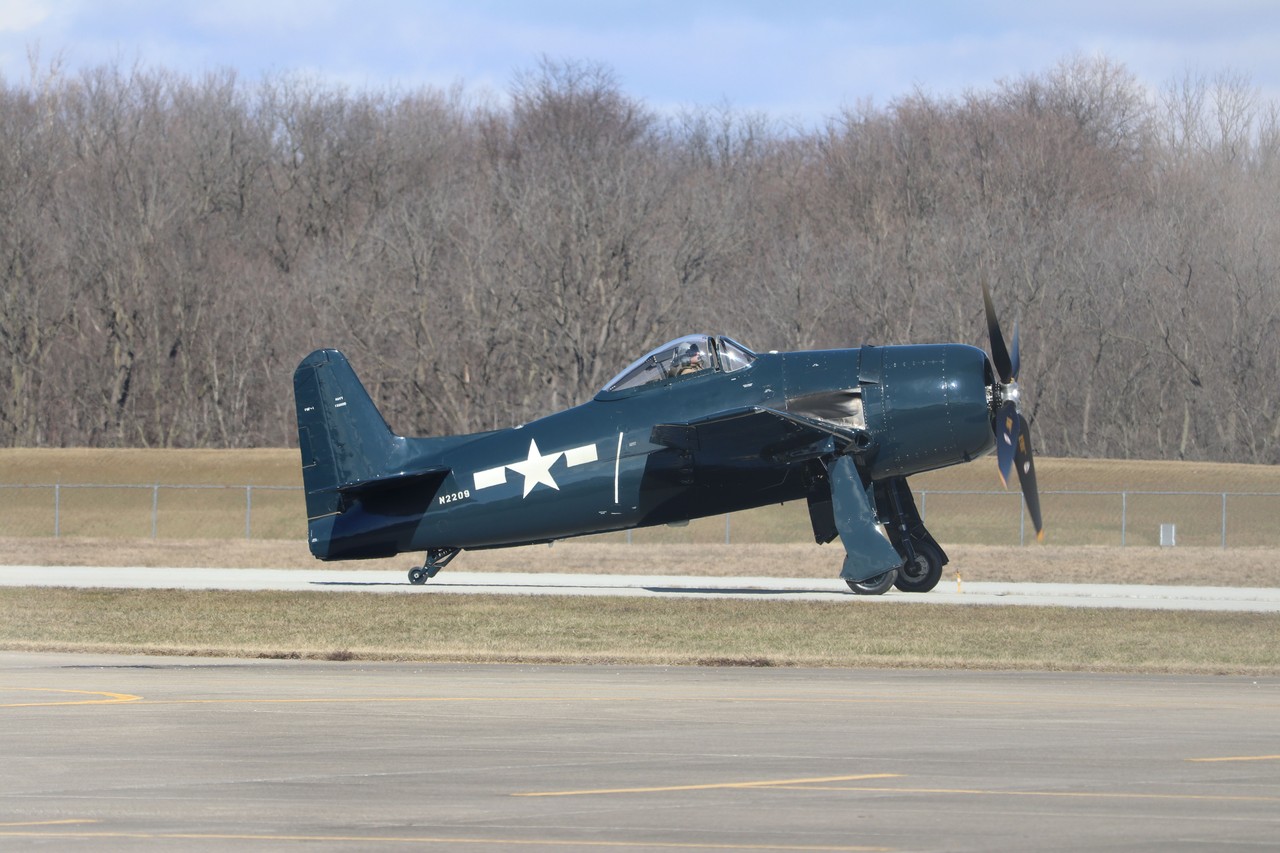
Service History
The F8F Bearcat entered service too late for World War II combat, with the first operational squadron VF-19 becoming active on May 21, 1945, just months after V-J Day. Despite missing the war it was designed for, the Bearcat quickly established itself as the Navy's premier carrier fighter. By 1948, twenty-four U.S. Navy and Marine Corps squadrons operated the type, making it the backbone of American carrier aviation during the immediate postwar period. The aircraft served with distinction from 1945 to 1952, when jet fighters began replacing piston-powered designs.
During the Korean War, French Navy pilots flew Bearcats in combat operations, launching ground attack missions from the carrier Arromanches. The French Aéronautique Navale found the aircraft particularly effective in the close air support role, though it primarily served in reconnaissance and patrol duties rather than air-to-air combat.
The Blue Angels and Notable Pilots
The U.S. Navy's Blue Angels demonstration team adopted the F8F-1 from 1946 to 1949, showcasing the aircraft's exceptional agility and climb performance to millions of spectators. Neil Armstrong, the future Apollo 11 commander, flew Bearcats as a young Navy pilot and later called it his favorite aircraft to fly. The type's responsive controls and powerful engine made it ideal for aerobatic displays and carrier operations alike.
The Manufacturer
Grumman Aircraft Engineering Corporation designed and built the Bearcat at their Bethpage, New York facilities. Founded in 1929, Grumman had established itself as the Navy's premier fighter manufacturer with successful designs including the F4F Wildcat and F6F Hellcat. The company earned the nickname "Grumman Ironworks" for producing exceptionally durable naval aircraft that could withstand the rigors of carrier operations. Grumman continued operations until 1994, when it merged with Northrop Corporation to form Northrop Grumman, which remains a major aerospace contractor today.
Design Philosophy and Development
Leroy R. Grumman and project engineer Bob Hall led the design team that created the Bearcat in response to Navy requirements for a lightweight interceptor superior to the Vought F4U Corsair. Development began in November 1943 with ambitious performance targets, including a climb rate of 4,800 feet per minute and maximum agility for carrier-based operations. The design philosophy emphasized weight reduction and power-to-weight ratio over range and payload capacity.
The first prototype XF8F-1 achieved first flight just nine months after design work commenced, demonstrating Grumman's engineering efficiency. The aircraft featured a cut-down fuselage and smaller wings compared to the larger F6F Hellcat, resulting in lower wing loading and exceptional maneuverability.
Engine and Performance
The heart of the Bearcat was the Pratt & Whitney R-2800 Double Wasp, an 18-cylinder air-cooled radial engine that represented the pinnacle of piston engine development. Early F8F-1 variants used the R-2800-34W producing 2,100 horsepower, while later F8F-2 models employed the R-2800-30W or -34W with water injection systems generating 2,250 horsepower. This powerplant had proven its reliability in aircraft like the P-47 Thunderbolt and F4U Corsair.
The combination of powerful engine and lightweight airframe enabled extraordinary climb performance. In 1946, a modified Bearcat set a time-to-climb record by reaching 10,000 feet in just 94 seconds, achieving a climb rate of 6,383 feet per minute. This record stood until 1956, when jet fighters finally surpassed it.
Variants and Armament
Grumman produced several Bearcat variants to meet different mission requirements. The standard F8F-1 carried four .50-caliber machine guns, while the F8F-1B and F8F-2 variants mounted four 20mm AN/M3 cannons for increased firepower. Night fighter versions included the F8F-1N and F8F-2N with radar equipment, and the F8F-2P served as a photo-reconnaissance platform. All variants could carry external stores including two 1,000-pound bombs or drop tanks.
Production and Legacy
Total production reached 1,266 aircraft between May 1945 and May 1949, far below the original Navy order for over 3,800 aircraft from Grumman and General Motors. Post-war budget cuts and the rapid advancement of jet technology led to cancellation of the General Motors contract and reduction of Grumman's order. The breakdown included 765 F8F-1s, 100 F8F-1Bs, 36 F8F-1Ns, 293 F8F-2s, 12 F8F-2Ns, and 60 F8F-2Ps.
Current Status
Approximately 20 to 30 Bearcats remain airworthy today, primarily serving in air racing and airshow demonstrations. Notable examples include the F8F-2P displayed at the National Naval Aviation Museum in Pensacola, Florida, and racing aircraft competing in the Unlimited class at the Reno Air Races. The Flying Bulls aerobatic team in Austria operates BuNo 121776, demonstrating the aircraft's continued appeal to aviation enthusiasts worldwide.
The Bearcat represents the evolutionary endpoint of piston-powered fighter design, combining maximum performance with the reliability required for carrier operations. Though it missed its intended war, the aircraft's exceptional climb rate and agility established benchmarks that influenced the transition to jet-powered fighters.