
Development and Design Philosophy
Jim Bede launched development of the BD-10 in 1983 with the audacious goal of creating the world's first supersonic kit aircraft for civilian pilots. The controversial aircraft designer envisioned an "everyman's personal supersonic fighter" that would democratize high-performance jet flight through homebuilt construction. Bede announced the project publicly in the late 1980s, shortly after an FTC Consent Decree against him expired in 1989.
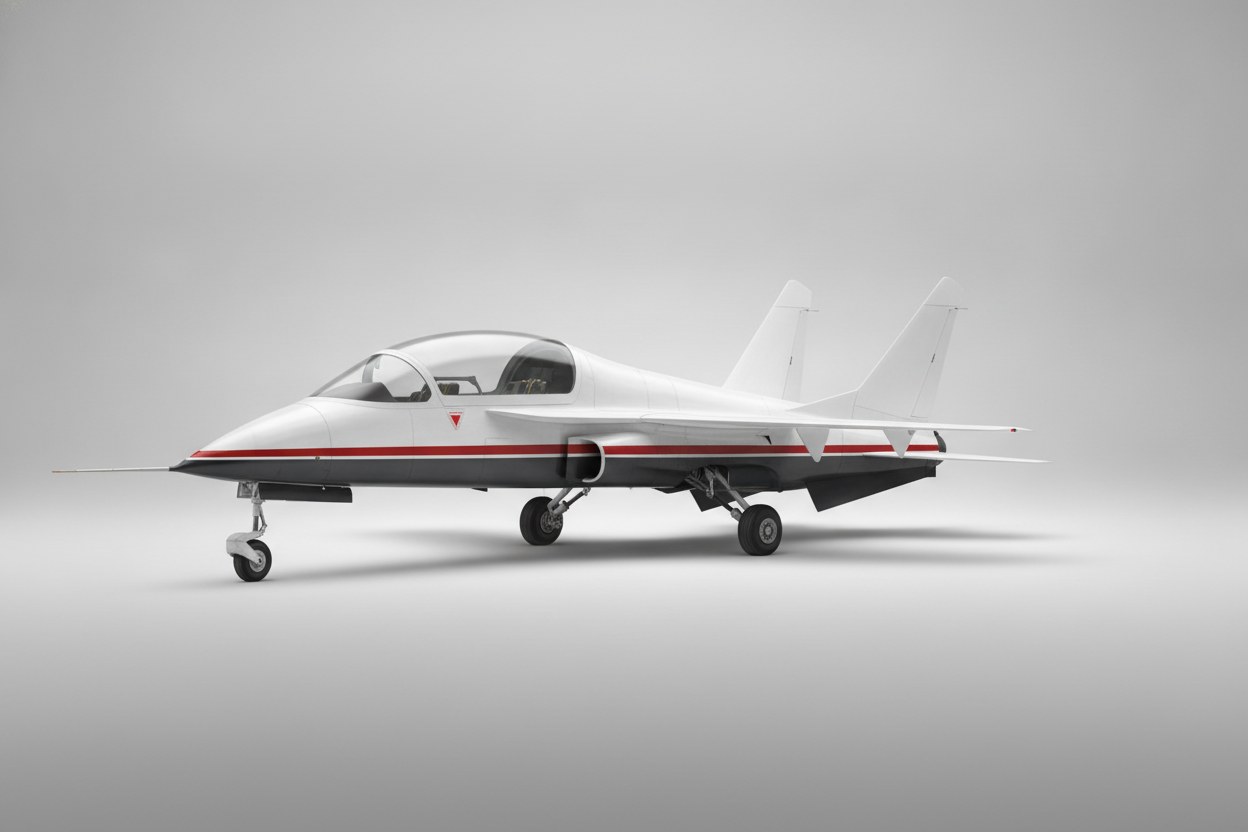
The BD-10's design drew inspiration from the military Northrop T-38 Talon advanced jet trainer, scaled down to single-engine dimensions. The aircraft featured a fighter-like profile with a pointed nose cone, shoulder-mounted swept wings, and distinctive twin vertical stabilizers. Its tandem cockpit configuration seated two under a single-piece, side-hinged canopy, while retractable tricycle landing gear completed the military aesthetic.
Technical Specifications and Promised Performance
Bede equipped the BD-10 with a single General Electric J85 turbojet, marketed commercially as the CJ-610. This non-afterburning engine, already proven in early Learjet Model 23 aircraft, produced 2,950 pounds of thrust. The company marketed impressive performance figures: a maximum speed of Mach 1.4 (1,075 mph), cruise speed of 595 mph, service ceiling of 45,000 feet, and climb rate of 30,000 feet per minute.
The aircraft's dimensions included an empty weight of 2,250 pounds and maximum gross weight of 4,400 pounds. Bede promised a takeoff run of just 850 feet and operational range of 1,350 nautical miles with 263 gallons of fuel capacity. Kit builders could expect approximately 6,000 hours of assembly time to complete their aircraft.
Flight Testing Reveals Critical Problems
The prototype began flight testing in mid-1992, but immediately revealed serious shortcomings. Performance fell dramatically short of marketing promises—even at full thrust, the BD-10 could not exceed Mach 0.83, far below its advertised supersonic capability. Weight growth during development reduced fuel capacity and operational range, while structural concerns emerged about the tail assembly.
Test pilot Mike Van Wagenen, a Vietnam-era fighter pilot and Bede's primary business partner, noted structural wrinkling on the vertical tail during demonstration flights at the 1994 Reno Air Races. Despite these warning signs, envelope expansion testing continued with tragic consequences.
Fatal Accidents End the Program
On December 30, 1994, Van Wagenen was killed when the prototype experienced catastrophic tail flutter and broke up in flight during high-speed testing. The loss of Bede's key partner and test pilot dealt a severe blow to the program, but development continued with a second prototype.
In August 1995, test pilot Joseph Henderson, who also served as company president, died near Minden, Nevada, when a flap failed to retract during an attempted go-around. The second fatal crash within eight months prompted Bede Jet Corporation to cease operations immediately.
A third tragedy struck in 2003 when the last kit-built BD-10 suffered an inflight breakup off the Southern California coast, killing pilot Frank Everett. Of the five BD-10 aircraft completed, three crashed with the loss of all pilots—a devastating safety record that ended any hope of program revival.
Aftermath and Failed Revival Attempts
Jim Bede had grown disenchanted with the BD-10 by 1993 as performance consistently disappointed and technical problems mounted. Despite accumulating over sixty customer deposits, the company abandoned the project after the 1995 crashes.
In 1996, Bede sold military rights to Monitor Jet, a Canadian company that attempted to market a modified version as the MJ-7 basic jet trainer. Monitor Jet proposed replacing the troublesome J85 with a Pratt & Whitney Canada JT-15D turbojet, but their test pilot refused to fly the aircraft. The sole Canadian example ended its career as a static display at the Toronto Aerospace Museum.
Legacy of an Ambitious Failure
The BD-10 represents one of general aviation's most ambitious failures, highlighting the enormous challenges of developing high-performance jet aircraft outside traditional aerospace industry structures. While marketed as the world's first supersonic kit aircraft, it never achieved supersonic flight and killed 60 percent of its pilots.
Only two BD-10 aircraft survive today as museum displays, serving as reminders of the program's tragic legacy. The project's failure contributed to lasting skepticism about homebuilt jet programs and demonstrated the critical importance of thorough structural testing and conservative design approaches in experimental aircraft development.