
Design Philosophy and Development
Jim Bede announced the BD-17 Nugget in June 2000 as the culmination of his 45 years in aircraft design, specifically targeting the homebuilt market with an emphasis on construction simplicity. The aircraft's design consisted of merely 110 components, making it even less complex than Bede's earlier BD-12 project. This minimalist approach aimed to attract first-time builders while delivering superior range and speed performance at an economical price point.
The prototype, registered as N624BD, was completed by December 2000 and achieved its maiden flight on February 11, 2001. Bede's design incorporated several innovative features, including wing spars tested to 11.2 Gs without structural failure and honeycomb wing ribs that formed sealed fuel panels capable of holding up to 10 gallons per wing section.
Construction Innovation
The BD-17's manufacturing process utilized high-performance epoxy bonds that cured in one hour at room temperature, employing bonding techniques typically reserved for military aircraft construction. The Bede Corporation factory-bonded fuselage panels to ensure precise geometry, while customers completed interior bonding during kit assembly. This hybrid approach maintained manufacturing quality while preserving the homebuilt aircraft classification.
Control surfaces represented another area of innovation, featuring torque-tube controls with polyurethane molded ailerons, flaps, and rudder designed for unlimited operational lifespan. The constant-chord wing design offered optional folding capability, addressing storage concerns for many homebuilders.
Engine and Performance Specifications
The standard BD-17 was powered by a Lycoming O-235 four-cylinder, air-cooled piston engine producing 118 horsepower. Alternative powerplant options included the 120-horsepower Jabiru engine, providing builders with flexibility based on availability and budget considerations. A variant designated BD-17G utilized either the 60-horsepower HKS 700E or 70-horsepower Hirth engine for reduced operating costs.
Flight testing commenced in 2003, revealing excellent flight characteristics that validated Bede's design objectives. The aircraft's performance claims of unmatched range and speed for its class were supported by its efficient aerodynamic design and relatively powerful engine installation.
The Bede Corporation Legacy
Jim Bede had established himself as a pioneering figure in homebuilt aviation long before the BD-17's development. His earlier designs included the foundational BD-4 homebuilt aircraft, the BD-5J pocket jet featured in the James Bond film "Octopussy," and the BD-10 fighter-like executive jet. The Bede Corporation continued operations through the BD-17's production period, maintaining an active presence in the kit aircraft market.
The company's approach emphasized accessible high-performance aviation design, making advanced aircraft technology available to individual builders rather than restricting it to commercial manufacturers. This philosophy attracted builders seeking alternatives to traditional certified aircraft while maintaining professional engineering standards.
Production and Variants
Production of the BD-17 spanned from 2000 through at least 2011, with approximately seven aircraft manufactured according to available records. The limited production numbers reflected the specialized nature of the homebuilt market rather than any design deficiencies. Five confirmed aircraft with known construction numbers remain documented in current fleet databases.
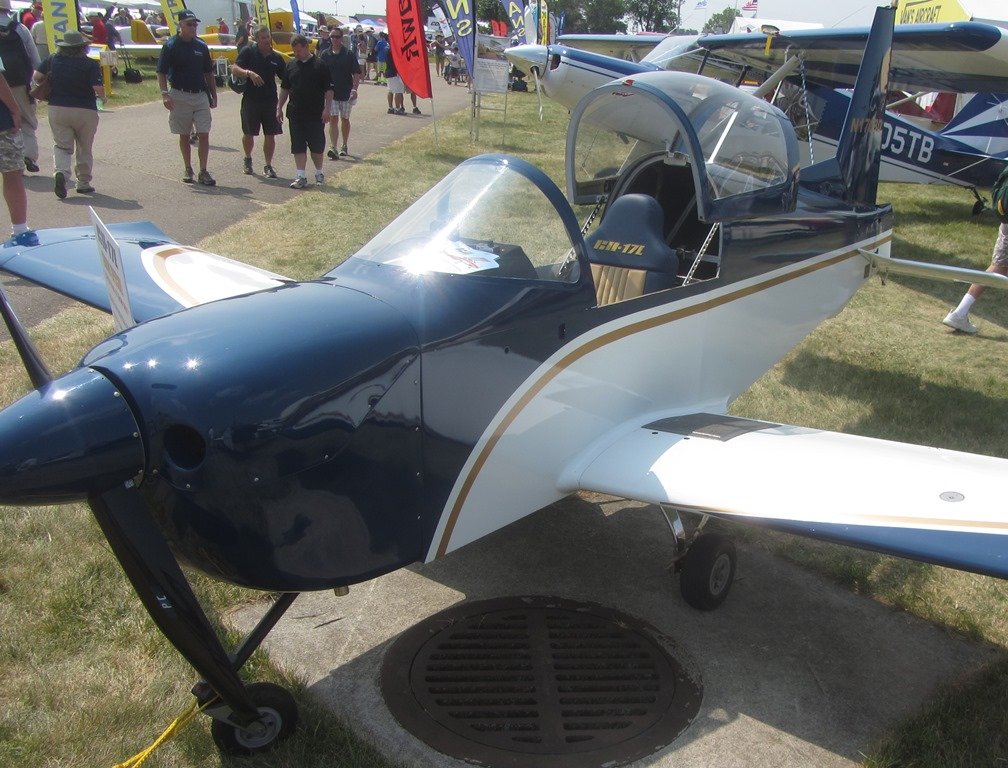
A significant development was the BD-17L variant, which introduced a two-seat configuration featuring composite fuselage construction while retaining metal wings. This aircraft, registered as N224BD, first appeared publicly in January 2015 and was powered by the same 118-horsepower Lycoming O-235 engine as the original single-seat version.
Current Status and Impact
The BD-17 Nugget represents a notable contribution to modern homebuilt aviation, embodying principles of simplified construction without compromising performance capabilities. Its limited production numbers place surviving examples among the rarer homebuilt aircraft types, with five confirmed aircraft still tracked in aviation databases.
The aircraft's legacy extends beyond its own production through its influence on subsequent homebuilt designs that emphasized construction simplicity and innovative manufacturing techniques. Jim Bede's approach of factory-prepared components combined with builder assembly became a model for other kit manufacturers seeking to balance quality control with homebuilt regulations.
While the BD-17 never achieved widespread adoption, it demonstrated the viability of ultra-simplified kit construction and advanced the state of homebuilt aircraft design. The project validated Bede's long-held belief that high-performance aviation could be made accessible to individual builders through thoughtful engineering and innovative construction methods.