
Service History
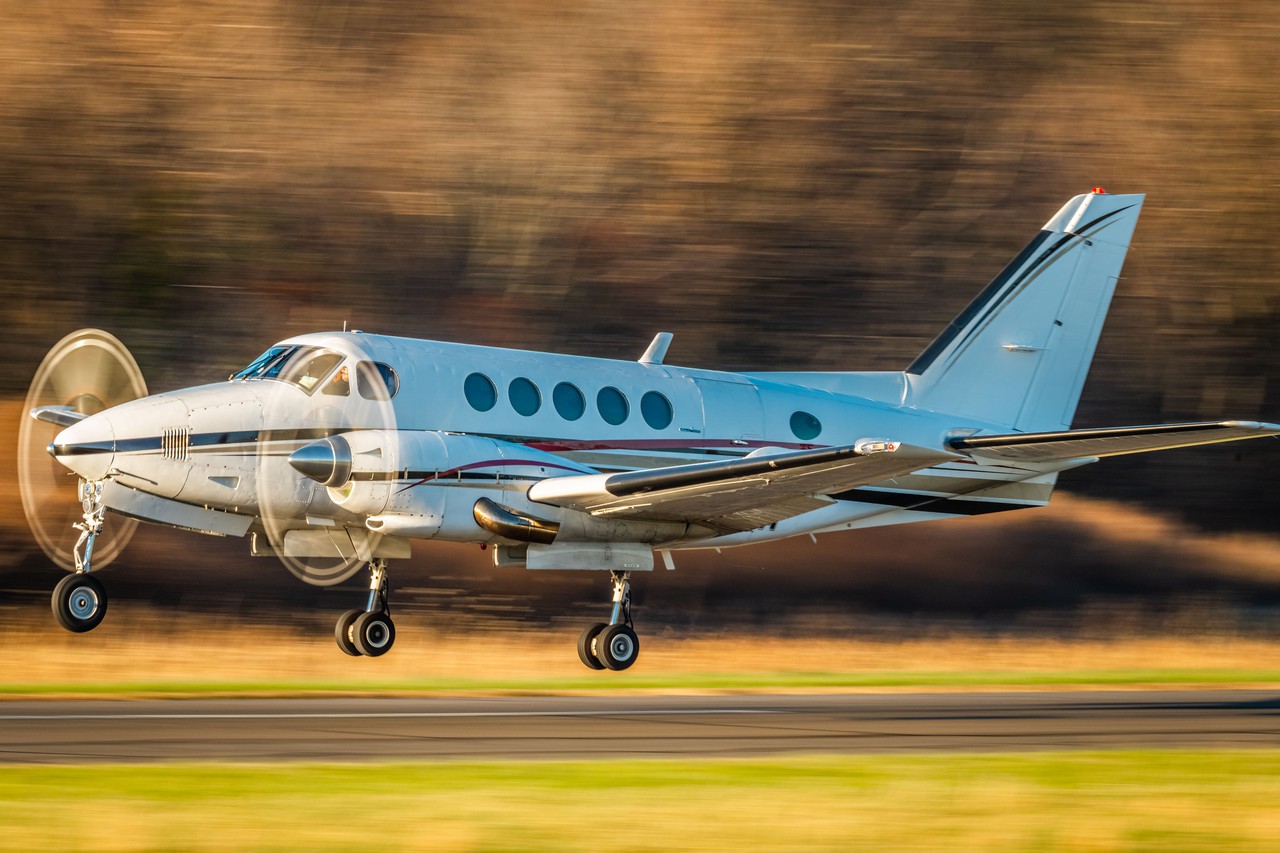
The King Air 100 series dominated the corporate turboprop market during the 1970s, building upon the King Air family's remarkable success that captured 77 percent of the turbine aircraft market share by 1968. With payload capacity exceeding two tons and a maximum takeoff weight of 10,600 pounds for the base model, the aircraft excelled in corporate transportation roles connecting small airstrips inaccessible to larger jets. The stretched fuselage, four feet longer than its King Air 90 predecessor, provided the additional cabin space that business operators demanded for passenger comfort and cargo capacity.
The Manufacturer
Beech Aircraft Corporation was founded in 1932 by Walter Beech and Ted Wells, establishing a legacy of premium general aviation aircraft. Following Walter Beech's death in 1950, his wife Olive Ann Beech assumed the presidency and guided the company through its golden era of King Air development. The company underwent significant ownership changes, being acquired by Raytheon in 1980, later becoming Raytheon Aircraft, then Hawker Beechcraft in 2006. After bankruptcy in 2012, Textron Aviation acquired the company in 2014 and continues King Air production today under the Beechcraft brand.
Engine & Technical Evolution
The Model 100 and A100 variants employed twin Pratt & Whitney Canada PT6A-28 turboprops, each producing 680 shaft horsepower. These reverse-flow free-turbine engines, which began production in 1963, became legendary for their reliability and ease of maintenance, with over 55,000 units produced by 2023. However, supply constraints with PT6 engines led Beechcraft to develop the B100 variant in 1976, powered by Garrett AiResearch TPE331-6-251B engines producing 840 shaft horsepower but flat-rated to 715 shaft horsepower. This engine change boosted cruise speed to 306 mph and extended the aircraft's production life through 1983.
Performance Characteristics
The King Air 100 series offered exceptional versatility with its pressurized cabin and over-weather capability. The base Model 100 achieved a cruise speed of 287 mph with a service ceiling enabling flight above most weather systems. The A100 variant increased maximum takeoff weight to 11,500 pounds and incorporated 470-gallon fuel capacity with standard four-blade propellers, extending range to 1,501 miles. The B100 represented the pinnacle of the series, with an 11,800-pound maximum takeoff weight and the highest cruise speed of 306 mph, making it competitive with larger cabin-class aircraft.
Production History
Beechcraft manufactured 383 King Air 100 series aircraft across three distinct variants. The base Model 100 had the shortest production run with 89 units built between 1969 and 1970. The A100 proved most popular with 157 aircraft delivered from 1972 to 1979, while the B100 accounted for 137 units from 1976 to 1983. All production took place at Beechcraft's Wichita, Kansas facilities, maintaining the company's reputation for quality manufacturing and attention to detail.
Design Innovation
The King Air 100 evolved from the earlier Model 90, itself derived from the piston-powered Queen Air (Model 65). The primary innovation was the four-foot fuselage stretch and enlarged wings, creating space for additional passengers while maintaining the aircraft's excellent short-field performance. The prototype received FAA certification on July 24, 1969, just four months after first flight, with initial delivery occurring on September 5, 1969. This rapid certification process demonstrated both the design's maturity and Beechcraft's engineering expertise.
Legacy and Impact
Production ceased in 1983 as the market shifted toward the larger King Air 200 series Super King Airs, but the 100 series established crucial design principles for business turboprops. The aircraft represented the first successful stretched turboprop in its class when introduced in 1969, solidifying Beechcraft's position as the premier manufacturer of business turboprops. While exact numbers of aircraft still flying remain unavailable, the broader King Air family has accumulated over 63 million flight hours across more than 7,600 delivered aircraft, testament to the enduring value of the design principles established by the 100 series.