
Service History
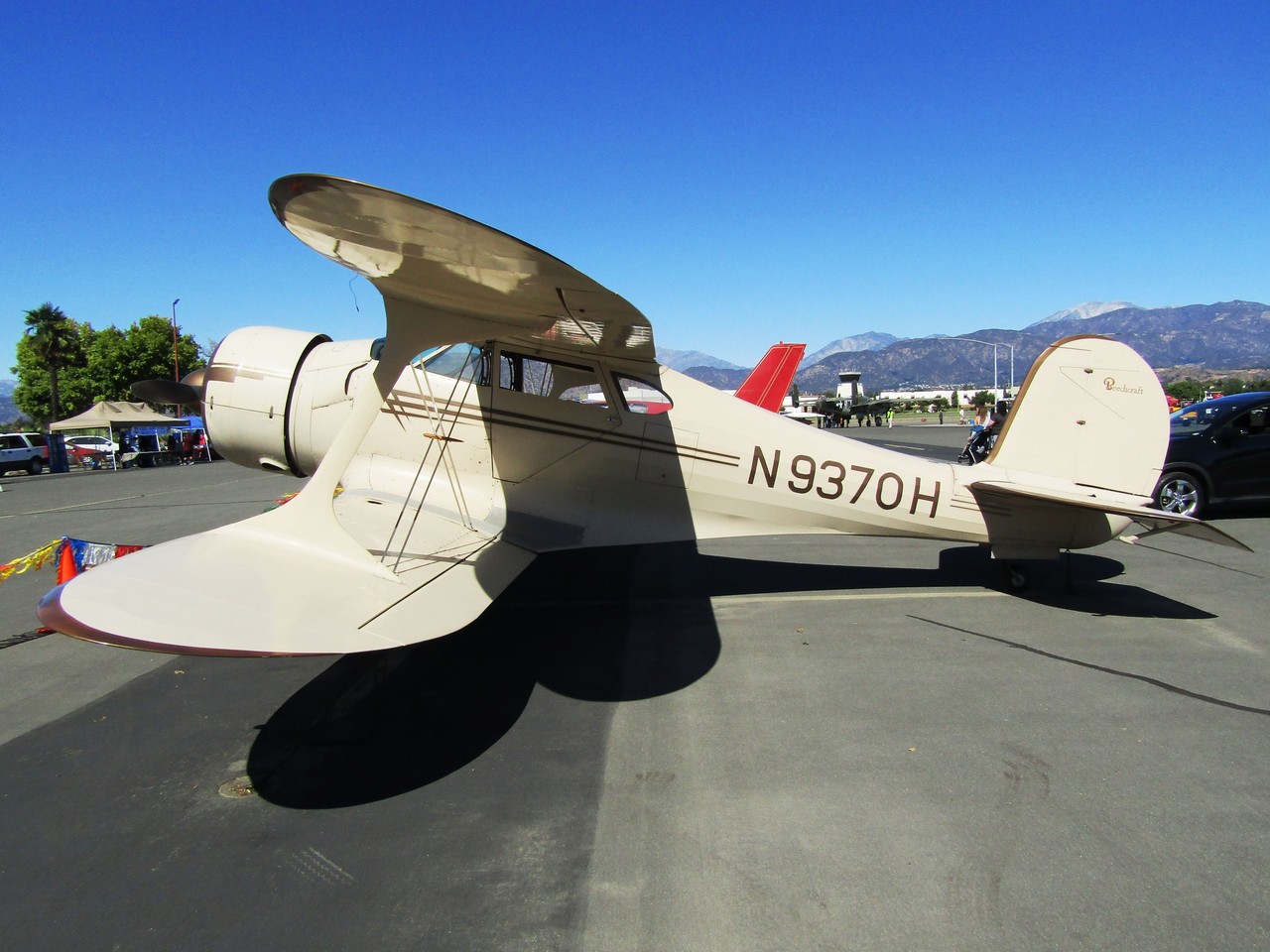
The Staggerwing established Beechcraft as the premier manufacturer of executive aircraft during the 1930s and 1940s, capturing a substantial share of the prewar business aviation market despite economic challenges. By World War II's outbreak, over 424 aircraft had been delivered to customers who valued the combination of speed and luxury previously unavailable in private aviation. Each aircraft commanded premium prices due to hand-built construction featuring leather and mohair cabin appointments that rivaled luxury automobiles of the era.
Wartime Service
Civilian production ceased in 1941 as Beechcraft shifted to military contracts, with the Staggerwing serving Allied forces throughout World War II. The US Army Air Forces operated the type as the UC-43 for transport and utility missions, while the US Navy designated their variants GB-1 and GB-2 Traveller for similar roles. The Royal Navy acquired Staggerwings under the Lend-Lease program, operating them as the Traveller Mk.I with aircraft like FT475 serving with 782 Squadron. Licensed production occurred in Japan, where Tachikawa built 20 C17E models plus two assembled from parts for various Japanese operators including Dai Nihon Koku and provincial police forces.
The Manufacturer
Walter Beech founded Beech Aircraft Corporation in Wichita, Kansas, in 1932, collaborating with designer T.A. "Ted" Wells to create aircraft targeting business executives during the Great Depression. The company's hand-built approach to manufacturing set new standards for private aircraft construction, with each Staggerwing requiring extensive individual craftsmanship. Beechcraft continued operations under various ownership structures, acquired by Raytheon in 1984, then Goldman Sachs in 2008, and ultimately becoming part of Textron Aviation, which continues producing business aircraft today.
Engine & Technical Innovation
Wells' design team pioneered the negative stagger configuration, positioning the lower wing forward of the upper wing to improve pilot visibility and aerodynamic efficiency. This arrangement, combined with pneumatically retractable landing gear introduced on the B17L variant, represented significant advances in private aircraft technology. Eight different radial engines powered various models, from the 225-horsepower Jacobs L-4 in early variants to the 450-horsepower Pratt & Whitney R-985-AN4 in the final G17S production aircraft.
The most popular powerplant was the Pratt & Whitney R-985 Wasp Junior, a nine-cylinder radial engine producing 420 to 450 horsepower depending on variant. This engine, with over 39,000 examples produced during its production run from the 1930s through 1950s, provided the reliability and smooth operation demanded by executive operators. Wright radials including the R-760 and R-975 series also equipped numerous variants, offering power outputs from 285 to 425 horsepower.
Production Variants
Staggerwing production spanned multiple series designations reflecting continuous refinement and different powerplant options. The B17 series, manufactured from March 1934 to March 1936, included 69 aircraft across four sub-variants with engines ranging from the 225-hp Jacobs L-4 to the 425-hp Wright R-975-E2. The D17 series became the most numerous, with production from March 1937 through 1945, including the popular D17S variant powered by the Pratt & Whitney R-985.
Postwar production resumed with the G17S, manufactured from 1946 to 1948 with 20 examples built featuring the 450-horsepower R-985-AN4 engine. Special variants included the SE17B amphibian with four examples produced, and two D17W aircraft purchased by famous aviator Jackie Cochran for $20,145 each, demonstrating the type's appeal to prominent pilots.
Performance and Pilot Experience
The Staggerwing delivered performance that matched or exceeded contemporary monoplane designs while maintaining the structural advantages of biplane construction. Typical cruise speeds reached 200 mph, with service ceilings above 20,000 feet and climb rates around 1,000 feet per minute. The spacious cabin accommodated up to five passengers in configurations that established new standards for private aviation comfort.
Pilots appreciated the type's stable handling characteristics and responsive controls, attributes that made it popular for both business transportation and competitive air racing. The negative stagger configuration provided excellent forward visibility during taxi and landing operations, while the robust radial engines delivered reliable performance across varied operating conditions.
Legacy and Preservation
Of the 785 Staggerwings produced, hundreds remain airworthy more than 70 years after production ended, testament to the type's robust construction and enduring appeal. Notable preserved examples include aircraft 6701, a D17S that served as US Navy GB-2 and Royal Navy FT475 before postwar civilian use, now maintained by The Fighter Collection at Duxford, Cambridgeshire, registered G-BRVE.
The Staggerwing's influence on executive aviation extended far beyond its production years, establishing design principles and luxury standards that influenced subsequent business aircraft development. Its combination of innovative engineering, premium construction, and distinctive aesthetics created a template for high-end private aviation that remains relevant in contemporary business aircraft design.