
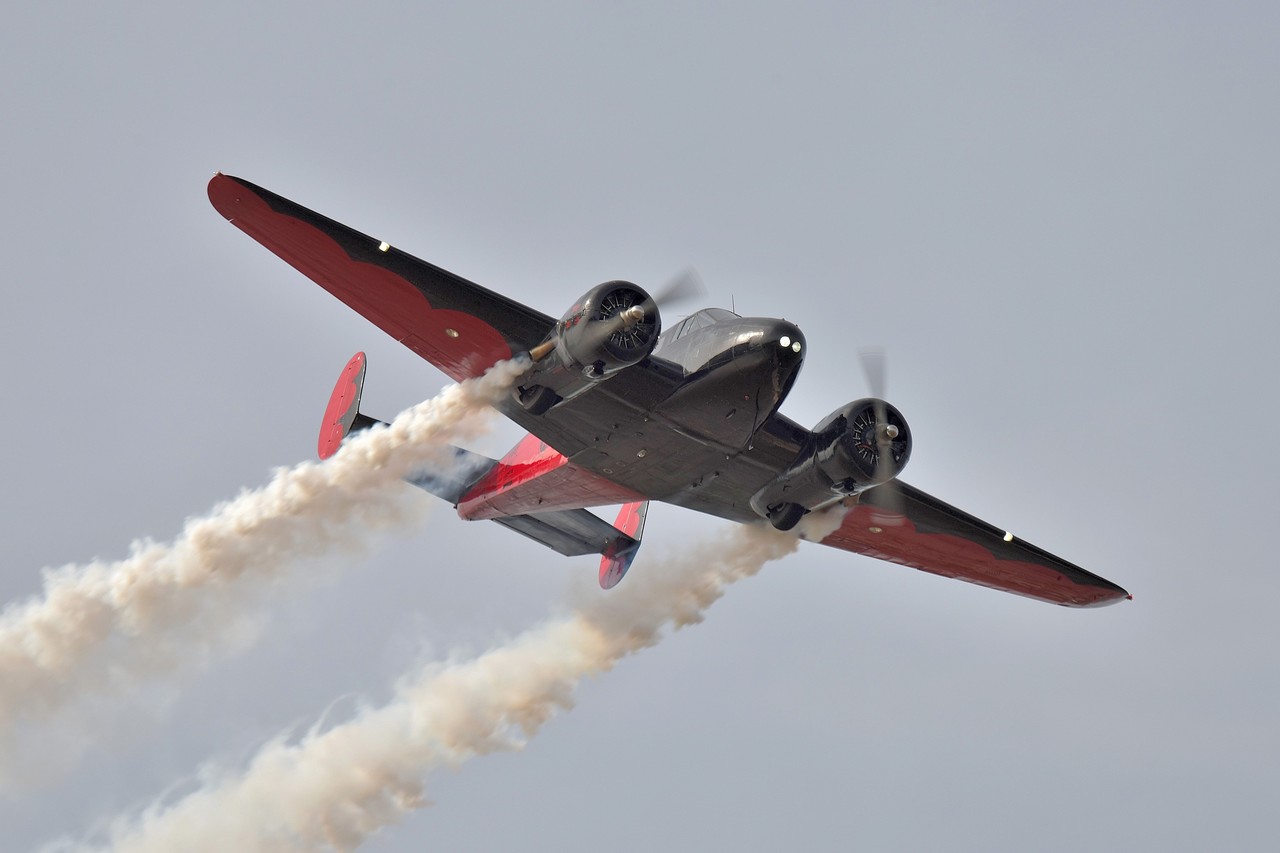
Service History
The Model 18 transformed from a modest beginning into one of aviation's most enduring success stories. By December 7, 1941, only 39 examples had been delivered, with just 29 going to civilian operators. However, wartime demand accelerated production dramatically, and the aircraft's exceptional versatility ensured its dominance across multiple aviation sectors for decades. The Twin Beech became the backbone of small feeder airlines, corporate aviation, and military training operations worldwide.
The aircraft's commercial success stemmed from its remarkable adaptability. Originally designed as a six-passenger executive transport, it evolved to serve roles ranging from mail carrier to air ambulance. Mike Mitchell operated aircraft N522B as an air ambulance for fifteen years, accumulating 1,250,000 miles while transporting nearly 15,000 patients—a testament to the design's reliability and operational economy.
Wartime Service
Military operators quickly recognized the Model 18's potential, adopting it across multiple air forces with various designations. The Royal Canadian Air Force and Royal Air Force operated it as the "Expeditor," utilizing it as a light transport and weapons trainer from 1939 until 1970. The Republic of China Air Force received six M18R light bombers in the late 1930s during the Second Sino-Japanese War, marking the type's early combat introduction.
Thousands of Model 18s served with United States Armed Forces during World War II in transport and training roles. The aircraft's robust construction and reliable performance made it ideal for military service, where operational demands often exceeded civilian specifications. In 1952, MacDonald Brothers in Winnipeg developed an armed variant for the Chilean Government, featuring nose guns, rocket rails, bomb racks, and camera mounts, though production ceased on March 27, 1954, after limited success.
The Manufacturer
Beech Aircraft Corporation emerged from the collaborative vision of aviator Walter Beech, his wife Olive Ann Beech, and engineer Ted A. Wells in 1932. The Wichita, Kansas-based company built upon Walter Beech's previous experience with the Travel Air Manufacturing Company, where he had worked alongside Clyde Cessna and Lloyd Stearman. The Model 18's unprecedented success ensured the company's prosperity throughout the 1940s and established Beechcraft's reputation for quality and innovation.
All primary production occurred at the Beech factory in Wichita, though MacDonald Brothers in Winnipeg participated in specialized conversions beginning in 1952. The company continues operations today as Beechcraft, maintaining its position as a major general aviation manufacturer and preserving the legacy established by the Model 18's remarkable commercial success.
Design and Engineering
Ted A. Wells led the engineering team that created the Model 18 in response to a 1935 Bureau of Air Commerce request. The resulting design was a low-wing, all-metal, twin-engine monoplane powered by two Pratt & Whitney Wasp Jr. air-cooled radial engines. Test pilot Ding Rankin and TWA senior pilot James N. conducted the first flight on January 15, 1937, at Beech Factory Airport, flying aircraft NX15810 with construction number 62.
The aircraft received its type certificate from the U.S. Civil Aeronautics Authority on March 4, 1937, launching a production run that would continue until 1969. The post-war Model D18S featured accommodations for eight passengers with a maximum takeoff weight of 8,750 pounds. Originally equipped with conventional tailwheel landing gear, later variants offered optional tricycle gear configurations to meet evolving operational requirements.
Performance and Operations
The Twin Beech's success derived from its balanced performance characteristics and operational flexibility. The twin Pratt & Whitney powerplants provided reliable service across diverse operating conditions, from corporate executive transport to bush flying operations in remote regions. Its all-metal construction ensured durability under demanding operational schedules that would have challenged lesser designs.
The aircraft's two-crew configuration and straightforward systems made it accessible to operators seeking reliable twin-engine performance without excessive complexity. This operational simplicity, combined with Beechcraft's reputation for build quality, made the Model 18 a preferred choice for operators requiring dependable service across varied mission profiles.
Production Legacy
Production concluded in late 1969 when the final aircraft, registered JA5174 with construction number BA-765, was delivered to Japan Airlines. Total production exceeded 9,000 aircraft across 32 distinct variations, representing an unprecedented achievement in general aviation manufacturing. This 32-year production run established records for longevity that remain unmatched among piston-engine aircraft.
Hundreds of Model 18s remain in existence today, with many still maintaining airworthiness nearly 90 years after the type's introduction. Notable museum examples include N522B at the National Air and Space Museum's Steven F. Udvar-Hazy Center, CF-VPK at the North Atlantic Aviation Museum in Gander, Newfoundland, and a D18S Expeditor at The Hangar Museum in Canada. The original prototype, NX15810, survives at Chino Airport in California, undergoing restoration to its original 1937 configuration, preserving the legacy of one of aviation's most successful and enduring designs.