
Service History
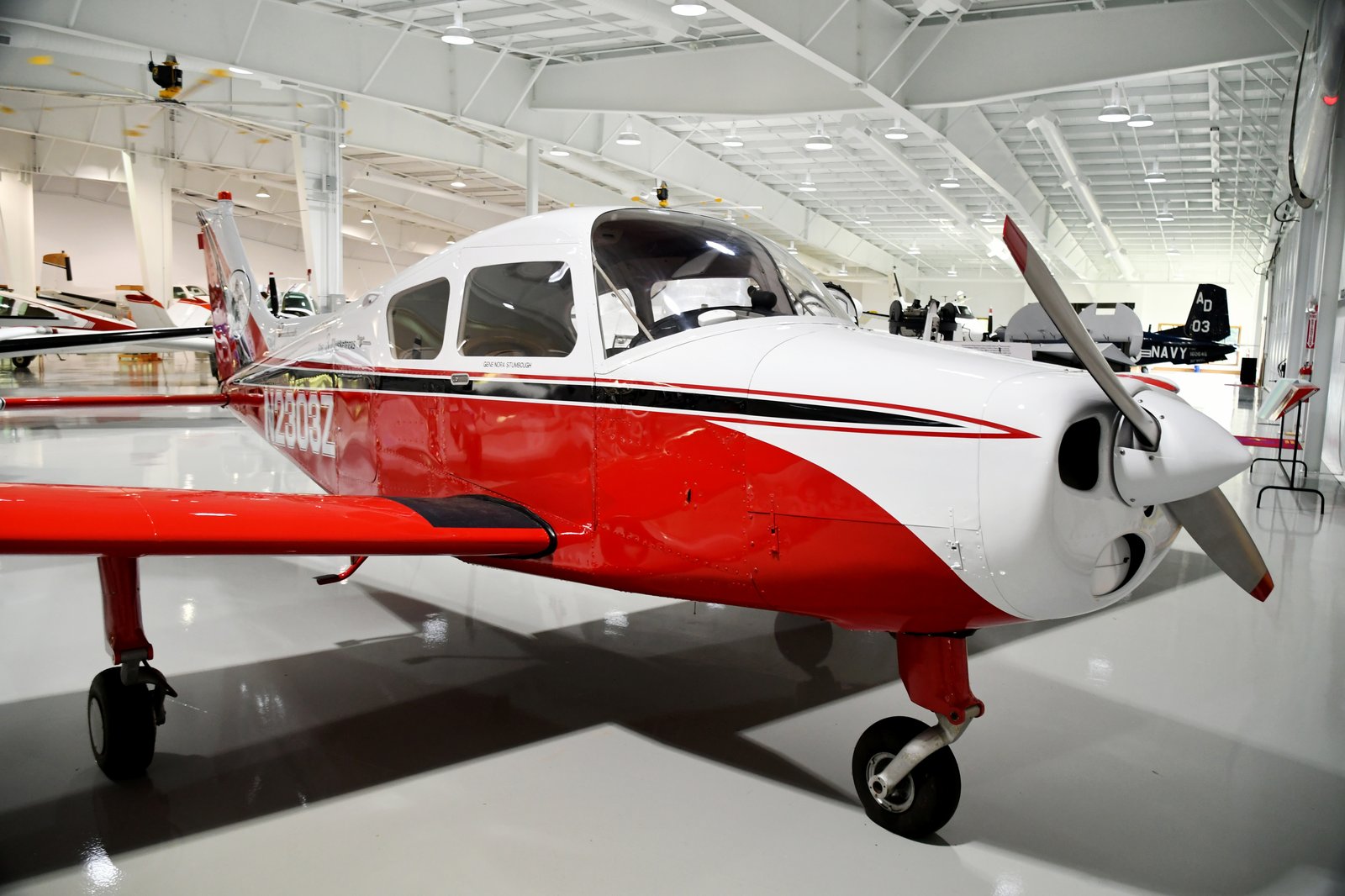
The Musketeer Super filled a critical gap in Beechcraft's lineup between basic trainers and expensive retractable-gear aircraft, allowing the company to compete directly with Cessna and Piper in the growing general aviation market. Flight schools and private owners embraced the aircraft for its combination of docile handling characteristics and superior cabin space, earning it the nickname "Baby Beechcraft." The broader Musketeer family achieved significant market penetration, with 553 aircraft delivered by 1964 and total production reaching 4,366 units across all variants by the program's conclusion in 1983.
The Manufacturer
Beech Aircraft Corporation was founded in 1932 by Walter H. Beech and Olive Ann Beech, initially gaining recognition for high-performance designs like the revolutionary Staggerwing biplane. After World War II, the company pivoted toward business aviation with the iconic Bonanza in 1947, establishing its reputation for premium general aviation aircraft. The company relocated Musketeer production to Liberal, Kansas in July 1964, demonstrating its commitment to efficient manufacturing. Through multiple ownership changes—Raytheon acquisition in 1980, management buyout forming Hawker Beechcraft in 2006, bankruptcy reorganization in 2012, and finally Textron Aviation purchase in 2014—the Beechcraft brand continues operations today from Wichita, Kansas.
Design Philosophy and Development
Executive Vice President Frank E. Hedrick announced the Musketeer program in 1961 as a deliberate strategy to broaden Beechcraft's commercial appeal beyond the complex, expensive Bonanza line. The design team prioritized simplicity, affordability, and an unusually large cabin for the four-seat category, directly challenging Cessna's dominance in the trainer market. Test pilot S.C. Tuttle conducted the prototype's maiden flight on October 23, 1961, with subsequent development requiring only minimal modifications, including repositioning the nose gear forward for improved ground handling characteristics.
Engine and Technical Innovation
The Musketeer Super's defining feature was its 200-horsepower Lycoming IO-360-A2B engine, delivering 26 kilowatts more power than earlier Musketeer variants and enabling the aircraft to achieve its 162-mph cruise speed at 7,500 feet. This fuel-injected, four-cylinder opposed engine provided smoother operation and superior high-altitude performance compared to carbureted alternatives, contributing to the aircraft's reputation for reliability in training environments. The IO-360 series, introduced in the early 1960s by Avco Lycoming, became one of general aviation's most successful powerplants with more than 20,000 units produced across all variants.
Performance and Pilot Experience
Pilots praised the Musketeer Super for its forgiving flight characteristics and exceptional cabin roominess, making it ideal for training operations and cross-country touring. The aircraft demonstrated a maximum speed of approximately 170 mph, service ceiling of 13,000 feet, and initial climb rate of 1,000 feet per minute, while maintaining a practical range of 711 statute miles at 75 percent power. Its 32-foot 9-inch wingspan and 8-foot 2-inch height provided excellent ground stability, while the spacious interior accommodated one pilot and three passengers in comfort levels typically associated with larger aircraft.
Production Legacy and Current Status
Beechcraft manufactured exactly 369 Musketeer Super aircraft between 1966 and 1969, with serial numbers running from MA-1 through MA-369 at the Liberal, Kansas facility. Production ceased as the company transitioned focus toward retractable-gear variants like the Model 24 Sierra, which better utilized the proven airframe's potential for higher performance. The type certificate remains active under Hawker Beechcraft's ownership since March 26, 2007, supporting hundreds of aircraft that continue flying today. While exact airworthiness numbers for the Super variant remain unavailable, the broader Musketeer family maintains strong parts availability and active operator support, with examples displayed at aviation museums including the Beechcraft Heritage Museum in Tullahoma, Tennessee.
The Musketeer Super's historical significance extends beyond its production numbers, representing Beechcraft's successful adaptation to the 1960s general aviation boom and proving that premium manufacturers could compete effectively in mass-market segments without compromising their reputation for quality and innovation.